The Master of Umbrian Frescoes: The Life and Legacy of Ottaviano Nelli
In the heart of the Italian Quattrocento, amidst the rolling landscapes of Umbria, the name Ottaviano Nelli resonates as a cornerstone of early Renaissance artistry. Born around 1375 in the historic town of Gubbio, Nelli was not merely an artist but a scion of a profound creative lineage. Emerging from a family steeped in the traditions of the brush—with his father, Martino Nelli, and grandfather, Mello da Gubbio, providing a foundational blueprint—he inherited a deep-seated connection to the regional stylistic conventions of his homeland. His life was a tapestry woven from both artistic devotion and civic duty; he was a man who moved seamlessly between the quiet sanctity of the workshop and the bustling political arenas of his community, serving as a consul for the St. Pietro district in 1400 and later for the Sant'Andrea district in 1440.
Nelli’s artistic journey was far from insular. While his roots remained firmly planted in the Umbrian soil, his vision was expanded by the winds of change blowing from Siena and Florence. As the burgeoning Renaissance began to reshape the Italian peninsula, Nelli absorbed the evolving sensibilities of these great artistic centers. His work reflects a sophisticated dialogue between the established Umbrian-Gothic style and the emerging humanism of the era. This period of transition is most vividly captured in his mastery of fresco, where he blended decorative elegance with an burgeoning sense of expressive dynamism. The influence of Lombard and Burgundian styles further enriched his palette and compositional depth, allowing him to create narratives that felt both timelessly sacred and strikingly contemporary.
A Narrative in Color: The St. Augustine Cycle
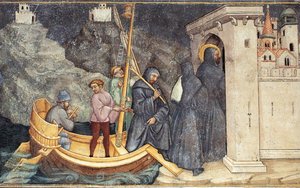
The true zenith of Nelli’s career is perhaps best embodied in the breathtaking fresco cycle dedicated to the life of St. Augustine, located within the choir apse of Sant'Agostino in Gubbio. Created between approximately 1410 and 1415, this monumental undertaking serves as a profound historical document of a changing theological landscape. Within these walls, Nelli captures the shift toward a more humanistic view of the saint, moving away from rigid iconography toward a more relatable, emotional portrayal. One particular masterpiece within this cycle, "St. Augustine Arriving in Carthage," stands as a testament to his technical prowess. In this work, Nelli utilizes perspective and color with remarkable skill to depict the saint's journey, creating a sense of movement and depth that draws the viewer into the very heart of the narrative.
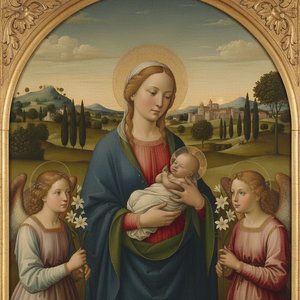
Beyond the grand scale of his frescoes, Nelli’s ability to infuse sacred themes with vernacular elements created a unique visual language. His figures possess a burgeoning naturalism and individuality, reflecting an early understanding of human anatomy and emotional nuance. While he did produce panel paintings—such as the Madonna del Belvedere and the Polyptych of Pietralunga—it is widely acknowledged by historians that his true genius flourished in the expansive, enduring medium of fresco. His ability to structure complex compositions using architectural elements like columns and arches provided a sense of stability and place, grounding his spiritual subjects in a tangible, earthly reality.
The Teacher and the Torchbearer
The significance of Ottaviano Nelli extends far beyond the borders of Gubbio, reaching into the very fabric of Renaissance art history through his role as a mentor. His workshop was a crucible of talent, where he passed down the secrets of the Umbrian tradition to a new generation of painters. His pupils included his own brother, Tommaso, as well as notable figures such as Domenico Di Cecco di Baldi and Ubaldo Di Matteo. Perhaps most impressively, the ripples of his influence can be felt in the works of masters like Gentile da Fabriano and Giovanni Sanzio, both of whom were shaped by Nelli’s innovative approach to light, color, and narrative structure.
As we look back upon the career of this pivotal Umbrian master, we see an artist who bridged the gap between the medieval past and the Renaissance future. His life, which likely concluded around 1444, left behind a legacy of vibrant frescoes that continue to illuminate the churches of Umbria. Through his dedication to both his craft and his community, Nelli ensured that the artistic identity of Gubbio would be forever etched in the annals of Italian history, providing a foundation upon which the great masters of the Quattrocento could build.
Questions & Answers
What are the birth city and country of Ottaviano Nelli?
Ottaviano Nelli was born in Gubbio, in Italy.
What are the birthplace and birth year of Ottaviano Nelli?
Ottaviano Nelli was born in Gubbio in 1375.
Where is Ottaviano Nelli from?
Ottaviano Nelli was born in Italy.