A Voice of Italian Realism: The Life and Legacy of Renzo Vespignani
Renzo Vespignani (1924 – 2001) was far more than a mere painter; he was a visual chronicler of the Italian soul during one of its most turbulent and transformative eras. Born in Rome to a working-class family, his early consciousness was forged in the crucible of the Nazi occupation. This period of profound hardship left an indelible mark on his psyche, instilling in him a lifelong commitment to social critique and an unflinching gaze toward the realities of human suffering. As he navigated the shadows of war, Vespignani began to develop a visual language that would later become synonymous with Italian Neorealism, capturing the grit, the anxiety, and the resilient spirit of a nation rebuilding itself from the rubble.
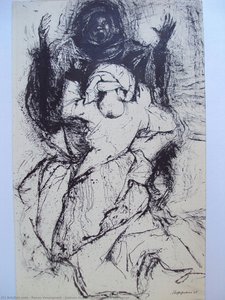
His artistic foundations were laid under the guidance of masters such as Alberto Ziveri and Luigi Bartolini, yet his true stylistic compass was often set by the haunting aesthetics of German Expressionism. The raw, emotive power found in the works of George Grosz and Otto Dix resonated deeply with Vespignani’s early drawings from 1944. These works, which documented the devastation of Roman landscapes with a stark, almost visceral honesty, were not merely sketches of war but psychological portraits of a city under siege. This early period established his reputation as an artist who did not shy away from the grotesque or the uncomfortable, setting the stage for a career defined by intellectual and political engagement.
The Evolution of Neorealism and Intellectual Engagement
As Italy transitioned into the postwar era, Vespignani’s work expanded beyond the immediate trauma of occupation to explore the broader complexities of urban culture and social stratification. He became a pivotal figure in the intellectual currents of his time, moving fluidly between the worlds of fine art, literature, and cinema. His collaborative spirit led him to participate in influential political and literary journals, where he worked alongside figures like Lino Bianchi Barriviera. This era saw him translating the cinematic language of Rossellini and De Sica onto the canvas, imbuing his paintings with a sense of narrative tension and documentary-like precision.
In 1956, Vespignani co-founded the magazine Città Aperta (Open City), a venture dedicated to confronting the pressing challenges of urban life. This commitment to social dialogue was further solidified in 1963 when he helped establish the group Il Pro e il Contro (Pro and Con). Through this collective, Vespignani and his contemporaries sought to champion a new form of neo-figurative art—one that remained critically engaged with the socio-political landscape. His focus shifted toward the harsh peripheries of Rome, finding profound meaning in the lives of those inhabiting the city's neglected margins, effectively turning the periphery into a stage for universal human drama.
Literary Mastery and Lasting Significance
Beyond the canvas and the print, Vespignani’s artistry found a unique home within the pages of world literature. He possessed a rare ability to translate text into visual poetry, providing illustrations for some of the most iconic works in the literary canon. His graphic interpretations breathed new life into:
- Giovanni Boccaccio’s Decameron, where he captured the wit and human frailty of the Renaissance tales.
- Franz Kafka’s The Metamorphosis, mirroring the existential dread and alienation inherent in the prose.
- T.S. Eliot’s Four Quartets, navigating the complex temporal and spiritual landscapes of the poet's vision.
Ultimately, the significance of Renzo Vespignani lies in his refusal to separate art from life. Whether through a delicate print, a stark drawing, or a sweeping painting, he remained a steadfast observer of the human condition. His work serves as a vital bridge between the traumatic memories of the mid-20th century and the burgeoning modern identity of Italy. Today, he is remembered not just as a master of form and line, but as an artist whose vision was inextricably linked to the heartbeat of his era, ensuring that the struggles and triumphs of postwar Italy would never be forgotten.
Questions & Answers
Where is Renzo Vespignani from?
Renzo Vespignani was born in Italy.
In which historical period did Renzo Vespignani work?
Renzo Vespignani worked in the Modern period. The period situates the artist's activity in history.