A Legacy of Clay and Grace
In the vibrant heart of the Italian Renaissance, the name Santi Buglioni, known to history as Santi di Michele, resonates with the enduring spirit of Florentine craftsmanship. A sculptor of profound skill, Buglioni emerged from a lineage deeply entwined with the secrets of the medium. As the nephew and collaborator of the distinguished Benedetto Buglioni, his early path was shaped by the intimate traditions of his family. In 1513, he entered a period of significant mentorship, serving as a ward and pupil to his relative, a connection that would eventually allow him to inherit and refine the delicate secrets of pottery glaze techniques once held by Luca della Robbia.
His formative years were marked by a seamless blend of apprenticeship and independent discovery. Working alongside Benedetto, he contributed to sacred monuments such as the Madonna della Cintola in 1521, demonstrating an early mastery of form and devotion. As he transitioned from an assistant to an independent artist, his repertoire expanded, notably seen in the altarpiece of the Annunciation and Saints in 1522. This evolution from a student of tradition to a creator of original vision marks the beginning of a career defined by both technical precision and emotional depth.
Mastery of the Glazed Terra Cotta
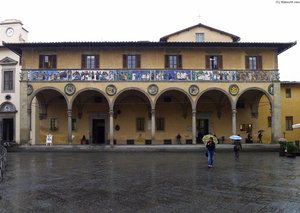
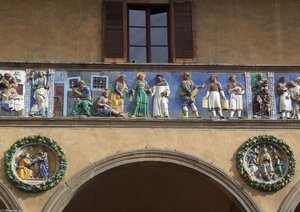
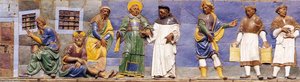
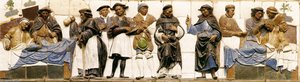
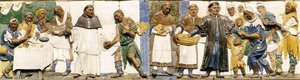
The true brilliance of Buglioni’s artistry is perhaps most vividly captured in his monumental contributions to public architecture. His most remarkable achievement remains the magnificent frieze depicting the Works of Mercy, located on the façade of the Spedale del Ceppo in Pistoia. Executed in glazed and colored terracotta, this work stands as a testament to his ability to transform humble clay into a narrative of profound human compassion. Through these sculpted scenes, Buglioni achieved a graceful simplicity, capturing the essence of charity and social duty with a clarity that captivated the public eye.
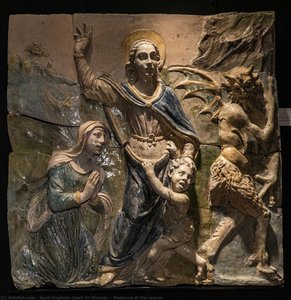
Beyond the architectural grandeur of Pistoia, his work often sought to bridge the gap between the divine and the earthly. In pieces such as Madonna of the Rescue, one finds an atmosphere of profound sanctity and maternal warmth. His ability to utilize light and form—influenced by the monumental spirit of masters like Michelangelo—allowed him to create figures that possessed a palpable sense of realism and psychological depth. Whether working in the delicate medium of glazed pottery or more ambitious sculptural forms, Buglioni’s hand was always guided by an intention to evoke tenderness, protection, and unconditional love.
Historical Significance and Artistic Heritage
The historical importance of Santi Buglioni lies not only in his individual technical achievements but in his role as a custodian of the Florentine tradition. He navigated a period of immense cultural flowering, maintaining the continuity of specialized techniques during the High Renaissance. His career serves as a vital link between the established methods of the della Robbia workshop and the burgeoning sculptural ambitions of the mid-16th century.
Through his collaborations and independent commissions, Buglioni left an indelible mark on the landscape of Italian art. His legacy is found in:
- The preservation of glazing techniques: Carrying forward the specialized knowledge of colored terracotta that defined a generation of Florentine art.
- Civic contribution: Creating enduring public works, such as the Spedale del Ceppo frieze, that integrated high art into the daily lives of the community.
- The evolution of sculpture: Moving from the collaborative workshop model to a more personal, expressive style that embraced the emotional complexities of the Renaissance era.
Questions & Answers
Where is Santi Buglioni (Santi Di Michele) from?
Santi Buglioni (Santi Di Michele) was born in Italy.
In which historical period did Santi Buglioni (Santi Di Michele) work?
Santi Buglioni (Santi Di Michele) worked in the Renaissance period. The period situates the artist's activity in history.
What are the birthplace and birth year of Santi Buglioni (Santi Di Michele)?
Santi Buglioni (Santi Di Michele) was born in Florence in 1494.
What are the birth city and country of Santi Buglioni (Santi Di Michele)?
Santi Buglioni (Santi Di Michele) was born in Florence, in Italy.