A Legacy of Persian Miniature Mastery
The name Shah Muhammad al-Katib al-Shirazi resonates with the refined elegance of the Safavid era, representing a pinnacle of the Shirazi painting tradition. Operating during a period of profound cultural and intellectual exchange, his work serves as a luminous window into the sophisticated world of the Muslim elite. While much of his life remains shrouded in the mists of history, his artistic presence is undeniably felt through the exquisite folios he contributed to some of the most prestigious manuscripts of the sixteenth century. His artistry was not merely about decoration but acted as a portable testament to wealth, culture, and the shared human experience of a cosmopolitan society.
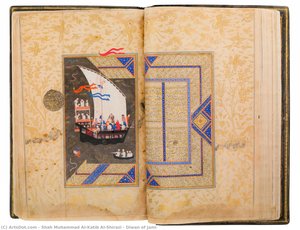
His technical brilliance is most vividly captured in his contributions to the Diwan of Jami, a celebrated collection of mystical and theological works. In these illustrations, he demonstrated an unparalleled command over the medium of watercolor, achieving a depth and luminosity that transformed simple book illustrations into immersive, breathing tableaux. His ability to navigate complex narratives within confined spaces—such as the bustling scene of figures upon a boat or ferry—showcases a mastery of controlled chaos. Through delicate brushwork, he captured every fold of drapery and subtle gesture, imbuing his subjects with a vibrant energy that seems to carry the viewer along the very current of the scene.
Historical Significance and Artistic Influence
The work of Shah Muhammad al-Katib al-Shirazi holds immense historical value, as his manuscripts were highly mobile objects of desire, exchanged as royal gifts or even transferred as war booties across vast distances. His art bridged the gap between different realms of power; for instance, pieces likely originating in Shiraz found their way into the royal library of Ibrahim Adil Shah II in Bijapur. This movement of art highlights his role in a larger network of Islamic intellectual and aesthetic exchange, connecting the Persian heartlands with the burgeoning courts of India.
His artistic achievements can be summarized through several key elements of his style:
- Narrative Precision: The ability to depict intricate human interactions and social gatherings with meticulous detail.
- Luminous Technique: A sophisticated use of watercolor to create layers of visual mystery and atmospheric depth.
- Cultural Synthesis: His work embodies the Shirazi painting tradition, reflecting the creative engagement of artists under the first Safavid rulers.
- Ornamental Mastery: The integration of fine painting with rich elements like gold script and lapis-lazuli accents found in the manuscripts he illustrated.
Ultimately, the legacy of Shah Muhammad al-Katib al-Shirazi is found in the enduring beauty of his compositions. His work remains a vital link to the courtly life and scholarly pursuits of the sixteenth century, offering a tangible echo of a time when art, poetry, and spirituality were inextricably woven together on the pages of illuminated manuscripts.
Questions & Answers
What are the birth city and country of Shah Muhammad Al-Katib Al-Shirazi?
Shah Muhammad Al-Katib Al-Shirazi was born in Shiraz, in Iran.
In which historical period did Shah Muhammad Al-Katib Al-Shirazi work?
Shah Muhammad Al-Katib Al-Shirazi worked in the Renaissance period. The period situates the artist's activity in history.
Where is Shah Muhammad Al-Katib Al-Shirazi from?
Shah Muhammad Al-Katib Al-Shirazi was born in Iran.
What are the birthplace and birth year of Shah Muhammad Al-Katib Al-Shirazi?
Shah Muhammad Al-Katib Al-Shirazi was born in Shiraz in 1546.