A Visionary of Modernity
Shakir Ali stands as a monumental figure in the landscape of Pakistani modernism, an artist whose life and work bridged the gap between classical traditions and the avant-garde movements of Europe. Born in 1916 in Rampur, his early artistic journey began in Delhi at the Sarda Ukil Brothers Studio, where he first encountered the delicate aesthetics of the Bengal School style. This foundational period, rooted in traditional Indian painting, provided a rich cultural substrate that would later interact with the radical shifts he experienced during his travels across the globe. His pursuit of excellence led him to the Sir Jamsetjee Jeejebhoy School of Art in Bombay, where he immersed himself in European academic techniques and the profound beauty of Ajanta cave paintings, setting the stage for a career defined by constant evolution.
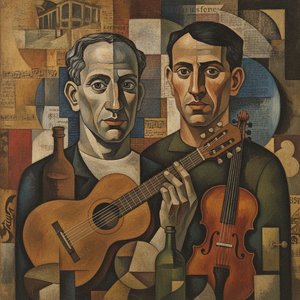
The trajectory of his artistry was irrevocably altered by his time in Europe, a period of intense intellectual and aesthetic discovery. After studying at the Slade School of Fine Art in London, Ali sought the pulse of modernism in Paris, working within the studio of Andre Lhote. This encounter with French modernism was transformative; it was here that he began to embrace the fragmented geometries of Cubism, a movement he would eventually introduce and inspire among the artists of Lahore. His travels further took him to Prague, where his studies in textile design and exposure to the poetry of Rainer Maria Rilke infused his work with a new layer of spiritual and intellectual depth. These diverse experiences allowed him to weave together disparate cultural threads into a singular, cohesive artistic language.
Evolution of Form and Symbolism
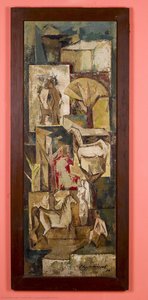
As his career progressed, Ali’s style underwent a remarkable metamorphosis, moving away from the structured rigidity of Cubism toward a more fluid and expressive abstraction. While his early works often drew upon classical European myths, such as Europa and the Bull or Leda and the Swan, his later compositions became increasingly stripped of literal narrative. He began to pare down the human form into sharp, decisive angles, eventually adopting red as a dominant and emotive color in his palette. This evolution saw the line transform from a mere boundary into an indispensable, expressive element that integrated seamlessly within his compositions.
Beyond the structural changes in his technique, Ali’s work is deeply imbued with personal symbolism. He frequently utilized birds as central motifs, viewing them as potent symbols of personal freedom amidst a world governed by convention. His later explorations also included pioneering work in painterly Arabic calligraphy, where he treated the alphabetic form as a linear design, using color and visual rhythm to provide a modern interpretation of traditional script. This ability to harmonize ancient calligraphic traditions with modern abstract sensibilities remains one of his most significant artistic achievements.
Legacy and Educational Impact
Shakir Ali’s influence extended far beyond the canvas, as he was equally a dedicated educator and a pillar of the academic community in Pakistan. His tenure at the Mayo School of Arts—which he helped rename the National College of Arts—was marked by his leadership as its first Pakistani principal. Through his role as a teacher and mentor, he cultivated a generation of modernist painters, including luminaries such as Muhammad Ahmad Khan, Jamil Naqsh, Bashir Mirza, and Ahmed Pervez. His presence in Lahore created a fertile ground for artistic experimentation, making him the spiritual and intellectual architect of a new era in Pakistani art.
His legacy is characterized by a profound belief that an artist belongs to the entire world, transcending national boundaries through the universal language of art. By integrating the lessons of Paris, London, and Prague with the cultural heritage of his homeland, Shakir Ali created a body of work that remains both deeply personal and globally resonant. He left behind a striking repertoire of paintings, drawings, and calligraphic designs that continue to serve as a cornerstone for understanding the development of modern art in Pakistan.
Questions & Answers
What are the birthplace and birth year of Shakir Ali?
Shakir Ali was born in Lahore in 1916.
Where is Shakir Ali from?
Shakir Ali was born in Pakistan.
In which historical period did Shakir Ali work?
Shakir Ali worked in the Modern period. The period situates the artist's activity in history.
What are the birth city and country of Shakir Ali?
Shakir Ali was born in Lahore, in Pakistan.