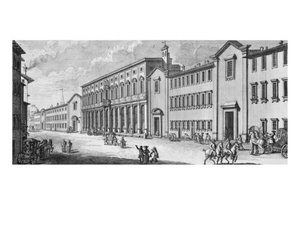
A Master of the Cosmos and Cartography
Vincenzo Maria Coronelli was not a painter in the traditional sense, but rather a brilliant polymath whose artistry resided at the intersection of scientific precision and visual splendor. An Italian Franciscan friar, cosmographer, cartographer, and encyclopedist, he occupied a unique space in the Baroque period where geography, astronomy, and fine art converged. Born in Venice, the son of a Venetian tailor, his early life took him to Ravenna, where as a young boy he was apprenticed to a xylographer. This foundational training in wood engraving would later inform the intricate detail and delicate patterns found in his vast body of work, which eventually spanned over one hundred and forty separate publications.
His intellectual journey was as expansive as the maps he created. After entering the Conventual Franciscans, Coronelli pursued rigorous studies in Rome, earning a doctorate in theology. Yet, his curiosity could not be contained by scripture alone; he immersed himself in the study of astronomy, Euclidian geometry, and ancient philosophy. This rare combination of theological depth and scientific rigor allowed him to approach the mapping of the world and the heavens with a profound sense of wonder. He did not merely record locations; he sought to capture the very fabric of the universe, blending mathematical accuracy with an aesthetic elegance that could inspire both scholars and nobility.
The Grandeur of Globes and Atlases
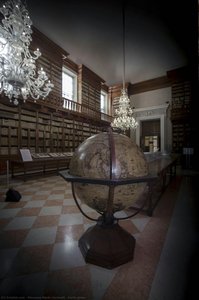
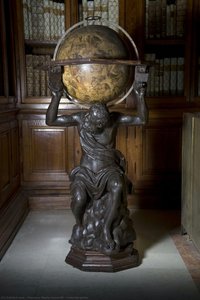
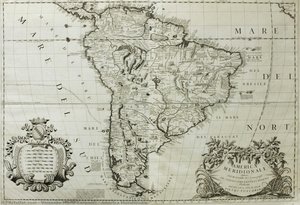
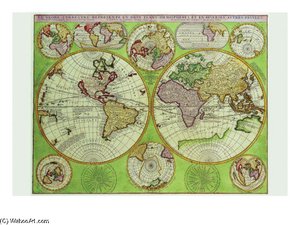
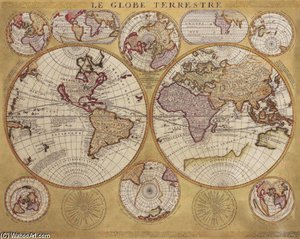
Coronelli’s most enduring legacy lies in his monumental achievements in globemaking and cartography. He gained international renown for his ability to translate complex celestial and terrestrial data into breathtaking physical objects. One of his most celebrated feats involved the creation of massive, highly technical globes for the Duke of Parma. These spheres, measuring five feet in diameter, were so masterfully executed that they secured Coronelli a position as the Duke's personal theologian. His reputation soon reached the highest courts of Europe, leading to commissions such as those for King Louis XIV of France. In Paris, he constructed gargantuan globes weighing two tons each, one representing the Earth and the other the heavens, the latter featuring the celestial vault as it appeared on the day of the King's birth, illuminated with constellations depicted as imaginary animals.
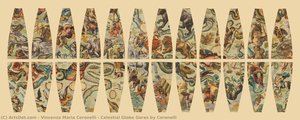
Beyond these singular masterpieces, his work included a vast array of atlases and celestial globe gores. These segments, designed to be applied to the surface of a sphere, serve as a window into the seventeenth-century mind. In pieces such as his celestial gores, one finds a dense, vibrant mosaic where the boundaries between geography and fine art are beautifully blurred. His work often features:
- Intricate arrangements of celestial segments that transform functional maps into profound meditations on the cosmos.
- A rhythmic complexity created by layering terrestrial life against the infinite sky, including graceful silhouettes of birds and human figures.
- The use of dramatic detail characteristic of the late Baroque period, imbuing static maps with an organic, breathing energy.
Legacy of the Accademia Cosmografica
In his later years, Coronelli returned permanently to his home city of Venice, where he continued to shape the scientific landscape of Europe. He was a man of immense organizational vision, establishing the Accademia Cosmografica degli Argonauti in 1684, which stands as the very first geographical society. Through this institution and his prolific publishing efforts, such as the Atlante Veneto and the encyclopedic Biblioteca Universale Sacro-Profana, he acted as a vital conduit for knowledge during the Age of Discovery. As the Cosmographer of the Republic of Venice, his life's work ensured that the mapping of the known world was not just a matter of navigation, but a grand, artistic endeavor that celebrated the majesty of the Earth and the heavens alike.
Questions & Answers
What are the birthplace and birth year of Vincenzo Maria Coronelli?
Vincenzo Maria Coronelli was born in Venice in 1650.
In which historical period did Vincenzo Maria Coronelli work?
Vincenzo Maria Coronelli worked in the Early-Modern period. The period situates the artist's activity in history.