A Legacy of Silk and Light
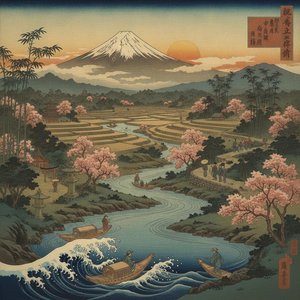
Watanabe Kakushū stands as a profound figure within the Shin-hanga movement, a transformative era in Japanese art that sought to breathe new life into traditional techniques through the lens of modern sensibilities. Born in Tokyo, Japan, Kakushū mastered the delicate and demanding medium of silk, using its natural luminosity to create works that possess an almost ethereal inner glow. His artistry is defined by a breathtaking ability to capture moments of profound stillness, where the grandeur of the natural world meets a quiet, human connection.
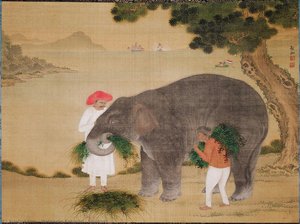
The essence of his work lies in the masterful synthesis of ukiyo-e traditions with emerging Western influences, such as the nuanced use of light, shadow, and atmospheric perspective. In his celebrated compositions, such as the evocative Elephant, Kakushū demonstrates a remarkable command over texture and depth. He does not merely document subjects; he interprets them through a lens of atmospheric beauty, utilizing subtle gradients to define musculature and distant, hazy landscapes that invite the viewer into a dreamlike realm.
Technique and Artistic Vision
To observe a Kakushū masterpiece is to witness a meticulous application of color that respects the very grain of his canvas. By working upon silk, he achieved a level of translucency and softness that traditional paper could not afford, allowing the greenery of his landscapes and the heavy textures of his subjects to appear vibrantly alive. His compositions are often characterized by a careful balance of scale, where the presence of human figures provides a grounding context to exotic or majestic animals.
His artistic development is marked by several key elements:
- The Mastery of Medium: The use of silk to capture light and create a sense of tactile reality.
- Atmospheric Depth: The layering of foreground subjects against distant, silhouetted mountains and calm waters to create an immersive experience.
- Synthesis of Styles: The seamless integration of traditional Japanese woodblock sensibilities with Western concepts of perspective and light.
Through his dedication to these techniques, Watanabe Kakushū contributed significantly to the historical significance of the Shin-hanga movement, leaving behind a body of work that continues to resonate with those drawn to the serene encounter between nature and the human spirit.
Questions & Answers
What are the birth city and country of Watanabe Kakushū?
Watanabe Kakushū was born in Tokyo, in Japan.
What are the birthplace and birth year of Watanabe Kakushū?
Watanabe Kakushū was born in Tokyo in 1870.
What aliases or alternate names does Watanabe Kakushū have?
Watanabe Kakushū appears under the alternate names Watanabe Kakushu.