
Gino SchmidtOskar Kokoschka · 1914
 Oil On Canvas
- WallArt
- Expressionist Portraiture
 1914
1914 95.0 x 68.0 cm
 Thyssen-Bornemisza Museum
Oskar Kokoschka (1886 – 1980)
Explore the intense expressionism of Oskar Kokoschka (1886-1980). Renowned for psychologically charged portraits, landscapes & 'The Bride of the Wind,' his art reflects a turbulent life and innovative style. #Kokoschka #Expressionism
Thyssen-Bornemisza Museum (Madrid, Spain)
Discover European art from the Renaissance to Post-Impressionism at the Thyssen-Bornemisza Museum in Madrid! Explore masterpieces by Van Gogh, Rembrandt & more in a stunning palace setting.
The Enigmatic Figure: Gino Schmidt by Oskar Kokoschka
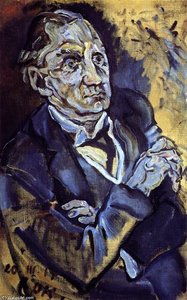
Oskar Kokoschka’s Gino Schmidt, painted in 1914 and currently residing within the hallowed halls of the Thyssen-Bornemisza Museum in Madrid, is not merely a portrait; it's an intensely psychological exploration rendered in oil on canvas. Measuring 95 x 68 cm, this work immediately draws the viewer into a world of quiet introspection, inviting us to decipher the unspoken narrative held within the subject’s downward gaze. Kokoschka, a pivotal figure in early Expressionism, was driven by a profound desire to capture not just appearances but the very essence – the anxieties and emotions – that shaped his subjects. This painting exemplifies that ambition with remarkable power.
A Study in Realism and Psychological Depth
The subject, identified as Gino Schmidt, is presented with a startling degree of realism – his meticulously rendered suit, tie, and the prominent lines of his beard all contribute to an immediate sense of familiarity. Yet, this apparent realism serves merely as a foundation for Kokoschka’s deeper exploration. The background, deliberately blurred, directs our attention entirely onto the man before us, isolating him within a space that feels both tangible and dreamlike. This technique isn't simply stylistic; it reinforces the painting’s central theme: the internal landscape of the individual. Kokoschka masterfully uses light to sculpt the figure, creating subtle shifts in tone that emphasize his features and contribute to an overall sense of dimensionality – a testament to his understanding of chiaroscuro.
The Expressionist Soul
Created during a period of immense social and artistic upheaval, Gino Schmidt is deeply rooted in the tenets of Expressionism. Kokoschka’s work was characterized by its raw emotionality and willingness to confront uncomfortable truths about the human condition. He rejected conventional portraiture, opting instead for a style that prioritized psychological insight over photographic accuracy. The man's contemplative posture, his downward gaze – these are not simply details; they speak volumes about an inner world grappling with uncertainty or perhaps even melancholy. It’s a visual embodiment of the anxieties prevalent in early 20th-century Europe.
Historical Context and Kokoschka’s Legacy
To fully appreciate Gino Schmidt, it's crucial to understand Oskar Kokoschka’s broader artistic trajectory. Born in Croatia (then part of Austria-Hungary) in 1886, his early career was shaped by the Jugendstil movement in Vienna before he embraced Expressionism with fervor. His tumultuous personal life – marked by passionate relationships and emotional instability – undoubtedly informed his art, lending a profound sense of vulnerability to his portraits. Kokoschka’s legacy extends far beyond this single painting; he remains one of the most significant figures in 20th-century art, renowned for his psychologically penetrating depictions of human nature. The Thyssen-Bornemisza Museum offers a rich context for viewing this work alongside other masterpieces by Kokoschka and his contemporaries.
Considering its historical significance and artistic merit, a high-quality reproduction of Gino Schmidt is an exceptional addition to any collection. Explore the exquisite detail and emotional depth of this iconic portrait at Mus3ums for a stunning representation of Kokoschka’s genius.
About this artwork
- Title: Gino Schmidt
- Artist: Oskar Kokoschka
- Year: 1914
- Original dimensions: 95.0 x 68.0 cm
- Format: Tall
- Copyright status: Under copyright
- Where to see it: Thyssen-Bornemisza Museum
- Movement: Expressionist Portraiture
- Medium type: WallArt
- Corpus context: vienna expressionism, social critique
Quick Facts
- Subject or theme: Contemplative man
- Artistic style: Expressionism
- Year: 1914
- Dimensions: 95 x 68 cm
- Artist: Oskar Kokoschka
- Notable elements: Blurry background
- Influences:
- Jugendstil
- Impressionism
Questions & Answers
How does "Gino Schmidt" by Oskar Kokoschka connect Expressionist Portraiture to the artist's home country?
"Gino Schmidt" was created by Oskar Kokoschka, born in Croatia, within the Expressionist Portraiture movement. The artist's origin links the work to Expressionist Portraiture as practiced by artists from Croatia.
When was "Gino Schmidt" made?
"Gino Schmidt" by Oskar Kokoschka was created in 1914.
What emotion does "Gino Schmidt" by Oskar Kokoschka convey?
"Gino Schmidt" is associated with a melancholic feeling. The emotional tone describes the impression the work gives.
How much light do the colors of "Gino Schmidt" appear to reflect?
"Gino Schmidt" by Oskar Kokoschka has a soft shadow luminance. Luminance describes how much light the colors appear to reflect.
How old was Oskar Kokoschka when creating "Gino Schmidt" in 1914?
Oskar Kokoschka was 28 years old when creating "Gino Schmidt" in 1914. The age is computed from the artist's birth year, 1886.
Who is the artist behind "Gino Schmidt"?
"Gino Schmidt" is attributed to Oskar Kokoschka.
What emotional tone accompanies the Expressionist Portraiture style of "Gino Schmidt"?
The melancholic emotion of "Gino Schmidt" accompanies its Expressionist Portraiture style.