

A Renaissance Triumph: The Soul of Mantua
In the heart of Lombardy, where the echoes of the Gonzaga dynasty still resonate through the cobblestone streets of Mantua, stands the Basilica di Sant'Andrea —a monumental achievement that transcends the boundaries of mere religious architecture. This is not simply a place of worship, but a profound dialogue between the earthly ambitions of a powerful ruling family and the divine aspirations of the Renaissance spirit. To step before its façade is to encounter one of the most audacious architectural experiments in history, a structure where the heavy brickwork of the Italian landscape is transformed into a soaring testament to classical revival and humanist intellect.
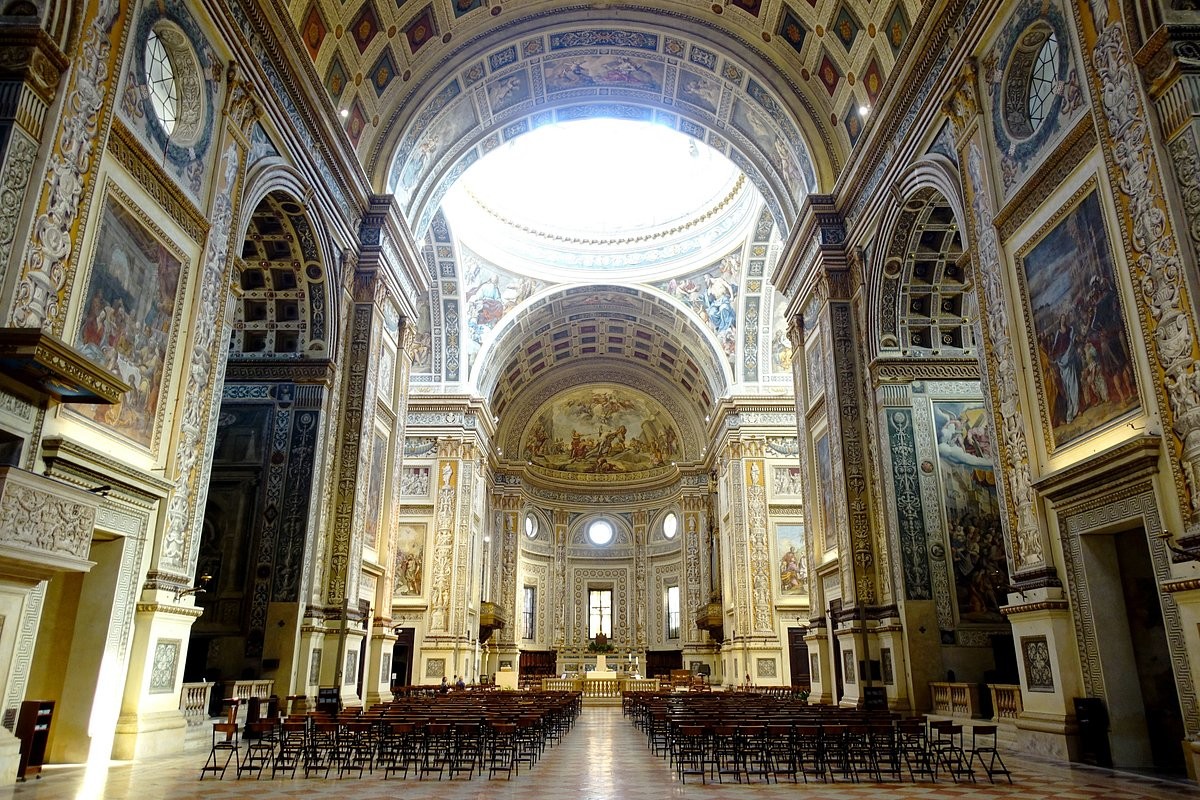
The genesis of this masterpiece lies in the brilliant, scholarly mind of Leon Battista Alberti . As the father of Renaissance architecture, Alberti sought to move beyond the traditional, often fragmented styles of his predecessors by looking backward to the grandeur of ancient Rome. Drawing direct inspiration from the monumental Basilica of Maxentius and Constantine, he reimagaged the Christian church through a Roman lens. By eschewing the traditional side aisles in favor of a singular, powerful central plan, Alberti created a space that directs every gaze toward the altar, emphasizing the centrality of Christ while simultaneously utilizing the mathematical precision of geometry to create an atmosphere of celestial order.
Architectural Ingenuity and Classical Majesty
The architecture itself is a masterclass in illusion and structural ingenuity. While the bones of the basilica are constructed from humble brick, Alberti’s vision utilized layers of smooth stucco to mask the utilitarian materials, creating surfaces that catch the light with a soft, ethereal glow. The exterior façade, dominating the Piazza Mantegna, functions as a triumphal arch for the faithful. Its colossal Corinthian pilasters and massive pediment evoke the imperial majesty of antiquity, while the central archway invites the visitor into a realm where the boundaries between the physical and the spiritual begin to blur.
Inside, the experience is one of overwhelming scale and grace:
- The Barrel Vault: An immense structure that rises with breathtaking momentum, creating a sense of infinite verticality.
- The Central Plan: A design choice that eliminates side aisles to focus all spiritual energy toward the high altar.
- Classical Motifs: The integration of Roman-inspired elements that celebrate the humanist revival of ancient knowledge.
Beyond the structural brilliance, the Basilica serves as a sanctuary for the artistic legacy of Andrea Mantegna , the preeminent court artist of the Gonzaga era. The spirit of Mantegna’s work—characterized by its rigorous perspective and classical idealism—is woven into the very fabric of the building. His mastery of illusionistic space finds a spiritual echo within these walls. For the art lover, the collector, or the designer, Sant'Andrea offers more than just a historical site; it provides a profound lesson in how light, proportion, and classical motifs can be synthesized to create an environment of timeless elegance. It remains a living monument where the intellectual currents of humanism and the enduring power of faith continue to converge.