


The History and Origins of Grand Palais
The Grand Palais occupies a significant position in the 8th arrondissement of Paris, France. Its existence is tied to the ambitions of the turn of the century, specifically the preparations for the 1900 Universal Exposition. Construction of the complex began in 1897, following the demolition of the Palais de l'Industrie. This site, once occupied by a temporary structure, was cleared to make way for a permanent venue designed for large-scale official artistic events. The grand opening took place on 1 May 1900.
The building was conceived to provide a monumental space for the Republic to present its artistic achievements. It was intended to be a site where the scale of the architecture matched the importance of the exhibitions held within its walls. The transition from the Palais de l'Industrie to the Grand Palais marked a shift toward a more permanent and expansive method of presenting culture to the public. The structure was built to accommodate diverse gatherings, ranging from fine arts to industrial and technological advancements.
The site has functioned as a venue for many significant moments in French history. It has hosted everything from riding competitions to aviation displays. The space remains a central part of the Parisian landscape, situated between the Champs-Élysées and the Seine. Its history is one of adaptation, evolving from a temporary exhibition site into a permanent fixture of the city's cultural life.
The Architecture of a Parisian Icon
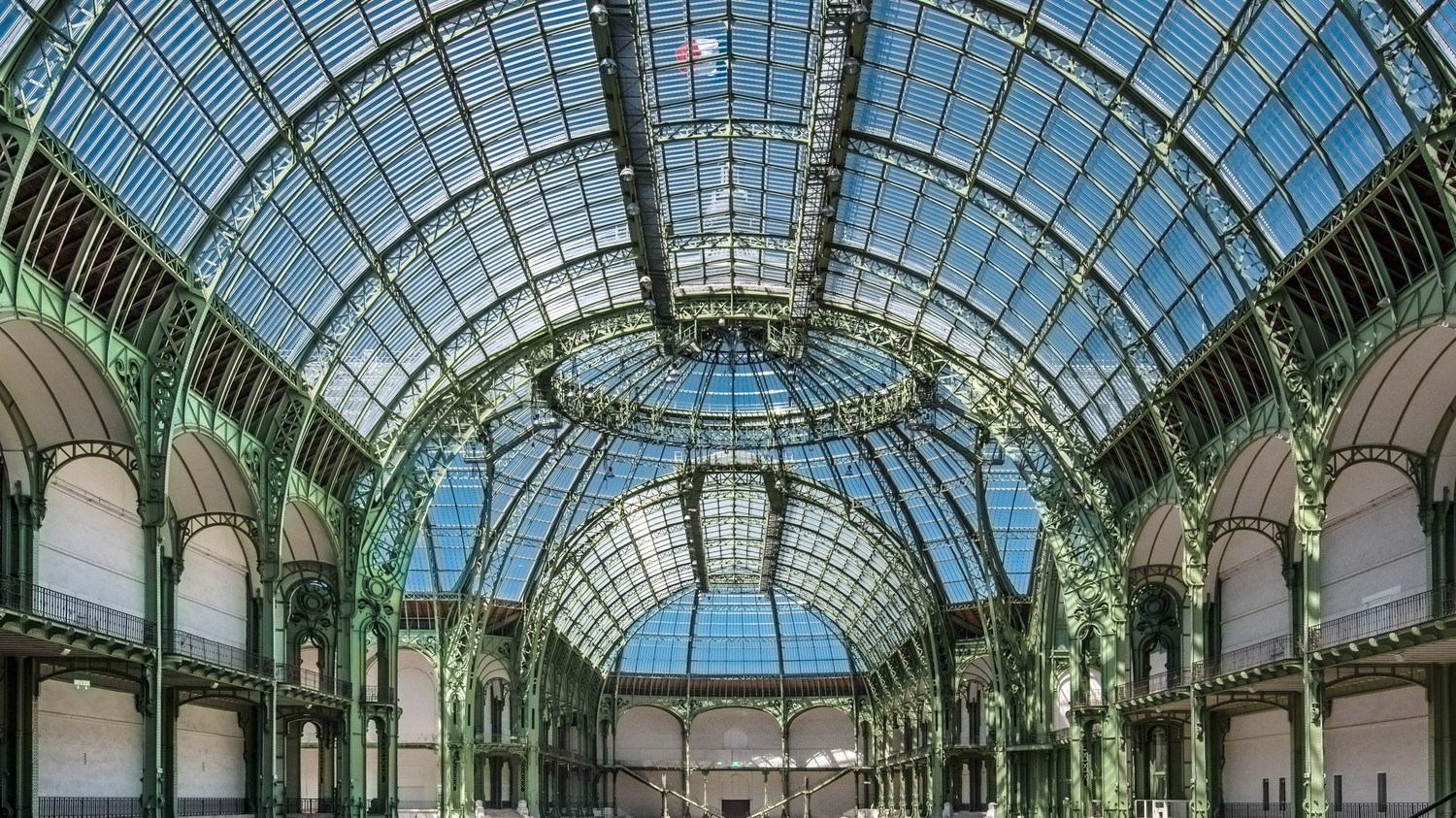
The structure is a study in Beaux-Arts style and Eclecticism, where heavy stone facades meet the lightness of glass vaults. This interplay of materials relies on period innovations, specifically the use of iron, light steel framing, and reinforced concrete. The scale of the interior is defined by a nave nearly 240 meters in length. While the width begins at 50 meters, it expands to 100 meters at the paddock. Above, the roof rises 35 meters from the floor to the main framework, a height complemented by a campanile that reaches approximately 60 meters.
There is a specific gravity to the way the light enters through the expansive glazing. The engineering allows for a vast, open volume that accommodates large-scale presence. The Ministry of Culture has listed the building as a historic monument, recognizing the permanence of its design. The weight of the stone is balanced by the transparency of the ceiling, creating a space where the structural elements are clearly visible to the observer.
Exhibitions and Cultural Programming
The space has long functioned as a venue for diverse displays, ranging from the technical to the fine arts. Early exhibitions focused on the rapid advancements of the era, presenting subjects such as automobiles and aviation to the public. These large-scale events and international trade fairs have occupied the nave for over a century, utilizing the vast volume of the structure to accommodate everything from industrial innovation to major cultural gatherings.
The history of the site is also marked by significant artistic milestones. A major retrospective of Henri Matisse was held here following his death, marking a significant moment for his legacy. While the main building underwent renovation for the 2024 Summer Olympics, the Grand Palais Éphémère was opened in 2021 to ensure the continuity of exhibitions. This temporary structure allowed for the ongoing presentation of art and culture during the transition. The Grand Palais is scheduled to open completely to the public in June 2025.
- The first major Henri Matisse retrospective after his death
- Exhibitions of automobiles and aviation
- International trade fairs and large-scale events
Recent Restoration and Modern Projects
The preservation of such a monumental structure requires constant vigilance. A significant restoration project concluded in 2017, addressing the structural needs of the building. This work involved reinforcing the steel framework and replacing damaged glass panels to ensure the integrity of the soaring vaults. These technical interventions allow the light to continue its movement through the nave as it has for over a century.
While the main building undergoes its own evolution, the city has seen the emergence of the Grand Palais Éphémère. Located in the Champ de Mars, this temporary exhibition hall was designed by architect Jean-Michel Wilmotte. It serves as a functional space to host various events while the primary site is prepared for the 2024 Summer Olympics. The structure was specifically intended to host the judo and wrestling events during the games.