

A Sanctuary of Art Across Time and Cultures
Nestled in the intellectual heart of Cambridge, Massachusetts, the Harvard Art Museums stand as a profound testament to humanity’s enduring creative spirit—a place where centuries converge and artistic dialogues echo through time. More than just a repository of masterpieces, this vibrant nexus for scholarship and aesthetic experience draws students, researchers, and art enthusiasts into its captivating embrace. The museums are not merely housed within the prestigious halls of Harvard University; they are intrinsically woven into its academic fabric, fostering an environment where artistic inquiry flourishes. What began in 1870 with the founding of the Fogg Museum has blossomed into a magnificent tripartite institution—comprising the Fogg, Busch-Reisinger, and Arthur M. Sackler Museums—each offering a unique lens through which to view the world’s vast artistic heritage.
The Fogg Museum serves as the cornerstone of this remarkable complex, celebrated globally for its exceptional holdings of Western painting. Within its walls, visitors can lose themselves in the luminous landscapes of Italian Renaissance masters like Leonardo da Vinci and Raphael, or encounter the evocative, soulful narratives of Pre-Raphaelite works by Dante Gabriel Rossetti and John Everett Millais. The collection captures the very essence of movement and light, from the revolutionary brushstrokes of Impressionist legends like Edgar Degas to the bold, emotive explorations of color found in Paul Gaucent’s masterpieces. Beyond the canvas, the Fogg boasts significant collections of drawings and photography, offering intimate glimpses into the meticulous observation and raw artistic processes that define the evolution of modern vision.
This journey through Western tradition is beautifully complemented by the specialized treasures held in the adjacent wings. The Busch-Reisinger Museum provides an immersive voyage through the art of Central Europe, presenting a realm where German, Austrian, and Swiss expressionism, symbolism, and abstraction intertwine to reflect the profound psychological anxieties of their eras. In contrast, the Arthur M. Sackler Museum transports the observer across continents to explore the rich, ancient traditions of Asia. From the commanding presence of Chinese bronzes and delicate ceramics to the intricate beauty of jades and elegant calligraphy, the Sackler’s collection offers deep insights into a diverse cultural landscape, alongside captivating Islamic art and powerful Indian sculptures.
Architecture as an Artistic Dialogue
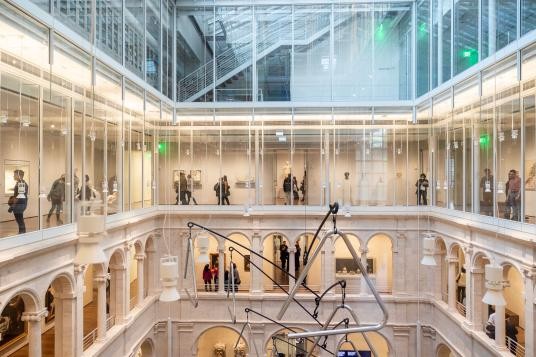
The physical embodiment of this artistic confluence is itself a breathtaking work of art. Designed by the internationally acclaimed architect Renzo Piano and completed in 2014, the museum building prioritizes the transformative power of natural light. Piano’s masterful design ensures that galleries are bathed in a soft, ethereal glow that enhances the viewing experience and invites quiet contemplation. The architecture does not merely act as a container for art; it actively participates in the dialogue, creating an inviting environment where visitors can connect with masterpieces on a deeper level. Its undulating façade, which subtly mimics the curves of the River Cam, symbolizes fluidity and harmony—a deliberate choice to mirror the continuous flow of artistic ideas across history.
This architectural triumph was born from a desire to foster interdisciplinary connections, encouraging viewers to see resonances between seemingly disparate traditions and historical periods. The integration of these distinct spaces allows for a seamless transition between the ancient and the modern, the East and the West. For the art lover or the interior designer seeking inspiration, the museum offers a masterclass in how space, light, and structure can elevate the perception of beauty. It is a place where the past is not just preserved but is actively studied, debated, and reinterpreted—a living testament to the enduring power of human creativity.
A Legacy of Discovery and Inspiration
What truly distinguishes the Harvard Art Museums is their dual commitment to world-class research and public engagement. As an integral part of Harvard University, they play a crucial role in educating the next generation of scholars and promoting a global understanding of art history. The museum’s state-of-the-art research facilities provide essential resources for conservators and historians from around the globe, facilitating groundbreaking discoveries regarding ancient techniques and modern conservation science. This dedication to scholarship extends far beyond the academic sphere, enriching the experience for every visitor through thoughtfully curated exhibitions and engaging public programs that make art accessible to all.
A visit to these museums is an enriching journey that transcends mere observation; it is an invitation to engage with the soul of human history. Whether one is a seasoned collector drawn to the rarity of the holdings, a budding artist seeking technical inspiration, or a designer looking for the perfect historical motif, the Harvard Art Museums offer an inexhaustible source of wonder. From the intimate details of a Renaissance portrait to the bold, transformative strokes of a modern masterpiece, every object holds a story waiting to be discovered—a testament to our collective ability to transform our understanding of the world through the lens of art.