The Physics of Light: Subsurface Scattering from Parian Origins to Modern Mastery
 Marble sculpture
Marble has been the preferred material for stone monumental sculpture since ancient times, with several advantages over its more common geological "parent" limestone, in particular the ability to absorb light a small distance into the surface before ...
To understand the allure of marble is to understand how light behaves when it encounters a surface that refuses to be merely opaque. Unlike the flat, immediate reflection of metal or the heavy density of granite, certain marbles possess a unique geological gift: subsurface scattering. This phenomenon allows light to penetrate the crystalline structure of the stone, traveling a short distance beneath the surface before being refracted back to the eye. It is this subtle, internal glow that mimics the translucency of human skin, lending a pulse to even the most static figures.
The ancient Greeks were the first to truly exploit this optical property, seeking out the quarries of Paros for their exceptionally pure white Parian marble. This material was prized because its fine grain and lack of impurities allowed for an ethereal luminosity that could transform a cold mineral into something that appeared to breathe. We see this same pursuit of light in the works of modern masters like Leon Underwood, whose
Untitled (544) utilizes the stone's natural capacity to catch diffused daylight, creating soft shadows that define the musculature of the female form. The technical requirement remains unchanged: whether in the fifth century BCE or a contemporary studio, the sculptor must work in dialogue with the light trapped within the grain.
The Sculptor’s Discipline: Trasting the Evolution of Tools from Ancient Greece to the Renaissance
 Classical Greek sculpture
Classical Greek sculpture has long been regarded as the highest point in the development of Ancient Greek sculpture. Classical Greece covers only a short period in the history of Ancient Greece, but one of remarkable achievement in several fields. It...
The transformation of a raw, unyielding block into a delicate anatomical study requires a rigorous, almost violent, progression of technique. The process begins with the heavy labor of "roughing out," where the sculptor uses a point chisel and a heavy mallet to strike away large, unwanted portions of stone. This stage is one of pure force, a rhythmic percussion that gradually reveals the silhouette hidden within the mass. As the form emerges, the tools become more refined; the flat chisel and the drill allow for deeper undercutting, creating the dramatic shadows necessary for complex drapery or the hollows of an eye socket.
This progression finds its historical echo in the works of the Renaissance, where masters like Michelangelo viewed the process as a liberation of the spirit already present within the stone. The transition from the heavy impact of the pitching tool to the delicate abrasion of rasps and polishing compounds mirrors the artist's shift from destruction to creation. Even today, while power tools may assist in the initial stages, the final refinement—the smooth, polished surface that invites the touch—still relies on the same ancestral patience and manual precision used by the artisans of antiquity.
Anatomy and Idealism: The Enduring Pursuit of the Perfect Form
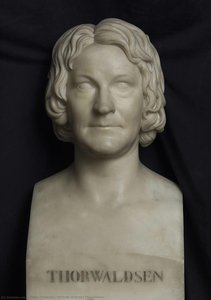 Portrait of Bertel Thorvaldsen
A Sculptor's Reverie: Exploring Pietro Tenerani’s Portrait of Bertel Thorvaldsen The marble bust depicting Bertel Thorvaldsen, executed by Pietro Tenerani in 1844, stands as a testament to the enduring fascination with classical ideals amidst the bur...
Marble sculpture has rarely been about mere imitation; it is more often an exploration of the ideal. In the Classical period, sculptors sought a balance between anatomical accuracy and a formal harmony that elevated the human subject above the mundane. This was not a rejection of reality, but a refinement of it, stripping away the accidental blemishes of life to reveal the mathematical perfection of the body. The use of
contrapposto—the weight shift of the hips that suggests potential movement—became the standard for conveying both grace and vitality.
This tension between the real and the ideal is palpable in the Neoclassical revival, particularly in the works of Pietro Tenerani. His
Portrait of Bertel Thorvaldsen demonstrates how the meticulous rendering of musculature can coexist with a serene, idealized expression. By studying the anatomical structures of the past, artists like Tenerani were able to project an image of strength and moral virtue through stone. The pursuit remains consistent: using the medium's durability to freeze a moment of perfect, unblemable human dignity.
The Lineage of Carrara: A History of Material Purity and Architectural Grandeur
 Carrara marble
Carrara marble, or Luna marble (marmor lunense) to the Romans, is a type of white or blue-grey marble popular for use in sculpture and building decor. It has been quarried since Roman times in the mountains just outside the city of Carrara in the pro...
While the Greeks looked to the islands of the Aegean, the history of European sculpture is inextricably linked to the mountains of northern Italy. The quarries of Carrara have provided the world with its most sought-after medium, specifically the pure white
statuario grade. This marble, characterized by its high tensile strength and ability to hold a high gloss, became the preferred choice for the monumental ambitions of the Roman Empire and later the Renaissance. Its availability allowed for a scale of production that could decorate entire basilicas and public forums, turning architecture into a narrative of power.
The legacy of this stone is visible in the very bones of history, from the Pantheon to the works of Michelangelo. The extraction of Carrara marble has always been a feat of immense physical endurance, a tradition of labor that connects the ancient Roman miners to the modern quarry workers of the Apuan Alps. When we observe the heavy, flowing drapery in a work like
Agar and Ishmael by François-Léon Sicard, we are seeing the result of a material that can support significant weight while maintaining a delicate, organic texture. The stone provides the structural soul upon which the artist builds their vision.
The Art of Texture: Achieving the Illusion of Flesh and Fabric in Mineral
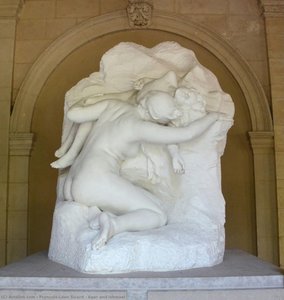 Agar and Ishmael
A Sanctuary in Stone: The Tender Vision of Agar and Ishmael In the quietude of white marble, François-Léon Sicard captures a moment of profound vulnerability and peace. Agar and Ishmael is not merely a sculpture; it is an evocative narrative frozen i...
The true mastery of marble lies in the ability to deceive the eye—to make the hardest substance appear as soft as silk or as tender as skin. This is achieved through a sophisticated command of texture, where the sculptor varies the finish of the stone across different surfaces. A highly polished area can represent the smooth expanse of a forehead or a limb, while a more matte, textured finish can simulate the ruggedness of a rocky outcrop or the heavy weave of a cloak.
This technical feat is perhaps most moving in the Romantic tradition, where the goal was to evoke profound emotion through tactile illusion. In Sicard's
Agar and Ishmael, the contrast between the smooth, sleeping figures and the rough, layered depth of the stone base creates a visceral sense of protection and vulnerability. The marble does not merely represent a scene; it absorbs the stillness of the moment. This ability to manipulate texture remains the ultimate benchmark for any sculptor, proving that through the disciplined application of tool and technique, even the most inanimate mineral can be made to express the complexities of the human soul.
***
At Mus3ums.com, we understand the profound impact of historical excellence on modern spaces. Whether you are looking to commission a custom portrait that echoes the classical precision of the Old Masters or seeking large-format murals to transform a corporate interior, our studio provides professional, reliable solutions for procurement managers and designers alike. From our meticulous six-step hand-painting process to our global logistics network, we ensure that every piece meets the highest standards of academic artistry.