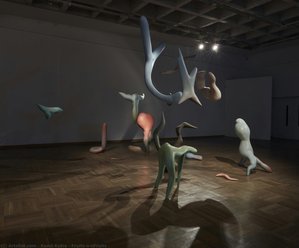
A Symphony of Sight and Sound
Kamil Kukla, born in 1989 in the historic Polish town of Tarnów, exists at a profound intersection where the auditory meets the visual. To encounter his work is to witness a translation of sonic landscapes into tangible, pigment-rich realities. His artistic journey began within the disciplined walls of Artur Grottier’s Art School in Tarnow, providing him with a rigorous foundation that would later serve as the scaffolding for his more experimental endeavors. This early training paved the way for his advanced studies at the Academy of Fine Arts in Kraków, where he studied under Professor Stanisław Tabusz and explored the intricate complexities of printmaking and animated film. This multidisciplinary education instilled in him an intellectual curiosity that refuses to be confined by a single medium, allowing him to move fluidly between the roles of painter, graphic artist, and composer.
The essence of Kukla’s practice lies in his ability to bridge the gap between different sensory experiences. Before fully immersing himself in the visual arts, he cultivated a formidable musical background, mastering instruments such as the piano and cello. This deep-seated understanding of rhythm, harmony, and timbre acts as the heartbeat of his paintings. He does not merely paint images; he composes canvases. His work often mirrors the structures of experimental music—incorporating elements of noise, drone, and ambient soundscapes into visual textures that can feel atmospheric and blurry one moment, or cacophonous and jarring the next. This rhythmic approach to color and form allows his art to pulsate with a life force that is both visceral and ethereal.
The Alchemy of Tradition and Abstraction
Kukla’s aesthetic language is a sophisticated dialogue between the weight of art history and the spontaneity of contemporary abstraction. While his canvases often embrace the energetic gestures reminiscent of Abstract Expressionism, they are deeply rooted in an "allusive abstraction" that references the masters of the past. He engages in a deliberate process of deconstruction and recycling, taking the grandeur of the Baroque and Rococo eras—the fleshy nudes of François Boucher or the dramatic still lifes of Frans Snyders—and transforming them into something entirely new. Through this lens, he creates travesties of classical art that feel both ancient and strikingly modern.
His technical approach is characterized by a captivating tension between meticulous detail and expansive freedom. In his more recent explorations, Kukla has moved toward a form of figurative painting that addresses the complexities of the human condition, specifically focusing on themes of corporeality, masculinity, and the ecological anxieties of the Anthropocene. His imagery often features organic, undulating shapes that evoke the biological structures of living organisms, yet these forms remain alien and unidentifiable to the real world. This creates a sense of surrealism that challenges the viewer's perception, pulling them into a space where the boundaries between the natural and the synthetic begin to dissolve.
Legacy and Contemporary Resonance
The significance of Kamil Kukla’s work lies in its refusal to remain static. His career is marked by a restless movement through various artistic territories, from digital graphics and sculptural objects to experimental soundscapes. This versatility has earned him recognition within prestigious institutions; his works are held in esteemed collections such as the Museum of Contemporary Art in Kraków (MOCAK), the National Museum in Gdańsk, and the Bunkier Sztuki Gallery in Kraków. His participation in international residencies, including the MeetFactory in Prague and the Dukley Art Center in Montenegro, has further expanded his artistic vocabulary, allowing him to integrate global influences into his Polish heritage.
As a contemporary figure, Kukla represents a new generation of polymath artists who view technology, music, and classical tradition not as separate entities, but as a unified toolkit for expression. Whether he is exploring the bold, vibrant hues of his piece “Fruits” or navigating the darker, more textured realms of digital decay, his work remains a testament to the power of interdisciplinary synthesis. He continues to push the boundaries of how we perceive beauty, inviting us to listen to the colors and see the music in an ever-evolving visual symphony.