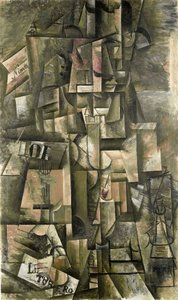


The Shattered Lens: Understanding the Departure from Renaissance Perspective
For centuries, the Western artistic tradition was anchored by a singular, sacred promise: the illusion of depth. From the dawn of the Renaissance, painters sought to master the mathematical precision of linear perspective, creating windows into worlds that obeyed the laws of light and distance. The canvas was a stage where objects receded toward a vanishing point, maintaining a fixed, unmoving eye upon the scene. However, as the twentieth century approached, this stable reality began to fracture. The arrival of Cubism did not merely suggest a new way of seeing; it staged a radical coup against the very concept of the singular viewpoint.
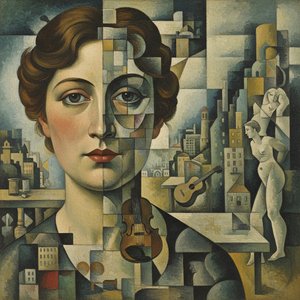
To understand the magnitude of this revolution, one must appreciate the psychological shift it demanded from the viewer. Where traditional art invited us to look at a scene, Cubism forced us to move through it. The artists of this movement—most notably Pablo Picasso and Georges Braque—rejected the deceptive stillness of the Renaissance. They recognized that human perception is never static; our eyes dart, our heads tilt, and our memories layer multiple moments into a single consciousness. By shattering the lens of traditional perspective, Cubism sought to capture the complexity of modern existence, replacing the illusion of depth with a profound exploration of surface, structure, and simultaneous viewpoints.
Analytical Cubism: Deconstructing Form and the Geometry of Reality
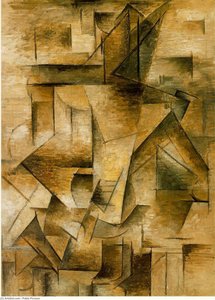
The first phase of this movement, known as Analytical Cubism, represents one of the most intellectually rigorous periods in art history. During this era, the subject matter—be it a portrait, a musical instrument, or a simple tabletop arrangement—was systematically dismantled. Artists utilized a muted, almost monochromatic palette of ochres, greals, and browns to ensure that color did not distract from the primary objective: the investigation of form. The world was broken down into its fundamental geometric constituents, reduced to facets, planes, and interlocking lines.
In these works, the distinction between the object and the space surrounding it begins to dissolve. Through a process of fragmentation, the artist presents various sides of an object at once—the top, the side, and the underside—all flattened onto the two-dimensional plane. This was not an act of destruction, but one of intense analysis. By deconstructing reality into a complex web of overlapping translucent shapes, the Cubists achieved a new kind of truth. They moved away from how an object looks under specific lighting to how an object is known by the mind, presenting a structural essence that transcends mere visual appearance.
Synthetic Cubism: The Art of Assemblage and the Introduction of Texture
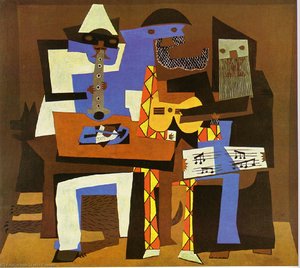
As the movement evolved, it transitioned from the analytical deconstruction of forms into the more additive, playful era of Synthetic Cubism. If the first phase was about taking things apart, this second stage was about putting them back together in unexpected, vibrant ways. This period saw a dramatic shift in palette, reintroducing brighter colors and a much broader range of textures. The focus moved from the dissection of a single subject to the construction of a new reality through the use of collage and mixed media.
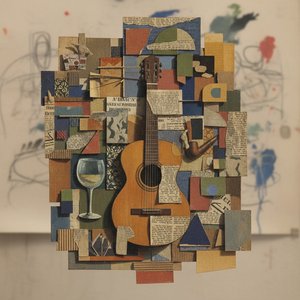
This era introduced the revolutionary concept of assemblage. Artists began incorporating non-traditional materials directly onto the canvas—newspaper clippings, wallpaper, sand, and even pieces of cloth. This technique bridged the gap between high art and everyday life, challenging the sanctity of the painted surface. By layering these disparate elements, the artists created a tactile, rhythmic composition that emphasized the flatness of the canvas while simultaneously providing a rich, sensory experience. The "synthetic" approach allowed for a more decorative and symbolic language, where the texture of the material itself became as much a part of the narrative as the depicted subject.
The Picasso Legacy: From Les Demoiselles d'Avignon to the Mastery of Form
No discussion of the Cubist revolution is complete without centering on the towering figure of Pablo Picasso. His 1907 masterpiece, Les Demoiselles d'Avignon, serves as the seismic precursor to the movement, a work that shocked the art world with its aggressive, angular figures and its infusion of African and Iberian sculptural influences. It was here that the foundations of modernism were laid, as Picasso abandoned the grace of classical anatomy in favor of a raw, confrontable power that prioritized emotional and structural impact over aesthetic prettiness.
Throughout his prolific career, Picasso’s mastery of Cubist principles allowed him to navigate between the analytical and the synthetic with unparalleled fluidity. His ability to manipulate geometric forms—seen in works like Guitar (1920)—demonstrates a profound understanding of how rhythm and space can be orchestrated on a flat surface. Picasso did not merely follow a style; he used Cubism as a language to explore the human condition, war, and identity. His legacy remains the cornerstone of modern art, providing a blueprint for every movement that followed by proving that art need not imitate life to capture its true, multifaceted spirit.
Collecting the Revolution: How Cubist Principles Influence Modern Interior Aesthetics
For the contemporary collector, the influence of Cubism extends far beyond the museum walls. The movement’s emphasis on geometric clarity, structural balance, and the interplay of light and shadow has become a fundamental pillar of modern interior design. The clean lines and rhythmic compositions found in Cubist works resonate deeply with minimalist and mid-century modern aesthetics, offering a sense of intellectual sophistication to any curated space.
Integrating Cubist-inspired elements into a home requires an eye for composition and contrast. A single, bold reproduction of a geometric abstraction can serve as a powerful focal point, anchoring a room with its structural weight. When paired with contemporary furniture—characterized by low profiles and organic shapes—the fragmented planes of Cubism create a dynamic tension that prevents a space from feeling static. The movement teaches us that beauty lies not in the literal representation of objects, but in the harmony of their arrangement and the evocative power of their form.
Beyond the Canvas: Integrating Cubist Fragments into Contemporary Art Collections
As we look toward the future of art collecting, the principles of Cubism continue to offer fresh inspiration for those seeking to build a meaningful and diverse collection. The movement’s core lesson—that reality is multifaceted and subjective—is more relevant than ever in our digital, hyper-connected age. Collectors today are increasingly drawn to works that challenge traditional boundaries, much like the early Cubists did when they first merged painting with collage.
Whether one is acquiring large-scale oil reproductions that celebrate the tactile depth of impasto or exploring new media that utilize digital fragmentation, the spirit of the revolution lives on. The true connoisseur understands that a collection is not merely a gathering of beautiful objects, but a dialogue between different perspectives. By embracing the Cubist ethos of deconstruction and reconstruction, collectors can curate spaces that are not just visually stunning, but intellectually stimulating—a testament to the enduring power of breaking the perspective to find a deeper truth.
At Mus3ums.com, we celebrate this enduring legacy of human creativity. From meticulously handcrafted oil reproductions that capture every textured brushstroke of the masters to bespoke commissions that allow you to reimagine your own world through a Cubist lens, our mission is to make the profound impact of art history accessible to collectors worldwide. Whether you are seeking a museum-quality print or a custom masterpiece, we invite you to explore the infinite facets of art with us.