The Primordial Mark: Tracing the Line from Cave Walls to Classical Mastery
Before the advent of color, before the complexity of shadow and light, there existed only the line. It is the most fundamental gesture of human consciousness, a singular movement that first etched our existence onto the limestone walls of prehistoric caves. In these ancient markings, we find the genesis of all visual storytelling—a raw, unadorned connection between thought and medium. As civilization progressed, this primitive mark evolved into the disciplined precision of the Old Masters. During the Renaissance, the line became a tool of divine geometry; artists like Leonardo da Vinci utilized disegno to define the very boundaries of anatomy and soul. This era taught us that a single, well-placed stroke could convey the weight of a limb or the softness of a gaze, transforming a flat surface into a window of profound depth. To study the history of the line is to witness the refinement of human perception, moving from the instinctual scratch of the ancestor to the calculated elegance of the master.The Architecture of Abstraction: Geometric Precision and the Minimalist Movement
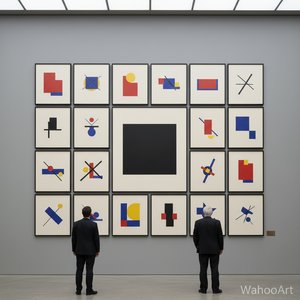
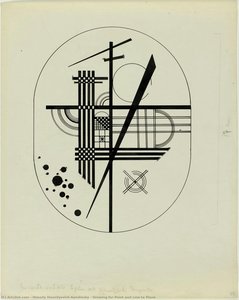
As the centuries unfolded, the line underwent a radical liberation, shedding its duty to mimic reality and instead seeking its own intrinsic truth. The dawn of the 20th century brought a shift toward the structural and the cerebral. We see this metamorphosis clearly in the works of artists like Sol LeWitt, where the line ceases to be a boundary for an object and becomes the object itself. In his Wall Drawing #338, the line is utilized as a mathematical architect, dividing space into precise, rhythmic quadrants that challenge our perception of order and chaos. This era of geometric abstraction stripped away the ornamental, leaving behind a skeletal beauty composed of intersections and trajectories. Here, the line functions with a cold, brilliant clarity, inviting the viewer to contemplate the purity of form and the silent strength of mathematical logic. It is an art of restraint, where every millimeter of ink or graphite carries the weight of intentionality.Emotional Resonance: The Expressive Power of the Gestural Line
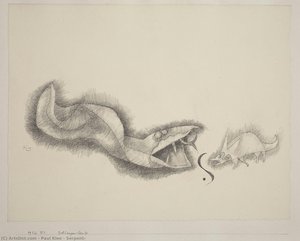
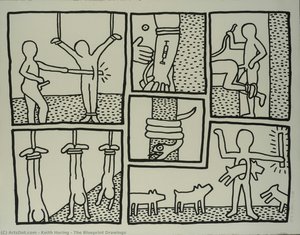
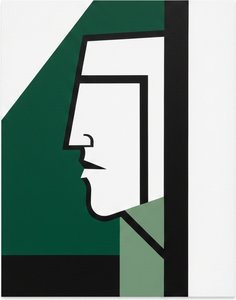
While some lines seek the stability of geometry, others find their purpose in the turbulence of the human spirit. There is a profound, almost visceral power found in the gestural line—a stroke that captures the fleeting energy of a moment or the heavy ache of melancholy. Consider the works of Hryhorii Havrylenko, where black and white lines dance with an expressive, somber intensity, evoking a sense of solitude through their very movement. In these drawings, the line is not merely a boundary but a pulse; it can be jagged and frantic, mirroring anxiety, or smooth and flowing, suggesting tranquility. This is the lineage of the sketch, where the artist’s hand leaves an indelible trace of their emotional state. When we observe a portrait like Joseph Cornell’s minimalist female figure, we are struck by how much can be communicated through a single, serene contour. The line becomes a vessel for empathy, bridging the gap between the artist's internal world and our own.The Interplay of Void and Form: Negative Space in Graphic Artworks
To truly understand the power of the line, one must acknowledge the silence from which it emerges. In the realm of graphic art, the line does not exist in isolation; it is defined by the void it carelates. This interplay between presence and absence—the relationship between the mark and the negative space—is where the true magic of composition resides. A masterfully drawn line creates a tension with the surrounding emptiness, forcing the eye to navigate the "nothingness" as if it were a tangible substance. This balance is essential in creating works that feel breathable and expansive rather than cluttered or suffocating. When an artist utilizes white space effectively, they are not merely leaving a canvas blank; they are composing with light and air. It is this delicate equilibrium that allows a minimalist drawing to command a room, providing a focal point that is both visually striking and intellectually quiet.Curating the Linear Aesthetic: Integrating Line Drawing into Modern Interiors
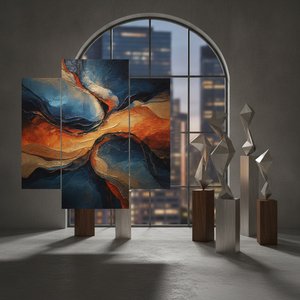
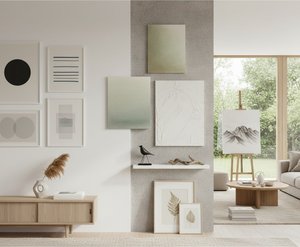
For the discerning collector, integrating line-based artworks into a contemporary environment offers an unparalleled opportunity for sophisticated curation. The inherent clarity of line drawings allows them to act as architectural elements within a room, providing structure without overwhelming the senses. A large-scale, geometric abstraction can serve as a modern anchor for a minimalist living space, while delicate, gestural sketches add layers of intimacy to a private study or bedroom. When selecting pieces, consider how the rhythm of the lines complements the existing textures of your home—the smoothness of marble, the grain of reclaimed wood, or the softness of velvet. By treating line art as a foundational component of interior design, one can create a sanctuary of calm and intellectual depth, where every stroke on the wall echoes the curated elegance of the life lived within.At Mus3ums.com, we celebrate this enduring legacy of human creativity. Whether you are drawn to the disciplined precision of geometric abstraction or the emotive depth of a hand-painted reproduction, our mission is to bring the world's most profound artistic movements into your personal collection. From museum-quality Giclée prints to bespoke oil masterpieces commissioned from academic masters, we provide the bridge between art history and your home.