

Introduction
The British Neoclassical movement emerged as a profound visual response to the Enlightenment, seeking to move away from the perceived frivolity of the Rococo in favor of the structured elegance and moral clarity of antiquity. During the eighteenth and early nineteenth centuries, artists across the United Kingdom looked toward the archaeological discoveries of Pompeii and Herculaneum to rediscover the balanced proportions and idealized forms of Greek and Roman art. This era was defined by a commitment to linear precision, a restrained color palette, and a sense of monumental calm that sought to elevate the viewer through reason and dignity.
These painters were not merely decorators; they were the visual architects of a changing social order. Through their mastery of portraiture and historical composition, they captured the intellectual rigor and the burgeoning sense of national identity that characterized the Georgian and Regency periods. Their work bridged the gap between the aristocratic traditions of the past and the burgeoning humanism of the modern age, utilizing light and shadow to imbue their subjects with a timeless, sculptural quality.
Today, the legacy of these masters remains vital for anyone studying the evolution of Western aesthetics. Their influence persists in the way we perceive formal portraiture and the classical ideal of beauty. By examining the techniques and philosophies of this specific group, we gain insight into a pivotal moment when art became a vessel for civic virtue and historical continuity. The following profiles explore the lives and contributions of ten essential figures who defined this sophisticated era of British art.
George Romney
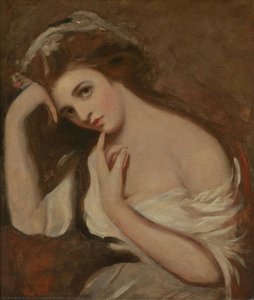 Emma, Lady Hamilton - George Romney
Born in Lancashire in 1734, George Romney’s journey to the pinnacle of British art began in an unlikely setting: a cabinet maker's workshop. The precision required by his father’s trade provided a foundational discipline that would later manifest in his meticulous attention to detail. After a brief apprenticeship, his talent was redirected toward the human form under the guidance of Christopher Steele, eventually leading him to the competitive social circles of London. It was here that he established himself as a formidable contemporary to Thomas Gainsborough, carving out a unique niche within the Neoclassical movement.
Romney belongs to the Neoclassical painters from the United Kingdom due to his ability to infuse portraiture with the movement's signature calm balance and idealized beauty. His work often avoids the chaotic energy of the Baroque, opting instead for a dignified, restrained elegance that mirrors the classical ideals of antiquity. This is masterfully exemplified in his 1791 work, Emma, Lady Hamilton. In this portrait, Romney utilizes a sophisticated glazing technique to create a luminous, psychological depth, capturing the subject with a sense of quiet grandeur and Neoclassical grace that defines the era's aesthetic transition toward Romantic sentiment.
Joshua Reynolds
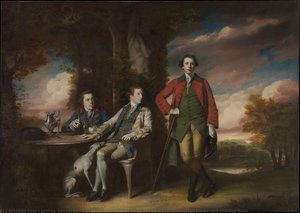 The Honorable Henry Fane (1739–1802) with Inigo Jones and Charles Blair - Joshua Reynolds
As the first President of the Royal Academy, Joshua Reynolds stands as a foundational figure among Neoclassicism painters from United Kingdom. His influence stemmed from a profound commitment to the "Grand Style," a philosophy that sought to elevate British portraiture by infusing it with the dignity, grace, and idealized proportions found in classical antiquity. Rather than mere literalism, Reynolds utilized the principles of Neoclassicism to transform his subjects into figures of timeless elegance, moving beyond simple likeness to capture an essential, noble character.
His mastery of this aesthetic is vividly realized in his 1761 work, The Honorable Henry Fane (1739–1802) with Inigo Jones and Charles Blair. In this monumental composition, Reynolds moves beyond standard portraiture to create a narrative of intellectual and social prestige. By placing these figures within an idealized pastoral landscape, he invokes the calm balance and harmonious compositions characteristic of the classical tradition. The painting serves as a quintessential example of how Reynolds integrated the scholarly ideals of the Enlightenment with the formal rigor of the Neoclassical movement, ensuring his legacy as a primary architect of British artistic identity.
John Hoppner
 Mrs. Richard Bache (Sarah Franklin, 1743–1808) - John Hoppner
A visitor recognizing a work by John Hoppner is immediately struck by a sense of refined elegance and a masterful command of character. His portraiture is defined by a sophisticated use of light that illuminates the complexion of his subjects, paired with a brushwork that balances technical precision with a certain painterly fluidity. As a prominent figure in the British Neoclassicism movement, Hoppner moved away from the heavy ornamentation of previous eras, focusing instead on the calm, dignified presence and clear, idealized forms characteristic of the Neoclassical aesthetic. His ability to capture the psychological depth of the sitter, particularly in his celebrated depictions of women and children, secured his status among the elite painters of the United Kingdom.
Born in London in 1758 to German parents, Hoppner’s journey began in the royal chapel as a chorister before he entered the Royal Academy in 1775. His technical brilliance was quickly validated by the Academy, earning him a silver medal for drawing and a gold medal for his historical composition of King Lear. In his 1793 work, Mrs. Richard Bache, we see this mastery on full display. The portrait utilizes a muted, sophisticated palette and soft, expressive brushwork to render the textures of lace and drapery, presenting the subject with a quiet, introspective dignity that epitomizes the era's high-society portraiture.
Thomas Lawrence
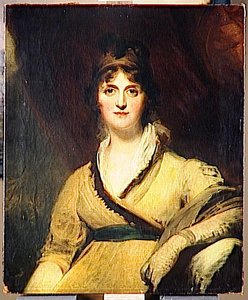 LA COMTESSE D'INCHIQUIN - Thomas Lawrence
Sir Thomas Lawrence (1769–1830) stands as a preeminent figure among British Neoclassical painters, embodying the transition from the structured ideals of the Enlightenment to the expressive vitality of the Regency era. His work is instantly recognizable by a virtuoso handling of paint that balances the disciplined clarity of Neoclassicism with a burgeoning Romantic sensibility. A visitor to his oeuvre will notice a distinctive ability to capture the psychological essence of his subjects, imbuing the aristocracy with a sense of effortless glamour and sophisticated character through fluid, luminous brushwork and a masterful command of light.
In his representative work, La Comtesse d'Inchiquin, Lawrence demonstrates the hallmarks of his style. The portrait utilizes a warm, understated palette and soft, diffused lighting to pull the sitter from a shadowed background, creating a profound sense of depth and presence. His technique relies on the careful layering of thin glazes to achieve a realistic softness in the complexion, contrasted against the more tactile, heavy textures of the drapery. By blending the refined poise of the Neoclassical tradition with a more fluid, organic approach to form, Lawrence secured his place as a master of the British portraiture tradition.
Thomas Sully
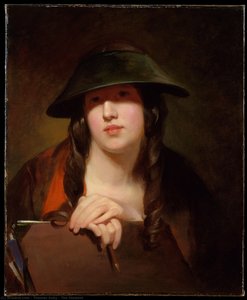 The Student - Thomas Sully
Born in Lincolnshire in 1783, Thomas Sully represents a vital transatlantic link within the Neoclassicism movement. His artistic lineage is rooted in the British tradition, having undergone pivotal studies in London under the esteemed Benjamin West. It was here that Sully absorbed the refined aesthetic of the era, specifically the elegant style and mastery of light championed by Thomas Lawrence. This training allowed him to bridge the gap between the formal clarity of Neoclassicism and the emerging emotional depth of the Romantic period, making him a defining figure for those studying the evolution of British-influenced portraiture.
His 1839 work, The Student, serves as a profound testament to this stylistic synthesis. The painting exemplifies Neoclassical principles through its precise, clear outlines and the organic, balanced composition of the subject. Sully utilizes a sophisticated palette of deep reds and greens, employing dramatic lighting to create a sense of quiet intensity. Through meticulous attention to detail—from the texture of the clothing to the symbolic presence of the sketchbook—Sully captures more than a mere likeness; he captures the very essence of introspection and the intellectual pursuit of art.
Henry Raeburn
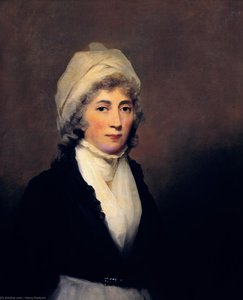 Lady Dalrymple - Henry Raeburn
Sir Henry Raeburn (1756–1823) stands as a preeminent figure among British Neoclassical painters, distinguished by his ability to marry the era's demand for formal dignity with a profound, realistic characterization. While many of his contemporaries focused on the rigid idealism of antiquity, Raeburn’s work often infused Neoclassical poise with a striking, lifelike vitality. His journey from a goldsmith’s apprentice to a master of oil on canvas allowed him to develop a precision of detail that became his hallmark, bridging the gap between the meticulous nature of miniature portraiture and the grand scale of Enlightenment-era portraiture.
In his representative work, Lady Dalrymple, Raeburn demonstrates the quintessential Neoclassical emphasis on composure and structural elegance. The subject is rendered with a contemplative intensity, her presence defined by the dramatic interplay of light and shadow. Through a sophisticated use of chiaroscuro, Raeburn sculpts the figure against a receding, dark background, allowing the luminous textures of her skin and the crisp white of her scarf to emerge with three-dimensional weight. This mastery of light, combined with the restrained, sophisticated attire of the period, exemplifies the refined aesthetic that defined the height of British Neoclassicism.
William Beechey
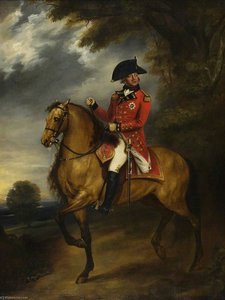 George III (1738–1820), on Horseback - William Beechey
Sir William Beechey (1753–1839) stands as a distinguished figure among British Neoclassical painters, embodying the movement's emphasis on poise, dignity, and the idealized grace of the Georgian era. After being admitted to the Royal Academy Schools in 1772, Beechey’s early development was shaped by the intimate, small-scale portraiture style reminiscent of Johan Zoffany. His ability to infuse his subjects with a sense of calm authority and refined elegance allowed him to rise from a regional painter in Norwich to a premier portraitist in London, eventually earning a reputation for capturing the very essence of the British aristocracy and royalty.
His mastery of the Neoclassical aesthetic is most profoundly realized in his work, George III (1738–1820), on Horseback. In this commanding equestrian portrait, Beechey moves beyond mere likeness to create a visual manifesto of sovereign stability. The composition utilizes the controlled energy and balanced proportions central to Neoclassicism, presenting the monarch with a disciplined strength that mirrors the era's ideals of order and imperial confidence. Through his precise brushwork and sophisticated handling of light, Beechey secured his place alongside his contemporaries as a vital voice in the history of British portraiture.
Charles Howard Hodges
 Portrait of Willem Bilderdijk - Charles Howard Hodges
Charles Howard Hodges (1764–1837) stands as a significant figure among Neoclassicism painters from the United Kingdom, largely due to his ability to marry British technical precision with the formal dignity required by the era's portraiture. Trained initially under John Raphael Smith, Hodges eventually transitioned from his native Portsmouth to the cultural hubs of The Hague and Amsterdam. His work embodies the Neoclassical movement through its emphasis on structured composition, clear outlines, and the depiction of subjects with a sense of intellectual gravity and calm balance.
In his 1810 Portrait of Willem Bilderdijk, Hodges demonstrates the hallmark characteristics of the style. The subject is presented in a contemplative, three-quarter view, surrounded by the symbols of scholarship—stacked books and handwritten papers—which anchor the sitter in a world of reason and order. The use of oil on canvas allows for a sophisticated play of light and shadow, particularly in the way the illumination defines the contours of the face and the crisp texture of the white cravat against the dark frock coat. The deep, red drapery in the background provides a rich, controlled backdrop that directs all focus to the subject's steady, scholarly gaze, epitomizing the dignified restraint central to Neoclassical portraiture.
George Dawe
 Portrait of Dmitry V. Golitsyn - George Dawe
George Dawe stands as a monumental figure among British Neoclassical painters, a master whose brush captured the very essence of an era defined by Napoleonic conflict and imperial grandeur. Born in St James's, United Kingdom, in 1781, Dawe was immersed in an artistic legacy from his earliest years. The son of the celebrated mezzotint engraver Philip Dawe, his foundational training in precise line work and tonal depth would later inform the meticulous, luminous detail found in his most celebrated oil paintings. After earning the prestigious Royal Academy Schools Gold Medal, his ascent through the British art establishment was marked by his election as a full Academician.
However, Dawe’s most enduring historical impact was realized in Saint Petersburg. His relocation to the Russian capital in 1819 led to the creation of the legendary Military Gallery of the Winter Palace, a massive undertaking involving 329 portraits of Russian generals. His Portrait of Dmitry V. Golitsyn (1825) exemplifies this mastery, utilizing the Neoclassical emphasis on order, clarity, and dignified composure to transform a military figure into a timeless icon of authority. Through his controlled brushwork and ability to convey the weight of responsibility, Dawe bridged the gap between British academic precision and the grand scale of imperial portraiture.
Arthur Devis
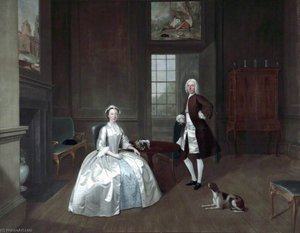 Mr (1703–1745), and Mrs William Atherton - Arthur Devis
Arthur Devis (1712–1787) holds a distinctive position among British Neoclassical painters, specifically through his mastery of the conversation piece. While many of his contemporaries focused on the grand, idealized gestures of the high Neoclassical style, Devis applied the movement's emphasis on clarity, order, and balanced composition to the intimate sphere of domestic life. His work reflects the era's desire for structured, dignified representations of social standing, moving away from the chaotic textures of the previous century toward a more composed and legible realism.
His technical precision is exemplified in his 1743 work, Mr. and Mrs. William Atherton. In this tableau, Devis captures the aristocratic elegance of the period through a meticulous rendering of textures—from the sheen of fine fabrics to the polished surfaces of a richly appointed interior. The painting functions as a window into 18th-century social hierarchies, utilizing directional lighting and a controlled palette to create a sense of three-dimensional space and quiet dignity. Though his career was marked by shifts in fashion, Devis's ability to blend topographical accuracy with portraiture ensures his legacy as a vital chronicler of British social history.
Conclusion
The legacy of British Neoclassical painters lies in their ability to marry the rigorous discipline of classical antiquity with a distinctively British sensibility, blending formal grace with a profound sense of character. From the grand, idealized portraiture of Joshua Reynolds and George Romney to the more intimate, light-drenched depictions of social elegance by Henry Raeburn and Thomas Lawrence, these artists defined an era of visual order and intellectual clarity. Whether through the sweeping narratives of George Dawe or the meticulous precision of Arthur Devis, this movement captured the poise and structural harmony that sought to elevate the human form to a state of timeless perfection.
For those seeking to honor this era of artistic excellence, our full collection offers a gateway to these historical masterpieces. We invite you to bring the dignity and balance of the Neoclassical period into your own environment through our museum-quality, hand-painted oil reproductions, each meticulously crafted to preserve the soul and brushwork of these legendary masters.


