Francisco Barrera: A Voice for Artists in the Shadow of Baroque
In the grand, sweeping narrative of the Spanish Golden Age, names like Velázquez and Zurbarán often command the spotlight, casting long shadows over their contemporaries. Yet, within this era of profound artistic transformation, Francisco Barrera emerged as a figure of singular importance, not merely for the brushstrokes he left upon canvas, but for the courage with which he stood for his peers. Born in Madrid around 1595, Barrera’s life was deeply woven into the vibrant and often turbulent fabric of 17th-century Spanish culture. While his technical mastery placed him firmly within the prestigious traditions of the Spanish Baroque, it was his role as an advocate—a defender of artists' rights against the heavy hand of government taxation in 1640—that cemented his legacy as a man of principle amidst a landscape of shifting political fortunes.
The early years of Barrera’s development were likely shaped by the rigorous training characteristic of the Madrid art scene. Immersing himself in the prevailing aesthetics of his time, he mastered the dramatic interplay of light and shadow known as tenebrism, a technique that allowed him to breathe life into the stillness of his subjects. While many of his contemporaries sought glory through grand religious or historical narratives, Barrera found a profound, quiet power in the depiction of the natural world. He possessed a rare ability to elevate the humble subject matter of the still life into something deeply symbolic and emotionally resonant.
The Symphony of the Seasons
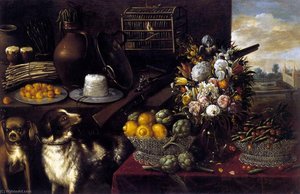
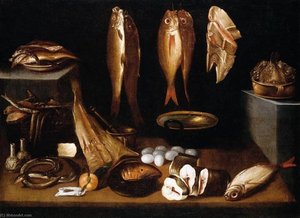
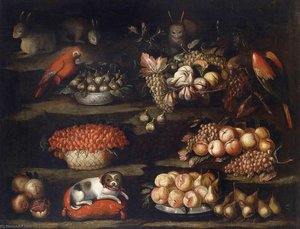
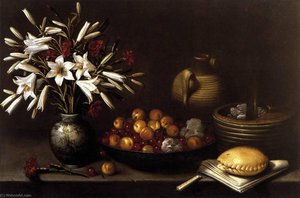
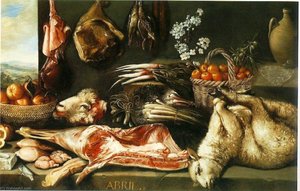
Barrera’s most celebrated achievement lies in his masterful command of the still life genre, particularly through his evocative “Four Seasons” series. These works, dating from approximately 1638, transcend simple botanical illustration to become complex allegorical meditations on existence itself. In these compositions, Barrera utilized a rich, saturated palette to present overflowing displays of seasonal bounty—fruits, vegetables, and flowers arranged with a meticulous, almost theatrical precision upon stone ledges or within window frames.
Each panel serves as a carefully orchestrated narrative of abundance and decay:
- The Vitality of Spring and Summer: Through vivid colors and dynamic arrangements, Barrera captured the warmth and burgeoning energy of the growing seasons, often incorporating animals and lush flora to represent fertility and life's peak.
- The Melancholy of Autumn and Winter: In these more somber movements, the artist utilized the textures of harvest and the starkness of colder months to reflect on the cyclical nature of time and the inevitable passage of all living things.
- Allegorical Depth: Beyond the physical beauty of the produce, Barrera often integrated figures or subtle symbols representing virtues and vices, transforming a simple display of food into a profound commentary on human morality and the rhythms of the natural world.
A Legacy of Artistry and Advocacy
The historical significance of Francisco Barrera extends far beyond the borders of his studio. He remains a vital link in understanding the socio-economic struggles of the 17th-century creator. His documented appeal on behalf of fellow artists against the proposed taxes of 1640 serves as a poignant reminder that the history of art is inseparable from the history of those who labored to create it. He was an artist who understood that the survival of beauty depends upon the protection of the artist.
Today, when we gaze upon his works—such as the delicate Allegory of May or his evocative depictions of seasonal change—we see more than just the mastery of the Spanish Baroque. We witness a painter who could find the infinite within the finite, capturing the fleeting essence of a ripening fruit or a blooming petal with a permanence that defies the very passage of time he so eloquently depicted. His life and work stand as a testament to the enduring power of both the creative spirit and the courageous voice.
Kérdések és válaszok
Milyen más nevét vagy álneveit használ még Francisco Barrera?
Francisco Barrera a következő más néven is ismert: Francisco De Barrera.