

Introduction
Emerging from the vibrant, light-drenched streets of late 19th-century France, the Post-Impressionist movement represented a profound evolution in the history of Western art. While the Impressionists had sought to capture the fleeting, objective effects of light and atmosphere, these French masters felt that the movement lacked structure and emotional depth. They did not seek to merely record the world as it appeared to the eye, but rather to interpret it through the lens of human feeling, memory, and the underlying geometry of nature. This shift moved art away from the purely observational and toward the expressive, paving the way for the radical abstractions of the 20th century.
The cultural landscape of France during this era provided a fertile ground for such experimentation. From the bustling cafes of Montmartre to the quiet, sun-soaked landscapes of the South, these artists pushed the boundaries of color and form. They moved beyond the spontaneous brushstroke to explore more deliberate techniques, such as the meticulous dots of Pointillism or the heavy, textured impasto that gives a canvas a physical presence. Their work was a rebellion against the constraints of realism, favoring instead a subjective truth that prioritized the artist's internal vision over the external reality.
Today, these painters remain essential because they fundamentally changed how we perceive the purpose of art. Their influence is felt in every movement that followed, from Fauvism to Cubism, as they proved that a painting could be a vessel for the soul rather than a mere mirror of life. By examining the lives and legacies of these ten pivotal figures, one gains a deeper understanding of the moment when art broke free from tradition to embrace the infinite possibilities of the human imagination.
Paul Cézanne
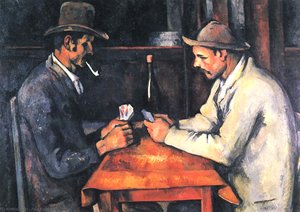 The Card Players - Paul Cézanne
Born in Aix-en-Provence in 1839, Paul Cézanne stands as a monumental figure who bridged the gap between the fleeting light of Impressionism and the structural rigor of Cubism. While his early training at the Free Municipal School of Drawing and the École de dessin d'Aix-en-Provence provided a disciplined foundation, his departure from law to pursue art marked the beginning of a revolution. He belongs to the Post-Impressionist movement because he moved beyond the mere observation of light to analyze the underlying geometric architecture of the natural world.
His masterpiece, The Card Players (1893), exemplifies this shift. In this work, Cézanne moves away from the broken brushstrokes of his predecessors, instead utilizing deliberate, modulated strokes and a palette of earthy tones to instill a sense of permanence and weight. Through his focus on the structural essence of subjects—whether the rugged peaks of Mont Sainte-Victoire or the quiet dignity of Provençal peasants—he transformed the canvas into a space of profound contemplation and formal stability, forever altering the trajectory of modern art.
Paul Gauguin
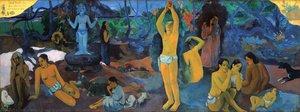 Where do we come from what are we where are we going - Paul Gauguin
Born in Paris in 1848, Paul Gauguin’s journey toward becoming a cornerstone of the Post-Impressionist movement was marked by a profound search for authenticity. His formative years in Peru, characterized by intense colors and sounds, left a sensory imprint that would later define his aesthetic. After a period as a merchant marine and a career in the Parisian financial sector, Gauguin abandoned the predictable life of a stockbroker to pursue a radical new vision of art.
He belongs to the French Post-Impressionist group because he moved beyond the fleeting light of Impressionism, instead utilizing Synthetism. This approach favored subjective emotion and symbolic meaning over realistic depiction, employing flat planes of vibrant color and bold outlines. His fascination with non-Western cultures, particularly his time in Tahiti, allowed him to push the boundaries of shape and feeling further than the eye could see.
His monumental work, Where do we come from what are we where are we going, serves as a philosophical masterpiece. This large-scale, dreamlike composition explores the cycle of human existence through a series of symbolic figures, utilizing a rich, non-naturalistic palette to evoke a sense of the mystical and the profound.
Henri De Toulouse-Lautrec
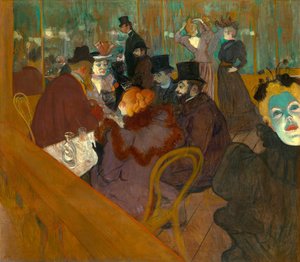
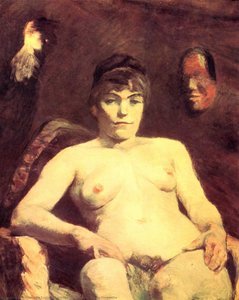
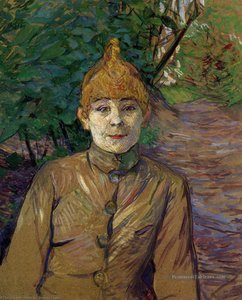
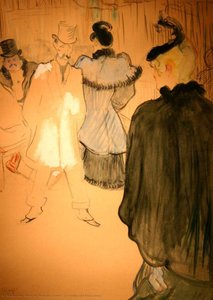
Born into the French aristocracy in 1864, Henri de Toulouse-Lautrec chose a life far removed from the quiet prestige of his lineage. Rather than retreating into the seclusion of his class, he immersed himself in the restless, electric energy of the Parisian streets. His work serves as a profound documentation of the Belle Époque, capturing the human condition through the lens of the bohemian nightlife and the fringes of society.
Toulouse-Lautrec is a vital figure among French post-impressionist painters because he moved beyond the mere observation of light to explore the psychological depth and expressive form of his subjects. He utilized bold, rhythmic lines and a vibrant palette to convey the movement and decadence of the era. His masterpiece, At the Moulin Rouge, exemplifies this approach, using energetic brushwork to freeze a fleeting moment of social interaction within the iconic cabaret. Through his mastery of caricature and printmaking, he transformed the ephemeral scenes of dance and conversation into enduring symbols of a changing world, prioritizing the emotional truth of the scene over strict anatomical or perspectival accuracy.
Paul Signac
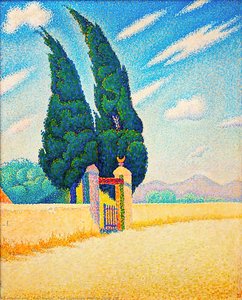 Two Cypresses, Mistral, Opus 241 - Paul Signac
In the masterpiece Two Cypresses, Mistral, Opus 241, painted in 1893, the viewer encounters a world where light does not merely fall upon objects but seems to vibrate from within them. This work serves as a profound testament to the rhythmic, breathing power of Neo-Impressionism. Through his revolutionary application of Pointillism, Paul Signac moved beyond the spontaneous, fleeting strokes of his predecessors to embrace a disciplined, almost scientific approach to color theory. By meticulously applying countless tiny dots of pure, unblended pigment, he trusted the human eye to perform the optical blending of light.
Born in Paris in 1863, Signac became a central figure in the French post-impressionist movement by pushing the boundaries of how we perceive color and form. His work is defined by a deep, lifelong connection to the Mediterranean coast, where the shifting light of the sea and the energy of the Mistral wind informed his palette. Unlike the Impressionists who sought to capture a passing moment, Signac sought a permanent, harmonious order. His canvases often feature luminous coastal scenes and architectural landscapes, rendered with a geometric precision that marries the precision of science with the deep, tranquil feelings of the artist.
Édouard Vuillard
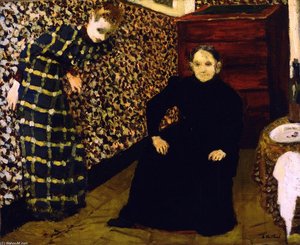 Interior, Mother and Sister of the Artist - Édouard Vuillard
Édouard Vuillard (1868–1940) occupies a singular position within the French post-impressionist movement, distinguished by his ability to push beyond the fleeting light of Impressionism toward a more structured, decorative, and psychological exploration of space. As a prominent member of the Nabis group, Vuillard moved away from purely naturalistic representation, instead using flattened planes and intricate patterns to evoke the emotional essence of a scene. His work is instantly recognizable by its intimate domesticity, where figures often appear to merge with their surroundings through a complex interplay of wallpaper, textiles, and muted, tonal colors.
In his 1893 masterpiece, Interior, Mother and Sister of the Artist, Vuillard demonstrates this characteristic synthesis of fine art and decorative pattern. The composition eschews traditional linear perspective in favor of a sophisticated layering of textures, a technique that defines the post-impressionist departure from mere visual imitation. His training at the Académie Julian and under masters like Diogène Maillart provided the technical rigor that allowed him to masterfully manipulate light and color, creating a sense of quiet, rhythmic resonance that transforms a simple household setting into a profound study of human presence and environmental texture.
Pierre Bonnard
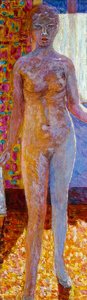 Nude - Pierre Bonnard
Born in 1867 in Fontenay-aux-Roses, Pierre Bonnard emerged from a structured family background to become a pivotal figure in the evolution of modern art. After studying at the Ecole des Beaux-Arts and the Academie Julian, he moved away from academic rigidity to join the avant-garde circle known as Les Nabis. His work represents a vital bridge in the history of French post-impressionist painters, as he transitioned from the fleeting light of Impressionism toward a more symbolic, decorative, and emotive language. Unlike the pure naturalism of his predecessors, Bonnard utilized color and form to express internal sensations rather than mere visual facts.
In his 1920 work, Nude, this mastery of Intimism is profoundly evident. The piece showcases a delicate balance between realism and stylization, using vibrant, layered brushwork to explore themes of vulnerability and introspection. By prioritizing the subjective experience of light and atmosphere, Bonnard solidified his place among the most significant French post-impressionist painters, using the canvas to transform mundane domesticity into a profound, mystical exploration of the human form.
Maurice Utrillo
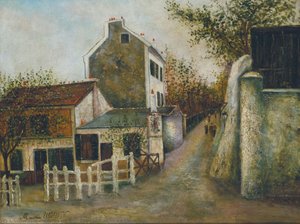 The Lapin Agile [Le Lapin Agile] - Maurice Utrillo
Born Maurice Valadon in 1883, the artist known as Maurice Utrillo was a product of the bohemian Montmartre district. Raised in a creative but turbulent environment by his mother, the artist Suzanne Valadon, he received no formal academic training. Instead, his education was a visceral, self-taught journey through the streets of Paris. His work is defined by a profound emotional resonance, often serving as a psychological anchor amidst personal struggles with isolation and illness. This focus on subjective feeling and the expressive use of texture is precisely what places him within the Post-Impressionist movement; he moved beyond the mere observation of light to capture the heavy, melancholic soul of the urban landscape.
Utrillo is most celebrated for his distinctive "White Period," a phase where he utilized a heavy impasto technique to create sculptural, tactile surfaces. In his 1913 masterpiece, The Lapin Agile, he captures the essence of Parisian nightlife. Rather than relying on the bright, fleeting colors of his predecessors, he employs a sophisticated, almost monochrome palette of whites, grays, and blacks. This technique mimics the weathered plaster of Montmartre, transforming a simple street scene into a profound, atmospheric nocturne that prioritizes the emotional weight of the setting over photographic accuracy.
Paul Sérusier
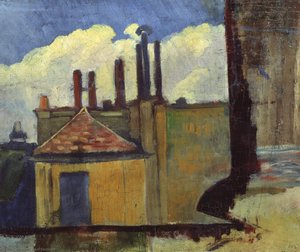 Roof Tops in Paris - Paul Sérusier
A visitor can recognize a work by Paul Sérusier by its striking departure from naturalistic depth, favoring instead a flattened, decorative space defined by bold, rhythmic contours. His technique, known as Cloisonnism, utilizes distinct planes of pure color separated by dark outlines, much like the enamelwork of the Middle Ages. This approach moves beyond the fleeting light of Impressionism to prioritize the artist's internal perception and the structural essence of the subject.
Sérusier’s place within the French post-impressionist movement is cemented by his radical rejection of academic realism. Following his time in Pont-Aven under the influence of Paul Gauguin, he became a pioneer of the Synthetist style, emphasizing simplified forms and emotional resonance over photographic accuracy. His 1888 work, The Talisman, serves as a foundational moment for this movement, pushing art toward the threshold of abstraction.
In his evocative work Roof Tops in Paris, Sérusier captures a quiet, melancholic urban moment. Rather than blending tones, he employs a mosaic-like application of color to render the cityscape, using the interplay of warm yellows and sharp reds to evoke a subjective, atmospheric experience of the Parisian skyline.
Edouard Cortès
 Waiting for The Practice - Edouard Cortès
Born in Lagny-sur-Marne in 1882, Édouard Cortès was a painter who famously declared himself "a student of myself only," a testament to the fiercely independent spirit that defined his career. While he received formal training at the École des Beaux-Arts in Paris, his work moved beyond the mere observation of light to capture the emotional atmosphere of the city. This focus on subjective perception and the expressive use of color firmly places him among the French post-impressionist painters, as he sought to convey the soul of Paris rather than just its architecture.
His representative work, Waiting for The Practice, serves as a profound example of this approach. In this oil on panel, Cortès captures a quiet, reflective moment of anticipation. Rather than focusing on grand historical narratives, he elevates a simple scene of a woman beside a flower cart into a study of light and texture. Through bold, palpable brushstrokes and a masterful command of color, he transforms a fleeting Parisian second into a timeless tableau, bridging the gap between the fleeting impressions of the previous generation and the deeper, more structured emotionality of the post-impressionist era.
Suzanne Valadon
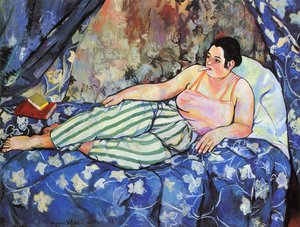 The Blue Room - Suzanne Valadon
Suzanne Valadon (1865–1938) stands as a singular force within the French post-impressionist movement, distinguished by her ability to transcend the mere observation of light to capture the psychological weight of her subjects. While many of her contemporaries focused on the fleeting effects of Impressionism, Valadon utilized the post-impressionist emphasis on subjective feeling and structural form to assert a uniquely feminine perspective. Her journey from a model for masters like Renoir and Degas to a formidable painter allowed her to infuse her work with an intimate, often subversive, understanding of the human form.
Her 1923 masterpiece, The Blue Room, serves as a profound testament to this stylistic evolution. In this work, she moves beyond traditional academicism, employing the expressive brushwork and textured surfaces characteristic of the post-impressionist era. The painting utilizes a sophisticated, high-contrast color palette—juxtaposing cool, atmospheric blues against warm, vibrant tones—to create a sense of modern introspection. Through this deliberate use of broken color and heavy pigment, Valadon does not merely depict a scene; she reconstructs the emotional atmosphere of the interior, cementing her legacy as a pioneer who redefined the boundaries of the female gaze in modern art."
Conclusion
The legacy of these French post-impressionist painters lies in their collective refusal to merely document the world as it appeared. From the structural rigor of Cézanne to the emotive, saturated palettes of Gauguin and Signac, each artist expanded the boundaries of visual language, moving beyond the fleeting light of Impressionism toward a deeper exploration of form, color, and psychological depth. Whether through the intimate, domestic scenes of Bonnard and Vuillard or the vibrant, urban energy captured by Toulouse-Lautrec, these masters redefined the relationship between the artist's perception and the canvas.
For those seeking to bring this transformative era into a private space, our full collection offers a gateway to these historic visions. We specialize in museum-quality, hand-painted oil reproductions that honor the specific textures and brushwork of these masters. By choosing a bespoke, handmade work, you can experience the tactile soul of these masterpieces, allowing the profound emotional resonance of French post-impressionism to become a permanent part of your home.


