


Introduction
The first decade of the twentieth century in Russia was a period of profound metamorphosis, a time when the boundaries of traditional representation began to dissolve into the vibrant currents of modernity. This era was defined by a tension between the deep, soulful roots of Slavic realism and the radical, experimental energy of the avant-garde. As the empire stood on the precipice of monumental social change, artists found themselves navigating a landscape where the old world of academic precision met the new world of abstraction, color theory, and spiritual expressionism.
This collection of works captures a pivotal moment in art history, where the heavy, narrative-driven traditions of the previous century gave way to the luminous impressions of Konstantin Korovin and the psychological depth of Valentin Serov. It was a decade of intense searching, where painters sought to translate the rhythm of modern life and the unseen spiritual essence of the Russian soul onto canvas. From the lush, folkloric celebrations of Boris Kustodiev to the early, transformative abstractions of Wassily Kandinsky, the art produced between 1900 and 1909 represents a bridge between the classical past and the fractured, kaleidoscopic future of the twentieth century.
Today, these masterpieces remain vital because they embody the very essence of artistic revolution. They serve as a testament to the power of color and form to transcend national borders, influencing movements from Fauvism to Surrealism. By examining these ten significant works, we trace the evolution of a visual language that was simultaneously deeply local and intensely universal, offering a window into a world that was being reimagined through every brushstroke.
Arabs I (Cemetery) - Wassily Kandinsky
 Arabs I (Cemetery) - Wassily Kandinsky
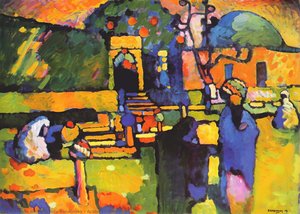
Wassily Kandinsky's 1909 work, Arabs I (Cemetery), serves as a profound threshold between the representational world and the burgeoning realm of pure abstraction. As a pivotal piece from the first decade of the 1900s, it captures the artist's deliberate dismantling of traditional form in favor of a deeper emotional resonance. The painting depicts a rural landscape where figures are engaged in ambiguous activities—some seated, others walking—within a setting that suggests a procession or gathering. Rather than adhering to the strict naturalism of the previous century, Kandinsky utilizes a highly expressive language of color and form to convey an inner spiritual state.
The composition is characterized by a dynamic, almost chaotic energy, utilizing thick impasto brushstrokes and angular, fragmented lines that eschew traditional perspective. The color palette is intensely saturated and non-naturalistic, employing hues of rose, ochre, and lavender that intermingle with deep Prussian blues. This interplay of light and shadow, combined with geometric shapes like triangles and curves, creates a sense of movement and heightened emotion. Through this gestural technique, Kandinsky moves away from imitating nature, instead using the canvas to explore themes of alienation and the rhythmic, musical interplay of the soul.
Interior (My dining room) - Wassily Kandinsky
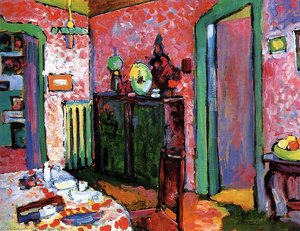 Interior (My dining room) - Wassily Kandinsky
Upon encountering Wassily Kandinsky's Interior (My dining room), the viewer is immediately struck by a vibrant, almost chaotic domesticity. The eye is drawn to a central table draped in a red-and-white checkered cloth, set against a backdrop of deep reddish-pink walls. A dark green cabinet stands as a heavy, grounding presence, while a lamp casts an artificial glow that defines the volume of the room. The composition is masterfully asymmetrical, utilizing open doorways to suggest a depth that transcends the flattened perspective of the scene. Through thick impasto brushstrokes and a non-naturalistic palette of intense oranges, yellows, and greens, Kandinsky prioritizes emotional resonance over strict spatial accuracy.
This work is a quintessential example of Russian art from the 1900s, capturing the transitional energy of the era. Created in 1909, it sits at the intersection of Post-Impressionism and the burgeoning Fauvist movement. It showcases the early stylistic evolution of a Russian pioneer who would eventually lead the Blue Rider movement, moving away from traditional representation toward the spiritual, musical interplay of color and form that defined the decade's avant-garde spirit.
Portrait of Fedor Chaliapin - Konstantin Korovin
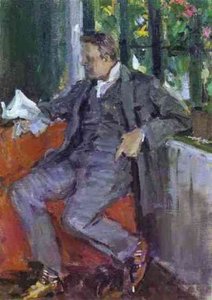
In this 1905 masterpiece, Konstantin Korovin captures a profound moment of stillness that defines the expressive potential of Russian Impressionism during the 1900s. The Portrait of Fedor Chaliapin moves away from the grandiosity of the opera stage, presenting the legendary bass singer in a state of intimate, relaxed repose. Seated upon a vibrant red sofa, Chaliapin is stripped of his theatrical persona, offering instead a glimpse of the man behind the voice.
Korovin’s technical mastery is evident in his fluid, loose brushwork and his ability to sculpt form through light rather than rigid outlines. Natural illumination streams from a nearby window, casting a soft glow across Chaliapin’s features and creating a shallow, intimate perspective. The composition relies on a sophisticated interplay of color: the muted grays and blues of the subject’s attire provide a striking contrast to the intense crimson of the upholstery, while lush greenery visible through the window adds a sense of vitality. This work remains a quintessential example of how Korovin utilized atmospheric light and spontaneous texture to elevate portraiture into a study of character and quiet grandeur.
Moscow in 1905 - Boris Kustodiev
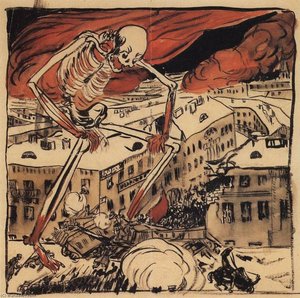 Moscow in 1905 - Boris Kustodiev
The eye is immediately arrested by a haunting, surrealist vision of urban devastation: a skeletal figure, dressed incongruously in a formal suit and tie, stands atop a mound of rubble. This central, eerie figure brandishes a defiant red flag against a backdrop of crumbling architecture, symbolizing the violent upheaval of the era. Scattered around this central monument are indistinct figures—soldiers and weary civilians—navigating a landscape of broken order and smoke. The composition creates a profound sense of chaos, capturing a city caught in the throes of revolutionary fervor.
This work is a quintessential representative of Russian artworks of the 1900s, as it captures the intense sociopolitical transformations defining the decade. Through his mastery of realism, Boris Kustodiev moves beyond mere depiction to embrace a dramatic, almost expressionistic intensity. By blending his signature vibrant palette with the grim realities of conflict, he documents the tension between the traditional merchant life he often celebrated and the shattering of the old world order. The painting serves as a powerful historical testament to the turbulent spirit of Russia during this pivotal decade.
The Model - Konstantin Somov
 The Model - Konstantin Somov
Created around 1903, The Model serves as a profound testament to the draftsmanship of Konstantin Somov, a pivotal figure in the Russian art of the 1900s. This work exemplifies the intersection of the Mir iskusstva movement and a refined Rococo sensibility, capturing a moment of quiet, introspective grace. The piece is a masterful study of the human form, rendered with a sketch-like immediacy that suggests a spontaneous observation of beauty.
The composition is vertically oriented, centering on a seated female figure whose relaxed, contemplative posture evokes a sense of vulnerability. Using a monochromatic palette of nuanced grays, Somov employs loose, gestural lines and delicate hatching to build tonal depth. The chair provides a structural anchor, its organic curves harmonizing with the fluid anatomy of the sitter. Through soft, diffused lighting and a focus on the downward gaze of the model, the artwork transcends a mere anatomical study, becoming a reflective exploration of melancholy and poise that defines the aesthetic spirit of the early twentieth century.
The Ghosts of Hellas - Vasily Polenov
 The Ghosts of Hellas - Vasily Polenov
Created in 1905, The Ghosts of Hellas serves as a profound example of the lyrical realism that defined Russian art during the first decade of the 20th century. Vasily Polenov, a leading figure of the Peredvizhniki movement, moves away from heavy, dramatic compositions to embrace a more meditative, humanist approach to the classical world. This watercolor captures a serene Mediterranean landscape where the boundary between the present and antiquity feels remarkably thin.
The composition centers on a striking interplay of light and shadow. To the left, a woman in classical attire gazes toward the calm sea, her presence adding a layer of quiet contemplation to the coastal setting. In the center, a muscular figure—resembling a statue caught in a moment of frozen action—is illuminated by a warm, celestial light. Polenov utilizes the inherent softness of the watercolor medium to achieve luminous washes and gentle transitions, avoiding harsh brushstrokes. The result is an atmosphere that feels both grounded in reality and filtered through a dreamlike lens, evoking a sense of timelessness and the enduring echoes of ancient Greek culture.
Saviour Almighty - Nicholas Roerich
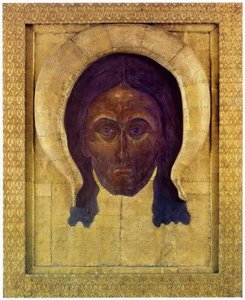 Saviour Almighty - Nicholas Roerich
Painted in 1907, Saviour Almighty stands as a profound testament to the spiritual depth of Nicholas Roerich’s early career. As a prominent figure in the Russian Symbolist movement, Roerich utilized this period to explore themes of Eastern mysticism and religious transcendence, making this work a quintessential example of Russian art from the 1900s. The piece moves away from mere portraiture, instead functioning as a meditative icon that bridges the gap between the earthly and the divine.
The composition is heavily indebted to the traditions of Byzantine iconography. Roerich employs a specific visual language to evoke an ethereal atmosphere, characterized by:
- Stylized Form: The elongated features of Christ emphasize a sense of spiritual majesty rather than anatomical realism.
- Emotional Resonance: The subject’s expression carries a palpable sense of sorrow and distress, inviting deep contemplation.
- Luminous Background: The use of an ornate, gold-toned background creates a sense of infinite depth, isolating the figure in a realm of sacred light.
Through this work, Roerich demonstrates how the aesthetic sensibilities of the early 20th century could be used to revitalize ancient religious motifs, creating a mysterious and powerful visual experience.
The Last Judgement - Viktor Vasnetsov
 The Last Judgement - Viktor Vasnetsov
Painted in 1904, The Last Judgement stands as a profound testament to Viktor Vasnetsov’s ability to synthesize academic realism with the spiritual depth characteristic of Russian art during the first decade of the 1900s. Commissioned by Yu. S. Nechayev-Maltsev for St. George’s Cathedral in Gus-Khrustalny, this oil on canvas was designed to serve a sacred architectural purpose, necessitating a composition of immense solemnity and scale.
Vasnetsov utilizes a dramatic vertical and horizontal division to illustrate the theological separation of realms. The central composition features a celestial procession of angels and saints ascending upon luminous clouds, their divine status marked by subtle halos. This ethereal movement is contrasted sharply with the left side of the canvas, where the artist depicts the descent into hell. In this darker realm, demons and sinners are rendered in somber, espresso tones, capturing a sense of profound distress and torment. Through this masterful use of light and shadow, Vasnetsov transforms a complex religious narrative into a vivid, dramatic visual experience, bridging the gap between traditional iconography and the evolving symbolic language of the early 20th century.
Still Life with Flask, Fruit and Figure - Alexej von Jawlensky
 Still Life with Flask, Fruit and Figure - Alexej von Jawlensky
Painted in 1907, Still Life with Flask, Fruit and Figure serves as a profound testament to the shifting paradigms of Russian art during the first decade of the 1900s. In this work, Alexej von Jawlensky moves beyond mere representation, utilizing the still life as a vehicle for intense emotional expression. The composition features a table laden with apples, oranges, and bananas, alongside bowls and vases, creating a scene that feels both domestic and mysterious. The inclusion of a seated figure introduces a layer of quiet contemplation, transforming a kitchen setting into a space of psychological depth.
Jawlensky’s technique in this period highlights the emergence of Expressionism, characterized by a rhythmic and simplified approach to form. Rather than seeking photographic accuracy, he employs a vigorous, tactile application of paint to create a surface that vibrates with energy. The color palette, often dominated by nuanced grays and clashing tones, eschews traditional blending in favor of raw, instinctual application. This piece exemplifies how Russian artists of the 1900s began to prioritize the internal essence of their subjects over the external reality of the physical world.
Portrait of Anton Chekhov - Valentin Serov
 Portrait of Anton Chekhov - Valentin Serov
Upon first encounter, the viewer is met with the profound, weathered gaze of a man whose presence is defined by a prominent beard and an aura of deep introspection. Valentin Serov’s 1903 Portrait of Anton Chekhov is a masterful study in psychological depth, capturing a sense of quiet observation and perhaps a touch of weariness. This work exemplifies the Russian artistic output of the 1900s through its sophisticated blend of Impressionistic light and realistic character study, a hallmark of the era's evolving aesthetic.
The composition focuses tightly on the subject's face and upper torso, utilizing a medium-toned palette of browns, pinks, and creams to evoke a sense of age and experience. Serov employs a loose, expressive technique, where organic, flowing lines define the contours of the face rather than rigid outlines. Through the deliberate use of impasto, the artist applies thick, visible strokes of oil on canvas, creating a tactile texture that lends the portrait a physical, living quality. The subtle layering of paint and blurred edges create a shallow perspective, drawing the observer into an intimate, reflective encounter with the sitter.
Conclusion
The dawn of the twentieth century in Russia was a period of profound artistic metamorphosis, where the boundaries between traditional realism and the radical energy of modernism began to dissolve. From the vibrant, impressionistic brushwork of Korovin to the spiritual abstractions of Kandinsky, these works capture a decade defined by intense color, psychological depth, and a search for new visual languages. Whether through the nostalgic charm of Kustodiev’s scenes or the structural experiments of the avant-garde, this collection represents a pivotal moment when Russian art moved toward the future while remaining deeply rooted in its unique cultural soul.
At Mus3ums.com, we invite you to bring this transformative era into your own space. Our master artists specialize in creating museum-quality, hand-painted oil reproductions that preserve the tactile texture and emotional resonance of these masterpieces. You can explore our full collection to find the perfect piece and experience the enduring beauty of these Russian treasures through a living, breathing work of art.


