

Introduction
The 20th century marked a profound metamorphosis for Chinese art, as painters navigated the complex intersection of ancient tradition and rapid modern transformation. This era was defined by a dynamic tension between the classical mastery of ink wash and calligraphy and the bold, expressive influx of Western techniques like Impressionism and Cubism. As the country moved through decades of intense social change, artists became the visual chroniclers of a shifting identity, blending the spiritual depth of the literati tradition with a new, globalized visual language.
What unites these masters is their ability to preserve the essence of the landscape and the human spirit while embracing the experimental spirit of modernity. Whether through the delicate brushwork of traditional landscapes or the vibrant, textured applications of oil on canvas, these artists redefined what it meant to be a painter in a changing world. Their work remains vital today, offering a bridge between the profound stillness of the past and the kinetic energy of the contemporary era.
In the following sections, we examine ten significant figures who shaped this artistic evolution, including the evocative works of Chen Chong Swee, the expressive mastery of Lim Cheng Hoe, and the modern sensibilities of Yeh Chi-Wei, tracing the diverse paths they took to redefine Chinese aesthetics for a new century.
Yun Dong-Ju
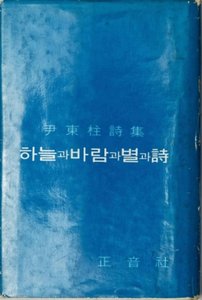 Sky and Wind and Star and Poem - Yun Dong-Ju
Born in Longjing, Jilin, China, in 1917, Yun Dong-Ju remains a profound figure within the landscape of 20th century Chinese painters due to his formative years and the cultural intersection of his upbringing. His artistic identity was forged through a rigorous education at Myeongdong School, Soongsil Middle School, and Yonhi College, eventually evolving during his studies at Kyoto Doshisha University in Japan. His presence in this era is defined by a poignant fusion of lyrical expression and political resistance.
While primarily celebrated for his evocative poetry, Yun’s visual sensibility was deeply informed by the Bunjinga art movement, which prioritized personal interpretation and individual spirit over rigid technicality. This influence is palpable in the emotional resonance of his rare paintings, which mirror the depth of his verses. His most enduring legacy is encapsulated in the symbolic weight of Sky and Wind and Star and Poem, a title that evokes the celestial motifs central to his soul. His life was tragically cut short in 1945, but his ability to translate the struggle for identity into both word and image ensures his place in the modern history of the region.
Chen Chong Swee
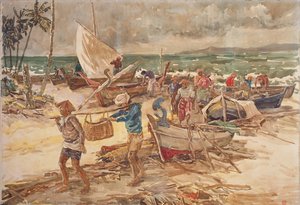 Returning from the Sea - Chen Chong Swee
In his 1972 masterpiece, Returning from the Sea, Chen Chong Swee orchestrates a breathtaking panoramic vision of coastal life. Through a delicate fusion of watercolor and ink, he captures a sun-drenched beach where the rhythmic pulse of the tides meets the quiet vitality of human presence. The composition unfolds with hypnotic atmospheric depth, portraying figures scattered along the shoreline and boats resting near the gentle surf, creating a sense of profound tranquility.
Born in China in 1910, Chen Chong Swee represents a vital link in the history of 20th century Chinese painters through his role in evolving traditional aesthetics into a modern, regional identity. After receiving rigorous training at the prestigious Xinhua Academy of Fine Arts in Shanghai, he brought his mastery of classical Chinese ink wash and calligraphy to Southeast Asia. As a pioneer of the Nanyang Style, he revolutionized the medium by infusing disciplined Eastern techniques with the luminous textures and vibrant light of the tropics. His work is characterized by a serene, calm emotional tone, often utilizing a palette of driftwood tones to depict bustling marketplaces, tranquil kampongs, and the timeless grace of maritime landscapes.
Full Name In English Not Provided
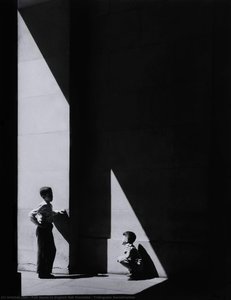 Triângulos Semelhantes - Full Name In English Not Provided
The artistic legacy of Full Name In English Not Provided represents a fascinating intersection of historical tradition and the evolving visual language of the 20th century. While his roots trace back to the scholarly traditions of the Qing Dynasty, his presence in the 20th-century landscape is marked by a profound shift in how light and form are captured. This transition from the classical ink landscapes of his ancestors to the stark, dramatic compositions of the modern era defines his unique position among 20th century Chinese painters.
His representative work, Triângulos Semelhantes (1949), serves as a testament to this stylistic evolution. Moving away from the ethereal mountain vistas of his lineage, this piece utilizes the medium of black and white photography to explore the geometry of the modern world. The composition is a masterclass in chiaroscuro, where sharp, diagonal shadows cast by sunlight intersect with architectural lines to create a structured, high-contrast environment. Through the depiction of childhood and urban geometry, the work captures a melancholic, dramatic essence that reflects the shifting social and visual realities of China during the mid-20th century.
Lim Cheng Hoe
 The Old Sikh - Lim Cheng Hoe
Born in Xiamen, China, in 1912, Lim Cheng Hoe represents a vital link in the history of 20th-century Chinese painters, specifically through his role in bridging traditional heritage with Western modernism. After relocating to Singapore at age seven, he moved away from purely classical Chinese aesthetics to embrace Western art education. This unique trajectory, shaped by his studies at Raffles Institution under Richard Walker, allowed him to become a pioneering force in Southeast Asian watercolorism while maintaining his cultural roots.
His mastery of the medium is profoundly evident in his 1937 work, The Old Sikh. In this piece, Lim moves beyond mere portraiture to create a meditative study of character. Using a rich, earthy palette of putty and deep browns, he captures the subject with a sense of timeless solemnity. The meticulous rendering of the turban and the textured detail of the beard imbue the figure with a palpable sense of dignity and lived experience. Through such works, Lim Cheng Hoe demonstrated how the 20th-century Chinese diaspora could synthesize diverse influences into a singular, expressive artistic voice.
Yeh Chi-Wei
 Women of the Philippines - Yeh Chi-Wei
A pivotal figure in the evolution of modern Asian aesthetics, Yeh Chi-Wei represents the profound cultural shifts experienced by 20th century Chinese painters. Born in Fuzhou, China, in 1913, his artistic identity was forged through a rigorous education at the Xinhua Academy of Fine Arts in Shanghai, where he graduated in 1936. This foundational training in China allowed him to later become a trailblazer in the Southeast Asian art landscape, specifically within Singapore, where he served as an influential educator for decades.
His work is characterized by a quiet, contemplative elegance, often featuring elongated figures set against textured, muted color fields. This stylistic choice creates a sense of timelessness and grace. In his representative work, Women of the Philippines (1976), one can observe his mastery of composition and his ability to blend Asian sensibilities with the vibrant essence of Southeast Asian life. Through his unique visual language, Yeh Chi-Wei bridged the gap between his Chinese heritage and his adopted home, leaving an indelible mark on the history of 20th century art.
Hsiao Chin
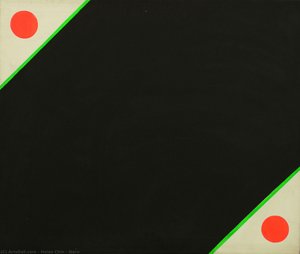 Nero - Hsiao Chin
A pivotal figure in the evolution of modern Asian art, Hsiao Chin represents the dynamic spirit of 20th century Chinese painters through his ability to synthesize heritage with global movements. Born in 1935, his journey began with a rigorous foundation in traditional Chinese painting at the Guangzhou Academy of Fine Arts. However, his artistic trajectory shifted significantly when he moved to Taiwan, eventually embarking on a transformative trip to New York in 1967. This exposure to Western abstraction allowed him to move beyond classical motifs, integrating a bold, modern sensibility into his practice.
His 1967 work, Nero, serves as a profound testament to this stylistic evolution. In this piece, the artist moves away from purely representational forms toward an intuitive, geometric abstraction. The composition is defined by a heavy, obsidian-like field of black that creates a sense of physical weight, interrupted by a sharp, diagonal streak of green and a stark white wedge. A single red circle acts as a rhythmic pulse, anchoring the tension between the flat planes. Through such works, Hsiao Chin bridged the gap between the calligraphic traditions of his youth and the hard-edged, high-contrast language of international modernism.
Liu Kang
 Batik Workers - Liu Kang
A visitor can immediately recognize a work by Liu Kang through his incredibly vibrant color palette and the palpable, expressive texture of his brushwork. Moving away from the constraints of strict realism, he embraced an emotive style that captures the very essence of light and atmosphere. His canvases are characterized by a sense of immediacy and vitality, often utilizing bold, thick applications of oil paint to convey the warmth of his subjects.
As a prominent figure among 20th century Chinese painters, Liu Kang’s journey reflects the era's profound cultural shifts. Born in Henan, China, his artistic evolution was deeply influenced by the principles of traditional Chinese art, yet his vision expanded significantly through his immersion in Southeast Asian life. This unique fusion of his Chinese heritage and the tropical landscapes of Southeast Asia allowed him to become a pioneer of modern art in the region.
His mastery of the medium is beautifully exemplified in his representative work, Batik Workers. In this piece, he captures the rhythmic essence of cultural practice through a joyful and bold composition, showcasing the skillful rendering of light and shadow that defines his celebrated legacy.
Lin Shu
 The Poetry Cottage - Lin Shu
Lin Shu (1852–1924) occupies a singular position in the history of 20th century Chinese painters and intellectuals, acting as a bridge between ancient tradition and the modern era. Although primarily celebrated as a monumental literary translator who brought Western fiction to China through classical Chinese, his visual legacy is deeply intertwined with the aesthetic sensibilities of his time. His work belongs to this 20th century group as his artistic and intellectual influence shaped the cultural landscape during the transition from the Qing dynasty to the modern age.
In his representative work, The Poetry Cottage (1914), we see the profound intersection of his Confucian scholarship and his reaction to a changing world. The painting, characterized by a subtle gray palette, depicts a cottage nestled within bamboo, evoking the melancholic longings of the yimin—those who felt left behind by the shifting tides of history. His landscape style, rooted in the traditions of Wen Zhenming and Daoji, reflects a deep reverence for classical aesthetics even as he engaged with the globalized ideas of the early 1900s.
Jin Shaofang
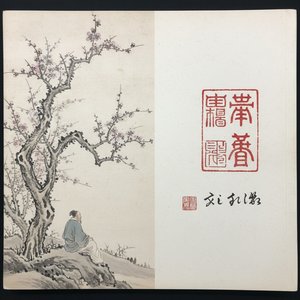
 Carved fan with plum-blossom painting - Jin Shaofang
Jin Shaofang (1890–1979) represents a singular intersection of technical precision and traditional aesthetics within the landscape of 20th century Chinese painters. Born in Nanxun, Zhejiang Province, his contribution to the era's artistic evolution was uniquely informed by his professional background as a civil and bridge construction engineer. This engineering expertise provided him with a structural understanding of form and a meticulous eye for detail that he seamlessly integrated into the fine arts, distinguishing his work from his contemporaries who focused solely on classical training.
A master of the scholar-artist tradition, Jin is celebrated for his ability to translate the fluidity of ink and brush into the rigid medium of bamboo. His expertise is most profoundly realized in his Carved fan with plum-blossom painting (1924), a work that exemplifies the sophisticated fusion of calligraphy and intricate carving. By utilizing the natural pliability of bamboo to replicate the subtle nuances of brushwork, he transformed functional objects into high art. His frequent depictions of plum blossoms and chrysanthemums serve as powerful cultural symbols of perseverance and resilience, marking him as a vital figure in the modern Chinese artistic canon.
Jin Cheng
 Landscape - Jin Cheng
Born in Beijing in 1998, Jin Cheng represents the contemporary evolution of the Chinese artistic lineage, bridging the gap between ancient heritage and modern sensibility. As a figure emerging from the late 20th-century cultural landscape, his work embodies the transition of Chinese aesthetics into the new millennium. His creative journey is uniquely marked by a dual mastery; he possesses the disciplined precision of a professional athlete—having made history as the first amateur to lead a PGA Tour China event—and the soulful, emotive observation required for fine art.
Jin Cheng’s practice is deeply rooted in the symbolic traditions of his homeland, particularly through his vibrant explorations of the peony, the "king of flowers," which he uses to evoke themes of prosperity and ephemeral beauty. His landscapes demonstrate a profound scholarly connection to classical masters, seeking to harmonize historical depth with a fresh, modern vitality. This commitment to tradition is vividly captured in his work Landscape, where his dedication to classical values is evident through a stylistic recollection of the tenth-century master Dong Yuan, rendered in a sophisticated rosy brown palette.
Conclusion
The evolution of 20th-century Chinese art represents a profound dialogue between ancient tradition and the rapid shifts of modernity. From the lyrical, ink-driven sensibilities of artists like Chen Chong Swee to the bold, experimental strokes of the Nanyang style seen in the works of Liu Kang, these painters redefined the visual language of their era. Whether through the delicate precision of classical landscapes or the expressive abstraction of the later century, each artist contributed a unique chapter to a narrative of cultural resilience and stylistic innovation. Their collective legacy offers a window into a transformative period that bridged the gap between historical mastery and contemporary vision.
At Mus3ums.com, we invite you to bring this rich history into your own living space. You can explore our full collection to find pieces that resonate with your personal aesthetic. Our master artists specialize in creating museum-quality, hand-painted oil reproductions that capture the authentic texture and soul of these masterpieces, allowing you to live with the beauty of Chinese art history every day.