The Venetian Soul in Hungarian Soil
The story of Jakab Marastoni, born Giacomo Antonio Marastoni, is a sweeping narrative of cultural migration and artistic devotion. Born in the luminous atmosphere of Venice in 1804 to Italian parents, his early life was steeped in the rich traditions of the Accademia di Belle Arti di Venezia. It was within these hallowed halls that he first encountered the rigorous discipline of Neoclassicism, a movement that demanded an unwavering commitment to anatomical precision and idealized beauty. Under the subtle influence of masters such as Antonio Canova and Francesco Hayez, Marastoni developed a brushwork characterized by meticulous detail and a profound respect for the human form, laying the foundation for a career that would eventually reshape the artistic landscape of Central Europe.
His journey took a transformative turn in 1836 when he moved to Pozsony, now Bratislava, before ultimately finding his true home in Pest. This relocation was more than a mere change of geography; it was a mission of cultural cultivation. As he settled into the vibrant heart of what was then Austria-Hungary, Marastoni emerged not just as a painter, but as a visionary educator. He recognized a profound void in the formalized artistic training available to Hungarian artists and, with tireless ambition, spearheaded the creation of the First Hungarian Academy of Painting in 1846. Through this institution, he bridged the gap between Italian classical rigor and the burgeoning national identity of Hungary, fostering an environment where classical ideals could flourish alongside new, local inspirations.
A Synthesis of Precision and Emotion
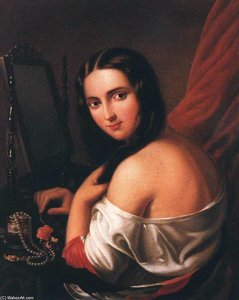
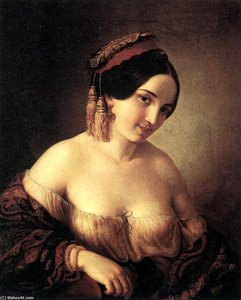
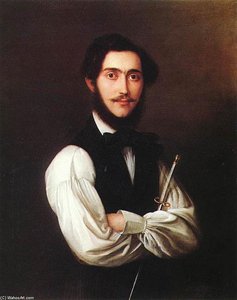
Marastoni’s oeuvre is a masterful dialogue between two seemingly opposing eras: the structured clarity of Neoclassicism and the evocative, soulful depth of Romanticism. In his portraiture, this duality is most palpable. He possessed a rare ability to capture the dignity and social standing of his subjects while simultaneously unveiling their psychological complexities. His portraits are never merely static records of appearance; they are studies in character, where a subtle tilt of the head or the soft light catching an eye conveys a narrative of inner life. This is perhaps most beautifully realized in works such as Woman Seated before a Mirror, where the artist utilizes gentle shadows and intimate lighting to create a sense of profound tranquility and domestic grace.
Beyond the confines of the studio portrait, Marastoni’s curiosity led him to explore the grandeur of the natural world. His forays into landscape painting allowed him to experiment with atmospheric perspective and delicate tonal modulations. In these works, he sought to capture the very essence of the Hungarian scenery, translating the light and mist of the region onto canvas with a sensitivity that mirrored his approach to the human face. Whether depicting the intricate lace of a sitter's gown or the sweeping vistas of the Hungarian plains, his technique remained anchored in a pursuit of truth—a truth found in both the physical accuracy of the subject and the emotional resonance of the atmosphere.
Legacy of a Cultural Pioneer
The historical significance of Jakab Marastoni extends far beyond the frames of his completed canvases. He was a man of his time, deeply engaged with the shifting political and social tides of the 19th century. As a champion of liberal reform, he played an active role in shaping the cultural identity of a nation in transition. His life work served as a vital link between the established traditions of the Italian Renaissance-descended academies and the emerging nationalistic spirit of Hungary.
Today, Marastoni is remembered not only as a skilled practitioner of oil on canvas but as a foundational architect of Hungarian art history. His achievements can be summarized through several enduring contributions:
- Institutional Foundation: The establishment of the First Hungarian Academy of Painting, which provided a structured path for future generations of local artists.
- Stylistic Integration: The successful blending of Neoclassical anatomical accuracy with Romantic emotional depth, creating a unique visual language.
- Cultural Bridge-Building: Bringing the sophisticated artistic techniques of Venice to the burgeoning art scene of Pest and Pozsony.
- Artistic Versatility: Mastery across diverse genres, ranging from intimate psychological portraiture to expansive, atmospheric landscapes.
Through his dedication to both the brush and the academy, Marastoni ensured that the visual language of his adopted home would possess both a classical dignity and a modern, expressive heart.
Q&A
Jakab Marastoni (Giacomo Antonio Marastoni)の出生地(都市および国)はどこですか?
Jakab Marastoni (Giacomo Antonio Marastoni)は、ItalyのValenciaで生まれました。
Jakab Marastoni (Giacomo Antonio Marastoni)は、どの時代に活動していましたか?
Jakab Marastoni (Giacomo Antonio Marastoni)は19th Centuryに活動していました。この時代背景は、その画家の活動を歴史の中に位置づけるものです。
Jakab Marastoni (Giacomo Antonio Marastoni)には、他にどのような別名や通称がありますか?
Jakab Marastoni (Giacomo Antonio Marastoni)は、Jacopo Antonio Marastoniという別名でも知られています。