Early Life and Artistic Foundations: A Derbyshire Beginning
 Wikipedia: Louis Bosworth Hurt
Louis Bosworth Hurt (1856–1929) was an English landscape artist. == Life and work == Hurt was born in Ashbourne in north Derbyshire in England. He was a student of George Turner. who was known as Derbyshire's John Constable and their paintings have...
Louis Bosworth Hurt, a name synonymous with the tranquil beauty of Highland cattle and the misty landscapes of Scotland, began his artistic journey far from those iconic scenes – in the rolling hills of north Derbyshire, England. Born in 1856, Hurt’s early exposure to the natural world profoundly shaped his aesthetic sensibilities. He wasn't merely replicating what he saw; he was absorbing a feeling, an atmosphere that would become the hallmark of his work. His formative education under George Turner, often referred to as “Derbyshire’s John Constable,” proved pivotal. Turner instilled in Hurt not just technical skill but also a deep appreciation for realism and a commitment to capturing the nuances of light and shadow – qualities readily apparent in Hurt's mature paintings.
While Turner’s influence is undeniable, Hurt quickly developed his own distinct voice. Unlike some artists who sought dramatic or idealized representations, Hurt gravitated towards quiet observation, finding beauty in the everyday lives of rural communities and the inherent dignity of working animals. This early grounding in Derbyshire provided a solid foundation for his later explorations of Scottish landscapes, offering a precedent for his meticulous attention to detail and his ability to evoke a sense of place.
The Allure of Highland Cattle: Subject, Symbolism, and Style
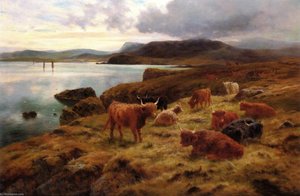
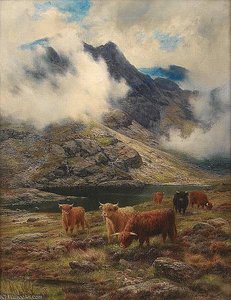 Rough Pastures
Discover Louis Bosworth Hurt’s ‘Rough Pastures,’ a serene 19th-century oil painting of Highland cattle & landscapes. Explore its realism, atmospheric perspective & connection to Scottish heritage.
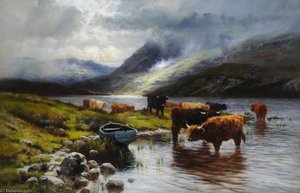
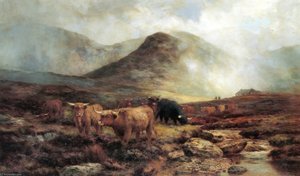
Hurt’s enduring fame rests largely on his depictions of Highland cattle. These weren't simply picturesque farm animals; they were imbued with symbolism deeply rooted in Scottish heritage and the rugged beauty of their native environment. The breed itself – with its long shaggy coats, impressive horns, and stoic demeanor – embodies resilience, strength, and a connection to the land. Hurt’s paintings don’t merely *show* these cattle; they convey a sense of their inherent character.
His style is characterized by a remarkable realism, achieved through painstaking observation and masterful oil painting techniques. He wasn't interested in fleeting impressions but rather in capturing the solidity and texture of his subjects. The thick impasto brushwork lends a tactile quality to the paintings, allowing viewers to almost feel the rough coats of the cattle and the dampness of the Scottish air. Rough Pastures, for example, exemplifies this approach – the cattle are rendered with such detail that they seem to emerge from the canvas, their presence both powerful and serene. This dedication to realism wasn’t simply about technical prowess; it was a means of honoring the animals themselves and the way of life they represented.
Mastering Atmospheric Perspective: Technique and Emotional Resonance
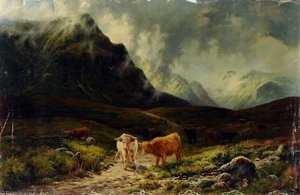
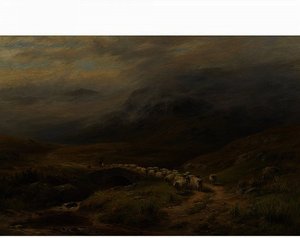 Morning - Near Crianlarich
Explore Louis Bosworth Hurt’s "Morning - Near Crianlarich," a dramatic oil landscape capturing Highland life. Admire its atmospheric perspective & somber beauty – a serene depiction of rural Britain.
Central to Hurt's success is his exceptional command of atmospheric perspective – the technique of creating depth in a landscape by depicting distant objects as paler, less detailed, and often bluer than those closer to the viewer. This wasn’t merely a technical exercise; it was integral to conveying the emotional resonance of the Scottish Highlands.
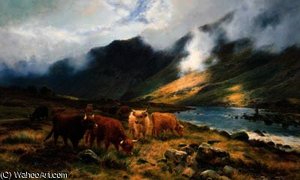
Paintings like In Ardgour and Morning - Near Crianlarich demonstrate Hurt's skill in this area. The misty mountains recede into the distance, their colors softening and blending with the sky, creating a sense of vastness and tranquility. This technique isn’t just about visual accuracy; it evokes a feeling of solitude, remoteness, and the sublime power of nature. The subtle gradations of light and shadow, combined with the muted color palette, create an atmosphere that is both hauntingly beautiful and deeply moving. Hurt understood that the true essence of a landscape lies not just in its physical features but also in the way it *feels* – the quality of the air, the play of light, and the sense of timelessness.
Hurt's Royal Academy Exhibitions and Provincial Recognition
Throughout the 1880s and 1890s, Hurt gained recognition for his work through numerous exhibitions at the prestigious Royal Academy in London. These showings were crucial in establishing his reputation among collectors and critics alike. While he didn’t embrace the radical experimentation of some of his contemporaries, his paintings resonated with a public that appreciated realism, technical skill, and depictions of rural life.
The thirteen times Hurt exhibited at the Royal Academy were not merely displays of artistic talent; they were affirmations of his commitment to traditional values and his ability to capture the beauty of the British countryside. Beyond London, Hurt also held successful exhibitions provincially, further expanding his reach and solidifying his position as a celebrated English artist. His paintings found their way into numerous private collections, including those of prominent patrons who recognized the quality and enduring appeal of his work.
A Lasting Legacy: Collections and the Enduring Appeal of Hurt’s Vision
Today, Louis Bosworth Hurt's paintings continue to captivate audiences with their serene beauty and masterful technique. His works are held in numerous public and private collections, including the Russell-Cotes Art Gallery & Museum in Bournemouth, which boasts a particularly large collection. The fact that paintings originally sold for modest sums – between £7 and £40 – now command prices upwards of £80,000 (as of 2005 valuations) is testament to his enduring legacy.
Hurt’s appeal lies in his ability to transport viewers to a simpler time, evoking a sense of peace, tranquility, and connection to the natural world. His paintings are not just representations of Highland cattle and Scottish landscapes; they are windows into a way of life that is increasingly rare – a celebration of rural beauty, quiet observation, and the enduring power of nature. At Mus3ums.com, we’re proud to offer high-quality reproductions of Hurt's masterpieces, allowing art enthusiasts around the world to experience the magic of his vision.