Introduction
The landscape of the nineteenth century in the Low Countries was defined by a profound shift from the structured clarity of the Golden Age toward a more emotive, turbulent engagement with the world. Dutch Romantic painters emerged from this cultural evolution, trading the mathematical precision of their predecessors for a deep, often spiritual connection to the sublime power of nature and the complexities of human sentiment. This movement was not merely a change in technique, but a fundamental reimagining of the relationship between the observer and the environment, where the wildness of a storm-tossed sea or the melancholic light of a twilight sky became vessels for the internal human experience.
During this era, the Netherlands served as a vital crossroads for artistic expression, where the influence of grand European Romanticism met a local tradition of meticulous observation. These artists sought to capture the ephemeral—the fleeting movement of clouds, the dramatic interplay of shadow, and the overwhelming scale of the natural world. Their works often oscillate between the tranquil beauty of pastoral scenes and the intense, dramatic tension of historical or mythological narratives, reflecting a period of significant social and intellectual transformation across Europe.
Today, these masters continue to resonate because they captured the essence of the sublime—that specific, breathtaking intersection of awe and terror. Their ability to translate raw emotion into visible brushstrokes allows their compositions to transcend their original era, offering a timeless meditation on the majesty of the earth and the fragility of life. By exploring the legacies of these significant figures, one gains a deeper understanding of how art transitioned from the depiction of external reality to the expression of internal truth.
The following selection highlights ten essential voices of this movement, ranging from masters of dramatic landscapes to specialists in intimate, emotive portraiture, each contributing a unique perspective to the Dutch Romantic canon.
Ary Scheffer
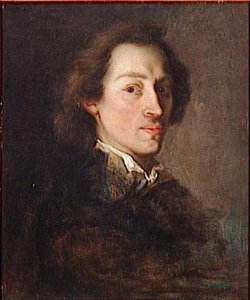 Portrait of Frédéric Chopin - Ary Scheffer
In his Portrait of Frédéric Chopin, Ary Scheffer achieves a profound distillation of the Romantic spirit, offering a window into the soul of a musical genius. This work transcends traditional portraiture, becoming a meditation on melancholy and the quiet intensity of creative life. Scheffer’s mastery lies in his ability to capture psychological depth, eschewing grandiosity to focus on the subtle nuances of his subject's demeanor.
Born in Dordrecht in 1795, Scheffer represents a vital link in the Dutch Romantic movement, bridging the meticulous technical traditions of his Dutch upbringing with the emotional intensity of the Parisian art scene. After moving to Paris, he studied under Pierre-Narcisse Guérin at the École des Beaux-Arts, absorbing the influences of masters like Delacroix and Géricault. His style often navigates a unique tension between classical precision and Romantic passion. His technique is defined by a sensitive handling of light and shadow, utilizing a restrained palette of muted browns, greys, and ochres. Through short, shimmering brushstrokes, he renders textures—from unruly hair to worn ivory piano keys—with a sensitivity that mirrors the ephemeral nature of inspiration, making him a quintessential figure of this era.
Barend Cornelis Koekkoek
Often celebrated as the 'Prince of Landscape Painting,' Barend Cornelis Koekkoek (1803–1862) represents the pinnacle of the Dutch Romantic movement through his ability to infuse nature with profound emotional resonance. Born into a prolific artistic dynasty in Middelburg, he refined his meticulous draftsmanship at the Drawing Academy of Middelburg and later at the prestigious Koninklijke Academie van Beeldende Kunsten in Amsterdam. His work transcends mere topographical accuracy, embracing the Romantic ideal of the sublime by capturing the wild, untamed spirit of the natural world.
In his evocative masterpiece, Sunset on the Rhine (1853), Koekkoek demonstrates the atmospheric mastery that defined his career. The composition utilizes a dramatic play of light and shadow, where the amber glow of a setting sun bathes a vast river valley, creating a sense of immense scale and quietude. By focusing on the transformative power of light and the emotional weight of the landscape, Koekkoek moved beyond the calm order of previous eras, securing his place as a central figure among the Dutch Romantic painters.
Nicolaas Pieneman
 Portrait of William II of Orange, King of the Netherlands - Nicolaas Pieneman
Born in Amersfoort in 1809, Nicolaas Pieneman emerged from a prestigious artistic lineage, receiving his foundational training in the studio of his father, Jan Willem Pieneman. His technical precision was further refined at the Royal Academy under the guidance of Jean Baptiste Madou. Pieneman’s significance within the Dutch Romantic movement lies in his ability to move beyond mere documentation, using history painting to shape a burgeoning sense of national identity through dramatic, emotive narratives.
His work often bridged the gap between academic rigor and the Romantic emphasis on power and grandeur. This is masterfully exemplified in his 1849 masterpiece, Portrait of William II of Orange, King of the Netherlands. In this commanding composition, Pieneman utilizes the dramatic interplay of light and shadow to highlight the monarch's ceremonial regalia, including gold epaulettes and an ermine-lined cloak. By placing the King amidst symbols of sovereignty—such as the crown, scepter, and heavy red velvet drapery—Pieneman captured the intense, heroic spirit characteristic of the era, cementing his reputation as a premier chronicler of both historical events and the high aristocracy.
Cornelis Kruseman
 Piety - Cornelis Kruseman
Cornelis Kruseman (1797–1857) stands as a vital figure among Dutch Romantic painters, bridging the gap between rigorous anatomical precision and the era's profound emotionality. Trained at the Amsterdam Drawing Academy under masters such as Charles Howard Hodges, Kruseman’s work is characterized by a sophisticated command of light and a deep, spiritual gravity. His time in Rome, where he was dubbed "the Italian Kruseman," allowed him to infuse his Northern training with the dramatic, classical grandeur of the Mediterranean, a hallmark of the Romantic movement's fascination with historical and religious narratives.
A visitor can recognize Kruseman’s hand through his masterful use of chiaroscuro and a palette of rich, earthy tones that heighten the drama of his compositions. In his 1823 work, Piety, this technique is used to create an intimate, sacred atmosphere. The painting depicts a quiet, intergenerational moment of devotion within a wooded setting, where light pierces through deep shadows to illuminate faces and crimson garments. Through such works, Kruseman captures the Romantic ideal: the intersection of human vulnerability and the sublime power of faith.
Moritz Calisch
 Twee vrouwen in Italiaanse dracht - Moritz Calisch
A prominent figure in the 19th-century Amsterdam art scene, Moritz Calisch (1819–1870) embodied the emotional depth and technical refinement of the Dutch Romantic movement. Trained at the Royal Academy of Amsterdam under the guidance of Jan Adam Kruseman, Calisch developed a mastery of composition and detail that allowed him to navigate both intimate portraiture and sweeping historical narratives. His ability to infuse scenes with dramatic storytelling and a sense of movement earned him significant accolades, including medals from the Drawing Society of Rotterdam, and eventually led to his leadership within the prestigious Arti et Amicitiae.
Calisch’s work often explores the intersection of cultural identity and romanticized sentiment. In his 1851 oil painting, Twee vrouwen in Italiaanse dracht, he moves toward a more stylized, intimate subject matter. The piece features two women in traditional Italian attire set against a lush, naturalistic landscape. Through the soft drapery of their chemises and the inclusion of a mandolin, Calisch captures a graceful, melodic moment that prioritizes feeling and atmosphere over rigid classical order. This focus on the evocative power of the human form and its connection to a picturesque setting marks him as a quintessential painter of the Romantic era.
Henriette Ronner Knip
 Kittens playing - Henriette Ronner Knip
Henriette Ronner Knip stands as a singular figure among Dutch Romantic painters, capturing the movement's emphasis on emotion and the spontaneous vitality of life through the lens of domestic intimacy. While many of her contemporaries sought the sublime in vast landscapes, Ronner Knip found it in the spirited, unscripted dramas of the household. Her work exemplifies the Romantic fascination with the individual character and the emotional resonance of a single, fleeting moment, elevating the animal subject to a level of profound psychological presence.
In her evocative work Kittens playing (c. 1880), this mastery of atmosphere is on full display. The painting captures a tangle of playful energy as kittens tumble around a wicker basket, their soft textures rendered with exquisite precision. A regal, long-haired adult cat observes the scene, providing a steady, watchful counterpoint to the youthful chaos. Through a warm palette of creams, browns, and deep reds, Ronner Knip transforms a quiet corner of a home into a stage for life's small, joyful movements. Born in Amsterdam in 1821 and trained by her father, Josephus Augustus Knip, she possessed a rare ability to infuse even the most domestic scenes with a sense of warmth and living breath.
Andreas Schelfhout
 Windmill beside a frozen river, Andreas Schelfhout, 1860 - 1862 - Andreas Schelfhout
A true master of the Dutch Romantic movement, Andreas Schelfhout (1787–1870) captured the sublime essence of the northern landscape through a lens of profound atmospheric emotion. His work is instantly recognizable by its meticulous attention to the interplay of light and shadow across vast, wintry expanses. He specialized in the quiet drama of frozen canals and snow-dusted rural life, utilizing a naturalistic color palette to evoke the crisp, biting air of a Dutch winter.
Schelfhout’s place within the Romantic movement is defined by his ability to elevate topographical accuracy into something deeply evocative, moving beyond mere documentation to capture the mood of nature. His training under stage designer Joannes Breckenheimer, combined with a deep study of 17th-century masters like Jacob van Ruisdael, allowed him to blend classical composition with the Romantic emphasis on the power of the elements. In his representative work, Windmill beside a frozen river (1862), we see this mastery on full display. The composition features a detailed ice face populated by figures with a sled, while a mill stands as a silent sentinel against a dramatic sky, and distant skaters add a sense of life to the frozen stillness.
Petrus Van Schendel
 A Merchant by Candlelight - Petrus Van Schendel
A true master of atmospheric mystery, Petrus van Schendel (1806–1870) stands as a luminous figure among Dutch Romantic painters. He earned the evocative moniker "Monsieur Chandelle" due to his unparalleled ability to capture the flickering, intimate glow of candlelight and the soft, silvered radiance of the moon. His technical foundation was laid at the Royal Academy of Fine Arts in Antwerp under the guidance of history painter Mattheus Ignatius van Bree, a mentorship that provided the mastery of perspective essential for his immersive nocturnal worlds.
Van Schendel’s work epitomizes the Romantic movement through its dramatic fascination with the interplay of light and shadow, or chiaroscuro. Rather than seeking the calm order of Neoclassicism, he embraced the emotive power of the night, transforming quiet interiors and bustling street markets into stages of profound mystery. In his representative work, A Merchant by Candlelight (c. 1850), he demonstrates this signature style perfectly. The composition utilizes a single, warm light source to define the figures against deep, espresso-toned shadows, elevating a simple genre scene into a captivating exploration of human presence amidst the darkness. His ability to render the specific effects of artificial light ensures his place as a specialist in the romantic, nocturnal sublime.
Johannes Bosboom
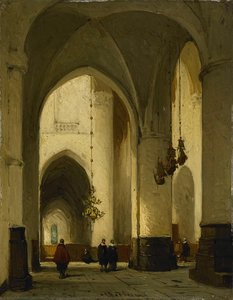 Interior of the Church of St Bavo in Haarlem, Johannes Bosboom, c. 1860 - c. 1891 - Johannes Bosboom
Johannes Bosboom (1817–1891) stands as a master of atmosphere, a painter who captured the silent, spiritual pulse of the Netherlands. While many of his contemporaries sought the grandiosity of nature, Bosboom found the sublime within the hallowed stillness of sacred spaces. His work is a quintessential expression of the Dutch Romantic movement, as he prioritized the emotional resonance of light and shadow over rigid, classical order. By focusing on the evocative interplay of light filtering through stained glass and the vast, quiet volumes of Gothic architecture, he transformed stone and timber into vessels of profound contemplation.
Trained at the Hague Academy of Art and influenced by the theatrical scenery techniques learned under Bartholomeus van Hove, Bosboom developed a sophisticated command of tonal values. His connection to other masters of the era, such as Andreas Schelfhout, underscores his central role in the 19th-century Dutch landscape. In his representative work, Interior of the Church of St Bavo in Haarlem, one can witness his ability to render complex spatial depth. The composition captures the solemnity of the great church, where the presence of hanging ship models adds a layer of historical texture to the drifting, ethereal light.
Fredrik Marinus Kruseman
 Monk Meditating near a Ruin by Moonlight, Frederik Marinus Kruseman, 1862 - Fredrik Marinus Kruseman
Fredrik Marinus Kruseman (1816–1882) stands as a quintessential figure of the Dutch Romantic movement, a period defined by the elevation of emotion and the sublime power of the natural world. Born in Haarlem, Kruseman’s artistic journey was shaped by rigorous formal training under Jan Reekers, followed by advanced studies with Nicolaas Johannes Roosenboom and Jan van Ravenswaay. His style was further refined through encounters with the works of Barend Cornelis Koekkoek, a titan of the landscape tradition, which helped Kruseman develop a signature ability to blend meticulous topographical detail with atmospheric grandeur.
His work exemplifies the Romantic fascination with the ephemeral and the melancholic. In his evocative piece, Monk Meditating near a Ruin by Moonlight (1862), Kruseman captures the essence of the era through a moonlit, Gothic scene. The composition features the ruins of the abbey of Villers-la-Ville, where a solitary monk sits in deep contemplation amidst overgrown structures and pine trees. By focusing on such themes of solitude, historical decay, and the dramatic interplay of light and shadow, Kruseman successfully transitioned from mere sketching to a soulful, poetic exploration of the Northern European landscape.
Conclusion
The Dutch Romantic movement represents a profound shift from the structured precision of the Golden Age toward a more emotive, atmospheric, and untamed expression of the world. Whether through the sweeping landscapes of Koekkoek, the dramatic light of Van Schendel, or the intimate, soulful portraits of Scheffer, these artists collectively captured the tension between human emotion and the overwhelming majesty of nature. Each painter contributed a unique lens to this era, from the architectural grandeur of historical scenes to the quiet, evocative stillness of a moonlit countryside, ensuring that the spirit of Romanticism would leave an indelible mark on art history.
For those looking to bring this era of passion and dramatic light into their own living spaces, Mus3ums.com offers a way to connect with these masters. Our artisans specialize in creating museum-quality, hand-painted oil reproductions that preserve the tactile brushstrokes and deep tonal ranges characteristic of these original works. You can explore our full collection to find the perfect piece and invite the timeless beauty of Dutch Romanticism into your home through our bespoke, handmade artistry.