


Introduction
Spanish impressionist painters captured the fleeting essence of light and atmosphere through a unique Mediterranean lens. While the movement originated in France, these artists adapted its core principles—the study of natural light and the use of rapid, visible brushstrokes—to the vibrant landscapes and intense sun of the Iberian Peninsula. Rather than adhering to the rigid, dark traditions of academic realism, they embraced the practice of painting en plein air, working outdoors to translate the immediate sensory experience of a moment onto canvas.
This period marked a significant cultural shift in Spanish art, as creators moved away from the somber tones of the previous century toward a more luminous and spontaneous palette. By prioritizing the play of light on water, the texture of sand, and the shifting shadows of the coast, they bridged the gap between traditional Spanish subjects and the modern European avant-garde. Their work reflects a profound dialogue between the soul of the landscape and the technical innovations of a new era.
Today, these masters remain vital for their ability to evoke emotion through color and movement, offering a window into a transformative era of art history. Their legacy continues to influence how we perceive the relationship between nature and the human eye. The following artists, including luminaries such as Joaquín Sorolla and Ignacio Pinazo Camarlench, represent the pinnacle of this movement, each offering a distinct perspective on the brilliance of the Spanish light.
Joaquín Sorolla
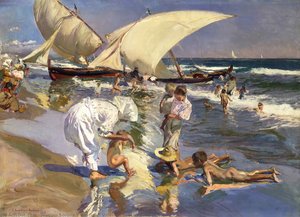 Valencia beach in the morning light - Joaquín Sorolla
Joaquín Sorolla stands as a preeminent figure among Spanish impressionist painters, celebrated for his ability to translate the sensory experience of the Mediterranean into vibrant, living canvases. His work is instantly recognizable through its masterful use of luminosity and a loose, energetic brushwork that captures the ephemeral dance of light on water. Unlike studio-bound traditionalists, Sorolla embraced the essence of the movement by working outdoors to seize the fleeting qualities of natural light, a technique that defines his contribution to Spanish Impressionism.
Born in Valencia in 1863, Sorolla’s artistic foundation was laid in his hometown before he moved to Madrid, where he established a significant professional reputation. His technical precision, developed under mentors like Cayetano Capuz and José Benlliure, allowed him to master the interplay of color and atmosphere. In his representative masterpiece, Valencia beach in the morning light (1908), he achieves a breathtaking synthesis of sun-drenched shores and shimmering tides. Through his rapid, spontaneous application of paint, he captures the warmth of the sun reflecting off wet sand, turning a simple coastal scene into a profound study of light and movement.
Ignacio Pinazo Camarlench
 Boats - Ignacio Pinazo Camarlench
A true precursor to the luminist style of Joaquín Sorolla, Ignacio Pinazo Camarlench (1849–1916) represents a vital bridge in the evolution of Spanish Impressionism. His journey from a childhood of hardship in Valencia—working as a silversmith and tile painter to support his family—to the prestigious San Carlos Academy, shaped a resilient and observant artistic eye. It was his transformative travels to Rome that fundamentally altered his trajectory, leading him away from rigid historical themes toward the spontaneous, light-driven essence of the Impressionist movement.
Pinazo Camarlench’s place within this movement is defined by his ability to capture the fleeting atmosphere of a moment through rapid, textured brushstrokes. In his work Boats, he moves away from the dramatic chaos of the open sea to explore a serene, maritime repose. The composition utilizes a balanced distribution of space, where the sky meets the water to create a profound sense of tranquility. By juxtaposing a cool palette of blues and whites with the grounded, earthy tones of the vessels, he masterfully documents the stillness of the harbor. This focus on light, atmosphere, and the immediate sensory experience of a scene marks him as a foundational figure in the Spanish Impressionist tradition.
Eliseo Meifrén y Roig
 A Square in Paris - Eliseo Meifrén y Roig
Born in Barcelona in 1859, Eliseo Meifrén y Roig represents a pivotal bridge between traditional Catalan training and the radical light-studies of the French avant-garde. Although he began his studies in medicine, his true vocation emerged at the Escola de la Llotja under masters like Antoni Cabà. However, it was his 1879 relocation to Paris that fundamentally reshaped his vision. By immersing himself in the atmosphere of the Belle Époque, Meifrén moved away from the somber, academic palettes of his youth to embrace plein air painting, a hallmark of the Impressionist movement. This shift allowed him to capture the ephemeral qualities of light and atmosphere, a technique he would later apply to both Mediterranean landscapes and urban settings.
His representative work, A Square in Paris (1887), serves as a masterful testament to this stylistic evolution. In this piece, Meifrén moves beyond rigid outlines, utilizing visible, spontaneous brushstrokes to define the rhythm of city life. The composition uses directional lighting to create depth, contrasting the structured architecture of the urban landscape with the soft, shifting shadows of a sunlit public space. Through this interplay of light and texture, Meifrén solidified his place among the Spanish Impressionist painters, translating the transient beauty of a single moment into a permanent visual record.
Javier Winthuysen Losada
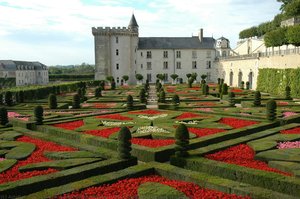 The Ornamental Garden – First Salon - Javier Winthuysen Losada
Born in Seville in 1874, Javier Winthuysen Losada represents a unique intersection of Spanish landscape tradition and the atmospheric sensibilities of the Impressionist movement. His artistic evolution was profoundly shaped by his move to Paris in 1903, where the burgeoning Impressionist and Post-Impressionist influences fundamentally altered his approach to color and light. This shift allowed him to move beyond the structured forms of his early training under masters like José Arpa and instead capture the fleeting, luminous qualities of the natural world.
His mastery of light and color extended beyond the canvas and into the realm of horticultural design, most notably through his pivotal collaboration on the ornamental gardens at the Château de Villandry in France. In his representative work, The Ornamental Garden – First Salon, this duality of talent is vividly realized. The painting captures a rhythmic geometry of living color, where the strict, mathematical order of clipped boxwood hedges meets the spontaneous, brilliant accents of crimson flowers. Through his brushwork, Winthuysen Losada translates the tension between human design and the organic movement of light, cementing his place among the Spanish painters who embraced the Impressionist desire to document the ephemeral beauty of the landscape.
Antoni Samarra i Tugues
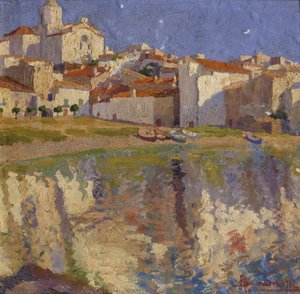 Cadaqués / Marine - Antoni Samarra i Tugues
Antoni Samarra i Tugues remains one of the most intriguing figures of the Catalan art scene, a multifaceted talent whose brief life left a profound impact on Spanish Impressionism. Though his career was tragically cut short at the age of twenty-eight in 1914, his ability to capture the fleeting essence of light and atmosphere aligns him perfectly with the Impressionist movement. His work often moves beyond mere representation, seeking to translate the sensory experience of a moment onto the canvas through a delicate, rhythmic application of paint.
In his 1912 masterpiece, Cadaqués / Marine, this mastery is vividly displayed. The painting serves as a serene window into Catalan coastal life, utilizing a soft, atmospheric palette to depict the waterfront of Cadaqués. One can observe the interplay of light and shadow across the Mediterranean surface, where small boats drift amidst the architectural intimacy of red-brick buildings. His brushwork avoids rigid lines, opting instead for a fluid touch that emphasizes the tranquil, ethereal quality of the sea and the quiet presence of figures within the landscape. Through this focus on light, color, and the immediate impression of the coast, Samarra i Tugues captured the very soul of the Mediterranean spirit.
Laura Domínguez
 The Alcarria countryside: freedom and calm - Laura Domínguez
Born in Spain in 1997, Laura Domínguez, affectionately known as Laurita, offers a contemporary perspective on the Impressionist tradition. Her artistic journey is defined by a profound, soulful connection to the rural heartland of La Alcarria. Rather than seeking photographic precision, Domínguez utilizes an impressionistic sensibility to capture the ephemeral essence of the Spanish countryside, focusing on the shifting interplay of light and atmosphere that defines a single, fleeting moment.
Her work is characterized by a deliberate pursuit of feeling over mere accuracy, translating the scent and atmosphere of the landscape onto the canvas. This is masterfully demonstrated in her representative work, The Alcarria countryside: freedom and calm. In this piece, she elevates rustic elements, such as a monumental haystack, into sculptural anchors of pastoral peace. Through fluid brushwork and a luminous palette of golden hues and verdant greens, she captures the rhythmic cycles of rural life. By prioritizing the emotional truth of the landscape and the movement of light across the plains, Domínguez firmly establishes her place among Spanish impressionist painters, turning the quietude of the Spanish landscape into a meditative experience of tranquility.
Hermenegildo Anglada Camarasa
 Coast north of Formentor - Hermenegildo Anglada Camarasa
Born in Barcelona in 1871, Hermenegildo Anglada Camarasa emerged as a transformative figure who bridged the gap between rigorous academic training and the radical avant-garde. After mastering classical foundations at the prestigious Llotja School, his artistic spirit sought a more sensory language, eventually finding a profound connection with the light-driven explorations of the Impressionist movement. His work is defined by a unique synthesis of Spanish folklore and a cosmopolitan sensibility, often infused with the vibrant, Fauvist colors and decorative patterns that characterized the early twentieth-century shift toward modernism.
His place within the Spanish Impressionist movement is most evident in his ability to capture the fleeting, atmospheric qualities of light through a meticulous layering of pigments. In his representative work, Coast north of Forjonter, he achieves a profound sense of tranquility, using loose, visible brushstrokes to depict the interaction of light and matter. The canvas becomes a tapestry of deep ochres, burnt oranges, and cool blues, employing atmospheric perspective to create an ethereal depth. Through this technique, Camarasa moves beyond mere representation to capture the very sensation of the Mediterranean landscape, making him a vital link between traditional Spanish heritage and the luminous experiments of the modern era.
Ovidio Murguía De Castro
 Winter landscape in the Sarela - Ovidio Murguía De Castro
Ovidio Murguía De Castro was a luminous talent of the late nineteenth century whose brief career left a profound impact on the Spanish landscape tradition. His work is instantly recognizable through its evocative mastery of light and shadow, capturing the very soul of the Iberian terrain. He belongs to the Spanish impressionist movement through his ability to move beyond mere topographical representation, instead using loose, textured brushwork to translate the fleeting sensations of the natural world into emotional territories.
His technique often involves the delicate interplay of textures, where the ruggedness of stone meets the softness of a hazy sky. This approach allows him to capture the dampness of a Spanish mist or the warmth of a setting sun with remarkable sensitivity. In his representative work, "Winter landscape in the Sarela," this impressionistic sensibility is on full display. The piece utilizes a muted, earthy palette of browns, grays, and subdued blues to depict a serene winter scene. Through the skillful application of atmospheric perspective and thin washes of color, Murguía De Castro creates a sense of movement and depth, making the landscape feel as though it is breathing under an overcast, tranquil sky.
Josep Mompou i Dencausse
 Barcelona. La Rambla - Josep Mompou i Dencausse
Josep Mompou i Dencausse stands as a vital figure in the evolution of Spanish Impressionism, specifically through his ability to synthesize the movement's obsession with light with the emotive intensity of Fauvism. Born in Barcelona in 1888, he was raised in a creative lineage that allowed him to perceive the subtle atmospheric shifts of the Catalan landscape. His work belongs to the Impressionist tradition because of his mastery in capturing fleeting, luminous moments, yet he pushed the boundaries of the movement by utilizing a radical, liberated palette to evoke deep emotional resonance.
In his representative work, Barcelona. La Rambla, this stylistic fusion is vividly realized. The painting captures the pulse of the city through a riot of color, using short, energetic brushstrokes to depict foliage and the movement of the street. He employs a technique of thick, visible application to build immediacy, favoring atmosphere over precise detail. The composition relies on a sophisticated interplay between the warm, vibrant tones of flower stalls and the cooler, muted shades of the urban architecture, creating a sense of depth and motion that epitomizes the Impressionist spirit of capturing life in a single, transient moment.
Joan Roig Soler
 Sitges train station - Joan Roig Soler
Born in Barcelona in 1852, Joan Roig Soler represents a vital link in the evolution of Spanish Impressionism, bridging the gap between rigorous academic training and the atmospheric freedom of the late nineteenth century. After honing his skills at the Escuela Superior de Bellas Artes Barcelona, Soler moved beyond the strictures of realism to embrace the ephemeral qualities of light and color that define the Impressionist movement. His work is characterized by an intuitive ability to capture the transient textures of the Mediterranean coast, often focusing on the sun-drenched landscapes of Catalonia.
In his evocative 1882 work, Sitges train station, Soler demonstrates his mastery of this style by merging industrial progress with atmospheric light. The painting captures a bustling Catalan railway platform where a steam engine releases thick, billowing plumes of smoke into the morning air. Rather than focusing on mechanical rigidity, he uses an Impressionistic sensibility to depict the interplay of light and shadow among the passengers on the platform. This focus on the fleeting, sensory experience of a specific moment—the haze of steam and the soft silhouettes of travelers—solidifies his place among the premier Spanish Impressionist painters.
Conclusion
The legacy of these Spanish impressionist painters lies in their profound ability to capture the fleeting essence of light and the vibrant soul of their homeland. From the luminous coastal scenes of Joaquín Sorolla to the atmospheric nuances of Ignacio Pinazo Camarlench, each artist contributed a unique perspective to the movement, translating the sensory experience of color and movement onto the canvas. Whether through the study of sunlight on water or the rapid, expressive brushstrokes of a landscape, they collectively redefined how the Spanish spirit could be felt through the medium of light.
For those looking to bring this historical brilliance into a modern setting, Mus3ums.com offers a way to experience these masterpieces firsthand. Our artisans specialize in creating museum-quality, hand-painted oil reproductions that preserve the tactile depth and emotional resonance of these iconic works. We invite you to explore our full collection and find the perfect piece to transform your home or professional space into a living gallery.


