
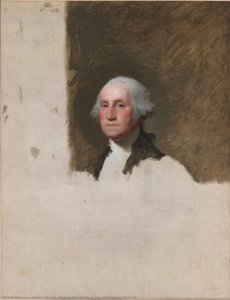

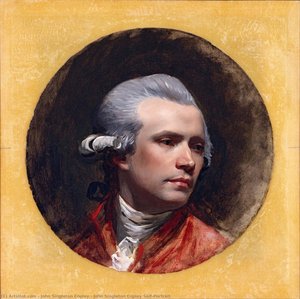

Introduction
The emergence of Neoclassicism in the United States marked a profound cultural shift as a young nation sought to define its visual identity through the lens of antiquity. During the late 18th and early 19th centuries, American artists turned away from the ornate flourishes of the Rococo style, looking instead toward the disciplined clarity, balanced compositions, and idealized forms of ancient Greek and Roman art. This movement was not merely an aesthetic choice but a philosophical one, mirroring the Enlightenment ideals of order, reason, and civic virtue that were foundational to the burgeoning American republic.
These painters utilized precise outlines and a controlled use of light to convey a sense of permanence and moral gravity. Their works often served to elevate the status of the new nation, portraying historical events, prominent statesmen, and dignified portraits with a sense of timelessness. By adopting the visual language of the classical world, they provided the young United States with a sophisticated artistic lineage that connected its democratic aspirations to the great civilizations of the past.
Today, these artists remain vital to our understanding of the American canon. Their mastery of form and their ability to capture the psychological depth of their subjects through structured, harmonious compositions continue to influence the study of portraiture and historical painting. To understand the visual foundation of American art history, one must examine the lives and legacies of the masters who defined this era, including figures such as John Singleton Copley, Gilbert Stuart, and John Trumbull.
John Singleton Copley
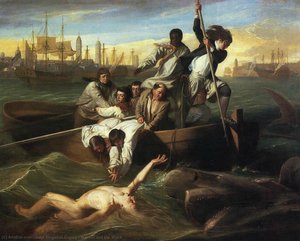 Watson and the Shark - John Singleton Copley
In his 1778 masterpiece, Watson and the Shark, John Singleton Copley captures a harrowing moment of maritime survival in Havana Harbor. This large-scale oil painting utilizes a dynamic, diagonal composition to guide the viewer through a scene of intense human struggle, contrasting the fluid, organic forms of the water and figures against the structured presence of a rescue boat. Copley’s technical precision is evident in his ability to render complex textures and dramatic light, creating a sense of profound emotional depth and movement.
As a foundational figure in American Neoclassicism, Copley moved beyond mere colonial portraiture to embrace the movement's emphasis on clear structure and historical narrative. His work exemplifies the Neoclassical transition from the rigid social hierarchies of the 18th century toward a more grand, dramatic style of storytelling. Born in 1738 in colonial Boston, Copley was largely self-taught, developing his mastery through the rigorous study of engravings rather than the traditional European academy system. His ability to translate material wealth and social identity into visual authority made him a premier artist of his era, bridging the gap between colonial realism and the sophisticated, balanced compositions characteristic of the Neoclassical movement.
Benjamin West
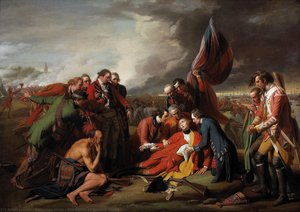 The Death of General Wolfe - Benjamin West
Born in colonial Pennsylvania in 1738, Benjamin West stands as a foundational figure in the American Neoclassical movement, bridging the gap between the raw energy of the New World and the refined traditions of Europe. His inclusion in this movement stems from his profound engagement with classical form and historical narrative, a sensibility he honed while studying the masters in Italy and later serving as President of the Royal Academy in London. West’s work is characterized by a dramatic, almost theatrical sense of composition that seeks to elevate contemporary events to the level of timeless epic.
A visitor can recognize a West masterpiece by its masterful use of light and a structured, often triangular, compositional balance. His brushwork serves a narrative purpose, guiding the eye through complex scenes of heroism and sacrifice. This is most vividly realized in his iconic 1770 work, The Death of General Wolfe. In this painting, West revolutionized the genre of history painting by depicting figures in contemporary military attire rather than classical drapery, yet he maintained Neoclassical rigor through a somber, earthy color palette and a composition that imbues the fallen general with a sense of martyrdom. His ability to blend historical accuracy with idealized, balanced forms defines the very essence of the Neoclassical spirit in the Americas.
Gilbert Stuart
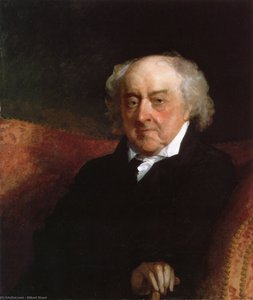
In his 1800 portrait of John Adams, Gilbert Stuart captures the dignified presence of a man central to the birth of a nation. The work exemplifies the Neoclassical ideal through its balanced composition and restrained palette of browns and subtle blues, presenting the subject with a sense of quiet strength and intellectual gravity. Stuart’s ability to convey character through formal, classical structures makes him a cornerstone of American Neoclassicism.
Born in Rhode Island in 1755, Stuart’s artistic lineage is deeply tied to the European traditions that shaped the American aesthetic. After early training in Scotland, he moved to London to study under the prominent Neoclassical master Benjamin West. This period was transformative, instilling in him the emphasis on idealized form and clear, authoritative portraiture that would define his career. Upon returning to the United States, Stuart became the premier portraitist of the founding era, immortalizing figures such as George Washington, Thomas Jefferson, and John Adams. His style is characterized by a sophisticated realism that avoids the flamboyant, opting instead for a refined, atmospheric approach to light and texture. By blending the formal rigor of his London training with a uniquely American intimacy, Stuart established a visual language for the new republic's leadership.
Charles Willson Peale
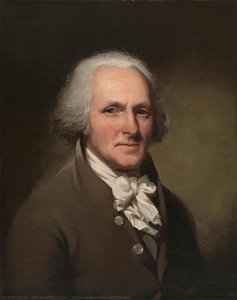 Charles Willson Peale Self-Portrait - Charles Willson Peale
Charles Willson Peale (1741–1827) stands as a foundational figure in American Neoclassicism, bridging the gap between European formal traditions and the burgeoning identity of the new Republic. His inclusion in this movement is defined by his rigorous training under Benjamin West in London, where he absorbed the Neoclassical emphasis on clear structure, dignified composure, and the idealized representation of character. Upon returning to the United States, Peale applied these principles to the most significant figures of the American Revolution, most notably George Washington, creating portraits that served as both historical documents and studies in civic virtue.
A visitor recognizes a Peale work by its remarkable clarity and a sense of restrained, intellectual stillness. His brushwork avoids excessive ornamentation, favoring a precise rendering of form and light that emphasizes the subject's presence. In his Charles Willson Peale Self-Portrait (1791), this approach is masterfully evident. The composition is characterized by a soft, diffused light and a palette of deep, sophisticated tones, such as the phthalo green of his chair, which highlights the anatomical accuracy of his features. This meticulous attention to detail reflects his dual legacy as a master portraitist and a dedicated naturalist who sought to document the world through a lens of scientific observation.
Charles Peale Polk
 General Washington at Princeton - Charles Peale Polk
Born in Annapolis in 1767, Charles Peale Polk emerged from the most influential artistic lineage in the early American republic. As the nephew of the celebrated Charles Willson Peale, Polk was shaped by the rigorous training available in Philadelphia, where he began his career by meticulously copying his uncle's compositions. His work is a quintessential example of the Neoclassicism movement in the United States, characterized by a commitment to the formal clarity, structured silhouettes, and dignified portraiture that defined the era's visual language.
His most enduring contribution to this movement is seen in General Washington at Princeton. This 1790 portrait, which Polk rendered in at least fifty-seven variations, demonstrates the Neoclassical emphasis on heroic composure and sharp, defined lines. The subject is presented in military attire, where the high contrast between the deep navy Continental Army uniform and the bright yellow waistcoat creates a sense of disciplined order. Through smooth brushwork and a controlled, atmospheric landscape, Polk captured the gravitas required of the young nation's iconography, securing his place among the foundational painters of the American Neoclassical tradition.
John Trumbull
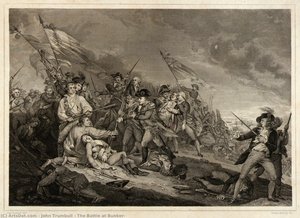 The Battle at Bunker - John Trumbull
John Trumbull (1756–1843) stands as a monumental figure among Neoclassicism painters from the United States, serving as the primary visual chronicler of a nation's birth. His work embodies the Neoclassical commitment to historical clarity and the idealized depiction of civic virtue, often focusing on the dramatic, structured narratives of the American Revolution. His artistic journey was deeply personal; having lost the use of one eye in a childhood accident, Trumbull developed a heightened sense of observation that would define his meticulous approach to composition.
A pivotal moment in his career occurred during his studies in London under the esteemed Benjamin West. It was West who encouraged Trumbull to move beyond mere portraiture and embrace the grand scale of history painting, focusing on the epic struggles of the War of Independence. This direction is vividly realized in his representative work, The Battle at Bunker Hill. In this piece, Trumbull utilizes a controlled, dramatic composition to capture the tension of the conflict, employing a sophisticated interplay of light and shadow to elevate a chaotic battlefield into a scene of profound historical significance. Through his ability to blend precise detail with the dignified poise characteristic of the Neoclassical movement, Trumbull transformed fleeting moments of combat into enduring symbols of national identity.
Edward Savage
 George Washington and Family - Edward Savage
Edward Savage (1761–1817) stands as a significant figure among Neoclassicism painters from United States, bridging the gap between meticulous engraving and the formal dignity of portraiture. His stylistic evolution was profoundly shaped by his time in London, where he studied under the esteemed Benjamin West, a master of the Neoclassical tradition. This European influence, combined with his travels through Italy, allowed Savage to infuse his American subjects with the balanced composition and clear, idealized forms characteristic of the movement.
His mastery of the era's aesthetic is most vividly realized in his 1798 work, George Washington and Family. This significant composition exemplifies the Neoclassical emphasis on order and domestic stability, portraying the first president within a structured, dignified setting. Through his precise application of light and shadow, Savage captures the tactile textures of late eighteenth-century life, from the heavy fabrics of formal attire to the intricate details of the domestic environment. By blending the precision of an engraver with the grandiosity of classical portraiture, Savage provided a visual language for the burgeoning American identity, immortalizing the founding era through a lens of poise and historical permanence.
James Peale
 Olivia Simes Morris - James Peale
In the 1814 portrait Olivia Simes Morris, James Peale demonstrates a masterful command of light and texture, capturing the sitter with a serene, poised dignity. The composition is defined by a sophisticated interplay of organic shapes, where the heavy folds of a red shawl contrast against the delicate, tactile reality of a white lace collar. This focus on clarity of form and the structured elegance of the subject's attire exemplifies the Neoclassical ideal of balanced, dignified representation.
As a prominent figure among Neoclassicism painters from the United States, Peale brought a unique precision to the American canon. While his brother, Charles Willson Peale, often sought the grandiosity of historical narrative, James specialized in the exquisite detail of miniature portraits and luminous still lifes. His work is characterized by a controlled brushwork that favors clarity and order over expressive chaos. Born in 1749 in Maryland, Peale’s artistic discipline was forged through an early apprenticeship in cabinetmaking and later refined under the guidance of his brother. His ability to render the subtle nuances of social standing through material texture—from the sheen of silk to the softness of skin—marks him as a vital practitioner of the Neoclassical style in early American art.
John Vanderlyn
 John A. Sidell - John Vanderlyn
John Vanderlyn (1775–1852) stands as a pivotal figure among American Neoclassical painters, serving as a cultural bridge between the burgeoning talent of the young United States and the refined academies of Europe. Unlike many of his contemporaries who looked toward London, Vanderlyn’s artistic trajectory was defined by his immersion in the Parisian art scene. This move was revolutionary, allowing him to embrace the Neoclassical movement's emphasis on clarity, balanced composition, and the idealized forms of antiquity, which he brought back to the American landscape.
His technical foundation was built upon a rich lineage; as the grandson of the colonial portraitist Pieter Vanderlyn, he possessed an inherent understanding of form. His early training was further sharpened by studying the works of Gilbert Stuart, absorbing a mastery of character and likeness. In his representative work, John A. Sidell (c. 1830), one observes the quiet prestige and formal dignity characteristic of the era. The painting exemplifies the Neoclassical pursuit of order and smooth, controlled brushwork, capturing the subject with a luminous, sculptural quality that reflects the movement's devotion to timeless elegance and the structured beauty of classical ideals.
Mather Brown
 Portrait of a Young Woman - Mather Brown
Mather Brown (1761–1831) represents a vital transatlantic link within the Neoclassicism movement of the United States, bridging the colonial traditions of New England with the sophisticated academies of Europe. Born in Boston, Brown’s artistic foundation was laid under the rigorous mentorship of John Singleton Copley, a master of meticulous detail and classical form. This disciplined training allowed him to transition from the American colonies to the prestigious Royal Academy in London, where he became a recognized figure in the British art establishment. His ability to balance the structured, idealized proportions of Neoclassicism with a burgeoning sense of dramatic narrative defines his unique contribution to the era.
His 1801 work, Portrait of a Young Woman, serves as a profound testament to this stylistic evolution. In this piece, Brown moves beyond mere likeness to create a tableau of refined elegance. The subject, posed with a quiet, dignified grace, evokes the classical ideals of antiquity, yet the composition hints at the emotive depth that would eventually characterize the Romantic period. Through his mastery of light and form, Brown captured the intellectual and social sophistication of the early 19th century, securing his legacy as a premier American-born master of the Neoclassical tradition.
Conclusion
The legacy of American Neoclassical painters lies in their ability to translate the rigid discipline of Greco-Roman ideals into a visual language for a burgeoning nation. From the formal portraiture of Gilbert Stuart and John Singleton Copley to the grand, historical narratives of John Trumbull, these artists provided the young United States with a sense of dignity, order, and permanence. Whether through the delicate precision of a landscape or the commanding presence of a statesman, this movement established a standard of academic excellence that defined the aesthetic identity of the early American republic.
For those seeking to bring this era of historical elegance into a modern setting, our curated full collection offers a gateway to these timeless masterpieces. At Mus3ums.com, we specialize in preserving this heritage through museum-quality, hand-painted oil reproductions. Each piece is meticulously crafted by skilled artists on cotton canvas, ensuring that the clarity of line and the balanced compositions of the Neoclassical masters are captured with the tactile depth and soul of an original work of art.


