Introduction
The 20th century in the United Kingdom was a period of profound transformation, where the traditional landscapes of the countryside met the radical, shifting energies of modern urban life. This era saw a remarkable departure from the rigid academicism of the past, as artists began to grapple with the complexities of a changing world through diverse lenses—from the sweeping, impressionistic light of maritime scenes to the bold, abstract geometries of modern sculpture and the vibrant, pop-infused colors of the post-war era. What unites these creators is a restless spirit of experimentation, a willingness to redefine the boundaries of form, color, and subject matter in response to the social and technological revolutions of their time.
Throughout this century, British art moved from the intimate, often pastoral observations of the Edwardian period into the intense, emotive struggles of the World Wars, eventually blossoming into the avant-garde movements that would influence global aesthetics. Whether capturing the quiet dignity of a rural landscape or the fractured, surrealist dreamscapes of the urban experience, these painters and sculptors navigated a landscape of immense cultural upheaval. Their work serves as a visual diary of a nation evolving from a traditional empire into a modern, multifaceted society.
Today, these artists remain vital because they captured the very essence of human experience during a century of unprecedented change. Their influence persists in contemporary art, offering a profound dialogue between the classical heritage of the past and the experimental freedom of the present. By examining the lives and legacies of ten pivotal figures—ranging from the master portraitists and landscape specialists to the pioneers of abstraction—we gain a deeper understanding of the visual language that continues to shape our perception of beauty and meaning.
David Hockney
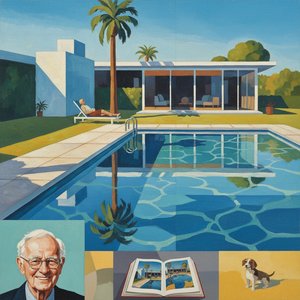
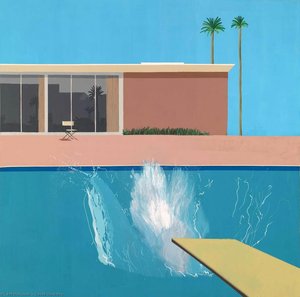 A bigger splash - David Hockney
A central figure in the landscape of 20th century British painters, David Hockney transitioned from the industrial grit of his native Yorkshire to the forefront of the international Pop Art movement. Born in Bradford in 1937, his formative years were shaped by the specific light and textures of the North of England, a visual foundation he later refined through rigorous training at the Bradford School of Art and the Royal College of Art, where he earned a Gold Medal distinction.
Hockney’s work is instantly recognizable by its exuberant use of color, clean geometric lines, and a profound fascination with how light interacts with modern surfaces. His 1967 masterpiece, A Bigger Splash, serves as a definitive example of his ability to capture a sense of tranquil yet dynamic motion. Through bold acrylic compositions, he explores themes of domesticity and leisure, often utilizing a vibrant palette to transform everyday scenes into iconic visual statements. Whether depicting the serene architecture of a poolside or the complex patterns of a landscape, his style remains a testament to the evolution of modernism in the United Kingdom during the latter half of the century.
Alfred Munnings
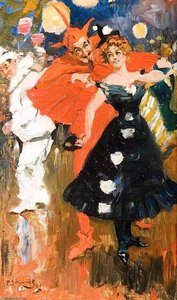 The Fancy Dress Ball - Alfred Munnings
A central figure in the landscape of 20th century British painters, Alfred Munnings (1878–1959) captured the shifting rhythms of the English countryside with unparalleled vitality. His work is defined by a profound connection to the rural life of his youth in Suffolk, where the presence of horses and the industrious nature of his father's mill shaped his artistic eye. As a master of equine Impressionism and a former President of the Royal Academy, Munnings bridged the gap between traditional subject matter and the vibrant, light-drenched techniques of the modern era.
His representative work, The Fancy Dress Ball (1901), serves as a brilliant precursor to his 20th-century mastery. In this piece, Munnings moves beyond mere social documentation to capture the very essence of Edwardian elegance. Through the use of impasto and loose, energetic brushstrokes, he creates a sense of dynamic movement within a crowded ballroom. The composition utilizes diagonal lines and a rich palette of bronze, reds, and blacks to evoke the excitement of a masked gathering. This ability to infuse a scene with palpable energy and light is what solidified his legacy among the most significant painters from the United Kingdom during this transformative century.
John Lavery
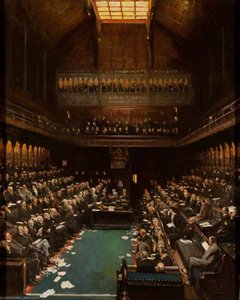 The Right Honourable J. Ramsay Macdonald Addressing the House of Commons - John Lavery
A master of Impressionist sensibilities, Sir John Lavery remains a defining figure among 20th century British painters. His career, which spanned the transition from the Victorian era into the modern age, was shaped by a rigorous international education, from the Haldane Academy in Glasgow to the Académie Julian in Paris. This diverse training allowed him to develop a sophisticated understanding of light and form, a skill further sharpened by his early experience working as a photographer's assistant. Such technical versatility enabled him to move seamlessly between capturing the vibrant energy of the Glasgow School and documenting the gravity of high-stakes political shifts.
His ability to blend meticulous realism with a painterly flair is perfectly encapsulated in his 1923 work, The Right Honourable J. Ramsay Macdonald Addressing the House of Commons. In this significant oil on canvas, Lavery transcends simple portraiture to capture a transformative moment in British history: the rise of the Labour Party. By immortalizing the first Labour Prime Minister in such a commanding setting, Lavery solidified his legacy as a chronicler of the social and political evolution that characterized the United Kingdom during the early 20th century.
Thomas Moran
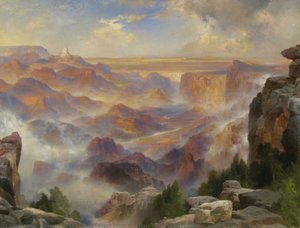 Grand Canyon Scene at Eastern End of Canyon - Thomas Moran
In the 1920 masterpiece Grand Canyon Scene at Eastern End of Canyon, the viewer is confronted with a profound sense of geological time and the sublime power of the American West. This work exemplifies the artist's ability to transform vast, monumental rock formations into an ethereal experience of light and atmosphere. Through a masterful command of color and composition, the sky seems to inhabit the landscape, creating a three-dimensional depth that invites quiet contemplation of the untamed wilderness.
Born in Bolton, Lancashire, in 1837, Thomas Moran represents the enduring legacy of British-born talent within the 20th-century landscape tradition. Although his career was defined by his move to the United States and his role as a master of the Hudson River School, his artistic DNA remained deeply connected to his roots. His formative years included a pivotal journey to London, where he studied the works of J.M.W. Turner. By emulating Turner’s approach to light and atmosphere, Moran translated European Romantic sensibilities into a new visual language for the American frontier. His technique, which seamlessly blended the precision of his early engraving training with the fluid brilliance of watercolor and oil, allowed him to capture the shifting moods of the natural world with unparalleled grace.
Henry Scott Tuke
 A Bathing Group - Henry Scott Tuke
Henry Scott Tuke stands as a significant figure among 20th century British painters, known for his masterful command of light and his evocative maritime subjects. Born in York in 1858, Tuke received his formal training at the Slade School of Art under Alphonse Legros and Sir Edward Poynter. His artistic trajectory was profoundly shaped by his time in Paris, where he encountered the influence of Jules Bastien-Lepage. This exposure encouraged him to embrace en plein air painting, a practice that would define his career as he moved toward the rugged coasts of Cornwall.
Tuke’s work is celebrated for its serene, Impressionist approach to the human form in natural settings. His 1914 masterpiece, A Bathing Group, exemplifies this technique. The oil on canvas depicts two young men on a sunlit, rocky shore, using thick impasto brushwork to capture the tactile grit of the coastline and the luminous quality of skin under the sun. By focusing on the interplay of light, shadow, and the sea, Tuke secured his legacy as a vital contributor to the British artistic landscape during the early decades of the 20th century.
Barbara Hepworth
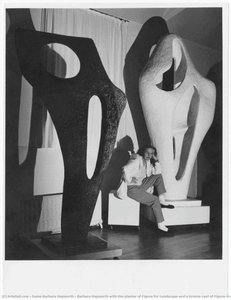
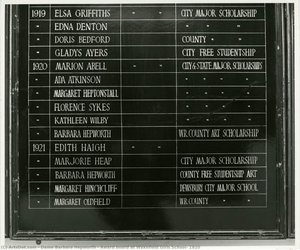 Award board at Wakefield Girls School, 1920 - Barbara Hepworth
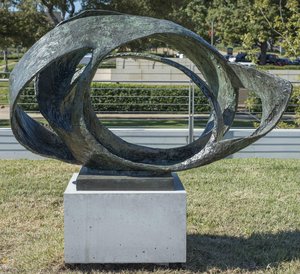
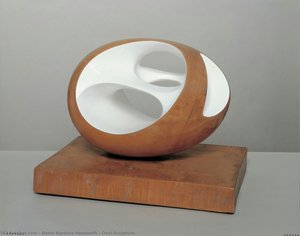
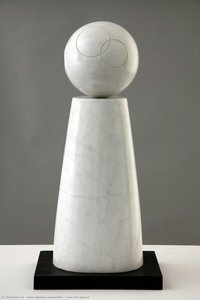
A central figure in the evolution of British modernism, Barbara Hepworth redefined the boundaries of three-dimensional form during the 20th century. While primarily celebrated as a pioneer of abstract sculpture, her profound influence on the visual language of the United Kingdom's art scene during this era is undeniable. Her work is instantly recognizable by its masterful command of the relationship between material and void, often utilizing direct carving to engage intimately with stone and wood. One can sense her signature approach through the rhythmic interplay of organic curves and the intentional use of negative space, creating a sense of calm and reflection.
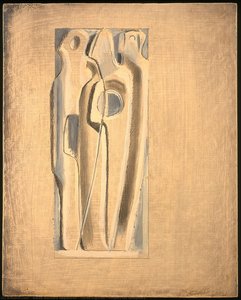
Her journey began in the West Riding of Yorkshire, where she was born in 1903. Her technical discipline was forged at the Leeds School of Art and later refined at the Royal College of Art in London, establishing the intellectual rigor that defines her legacy. A significant piece of her history is captured in the Award board at Wakefield Girls School, 1920, a work that reflects the precision and structural awareness present even in her formative years. Through her exploration of surrealism and abstraction, Hepworth transformed the physical presence of sculpture into a poetic dialogue between shape and space."
Henry Moore
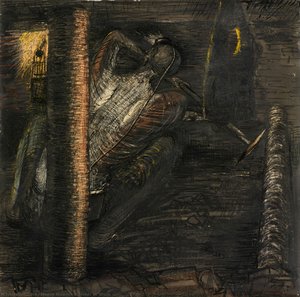 A Miner at Work - Henry Moore
Born in the Yorkshire mining town of Castleford in 1898, Henry Moore emerged as a transformative force in 20th century British art. His journey from the industrial landscapes of northern England to the Royal College of Art in London allowed him to synthesize classical training with a radical, modern sensibility. A defining moment in his evolution occurred during a 1925 trip to Mexico, where the primal, abstract power of pre-Columbian sculpture liberated him from traditional European realism, steering his focus toward the essential essence of form.
As a central figure among 20th century British painters and sculptors, Moore’s work often bridged the gap between the organic and the abstract. His 1942 piece, "A Miner at Work," serves as a profound testament to this era. In this work, he moves beyond mere depiction to explore the psychological weight of labor. Through the strategic use of negative space and simplified, geometric shapes, he captures a solitary figure seated at the coal face. The piece reflects a somber, dramatic dignity, translating the physical toil of the Yorkshire landscape into a monumental meditation on human resilience and the enduring strength of the spirit.
Charles Haslewood Shannon
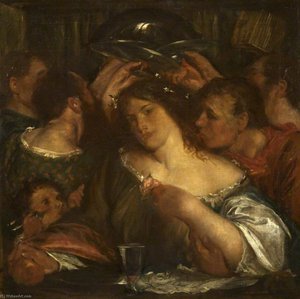 Tibullus in the House of Delia - Charles Haslewood Shannon
In his 1905 masterpiece, Tibullus in the House of Delia, Charles Haslewood Shannon captures a profound sense of longing and vulnerability through a composition that feels both intimate and timeless. This work exemplifies the artist's signature ability to blend classical themes with a soft, atmospheric sensibility. His style is deeply rooted in the Venetian tradition, drawing significant inspiration from the works of Giorgione and Titian. This influence is evident in his masterful use of diffused light and a subtle layering of color that creates a dreamlike, almost melancholic quality.
As a prominent figure in the British art scene of the early 20th century, Shannon’s career spanned the transition of modern aesthetics, marked by his transition from heavy, low tones to a more transparent and luminous palette. His expertise in portraiture and Giorgionesque figure compositions earned him international recognition, including prestigious medals in Munich and Paris. Though his creative journey was prematurely altered by a neurological injury in 1928, his legacy remains a vital part of the 20th century United Kingdom painters' canon, characterized by an exquisite sensitivity to texture and a romantic, symbolic approach to the human form.
Stanley Spencer
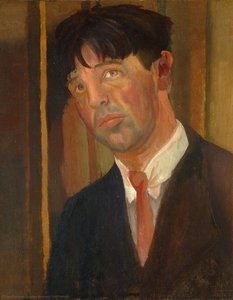 Self Portrait - Stanley Spencer
A central figure among 20th century British painters, Stanley Spencer (1891–1959) developed a singular visual language that bridged the gap between the mundane and the divine. Trained at the Slade School of Fine Art under Henry Tonks, Spencer’s work is inextricably linked to the village of Cookham, which he envisioned as a spiritual landscape. His ability to infuse everyday English life with profound religious significance placed him at the forefront of a unique brand of contemporary realism, eventually influencing major figures such as Lucian Freud.
His approach was a sophisticated synthesis of influences, blending the meticulous detail of the Pre-Raphaelites with the expressive color of French Post-Impressionism and the compositional clarity of Giotto. This stylistic fusion allowed him to transform local villagers into characters within epic biblical narratives. In his 1939 Self Portrait, this introspective quality is palpable; the work moves away from rigid academic portraiture toward a more expressive, modern sensibility. Through his deeply personal depictions, Spencer remains a vital representative of the British artistic evolution during the interwar period, capturing the weight of human experience through a lens of sacred intimacy."
Mark Gertler
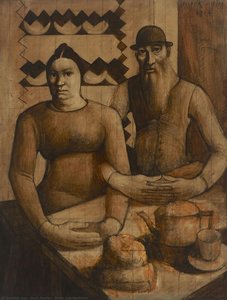 Rabbi and Rabbitzin - Mark Gertler
A central figure in the landscape of 20th century British art, Mark Gertler (1891–1939) brought a profound, often somber intensity to the modern movement. His work is instantly recognizable through its expressive figure studies and a sophisticated command of Post-Impressionist color and form. Whether capturing the quietude of a still life or the psychological depth of a portrait, Gertler’s brushwork possesses a sculptural permanence that elevates everyday subjects into something monumental.
His artistic journey began in London, where he moved from an apprenticeship in stained glass to the prestigious Slade School of Art. During this formative period, he became a contemporary of major figures like Stanley Spencer, developing a style that balanced formal training with a deeply personal, modernist vision. This dedication to his own aesthetic often led him away from the traditional social portraiture of the era, favoring instead a more visceral, emotive approach to his subjects.
In his 1914 work, Rabbi and Rabbitzin, this mastery is on full display. The painting captures a moment of profound stillness, using light and shadow to anchor a man and woman amidst the ritualistic objects of daily life. Through such works, Gertler solidified his place as a vital voice in the British avant-garde.
Conclusion
The 20th century was a transformative era for British art, a period where the boundaries of form and color were constantly redefined. From the vibrant, pop-infused landscapes of David Hockney to the profound, organic abstractions of Henry Moore, these artists collectively navigated the tension between tradition and modernity. Whether through the intimate portraiture of Stanley Spencer or the sweeping, light-filled compositions of John Lavery, this group of painters captured the evolving spirit of a nation in flux, leaving behind a legacy that continues to influence contemporary aesthetics.
At Mus3ums.com, we invite you to bring these historical perspectives into your own living space. Our master artists specialize in creating museum-quality, hand-painted oil reproductions that honor the unique brushwork and textural depth of these icons. By choosing a custom commission or a fine art reproduction, you can transform your home or office into a curated gallery. Explore our full collection and find a piece that resonates with your personal style, allowing the genius of British modernism to live with you for generations.