Introduction
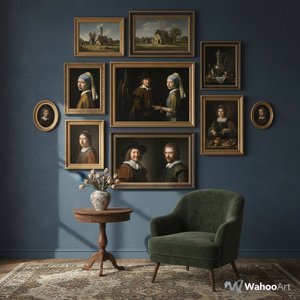
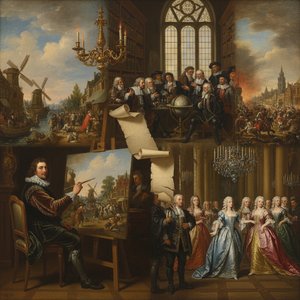
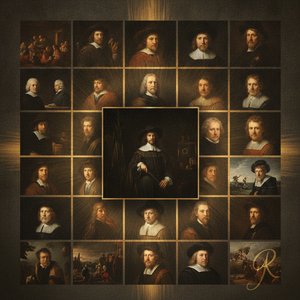
The Golden Age of the Netherlands birthed a visual language defined by unparalleled dramatic tension and a profound mastery of light. During the seventeenth century, a unique confluence of economic prosperity and religious shifts transformed the Dutch Republic into a cultural powerhouse, moving away from grand ecclesiastical commissions toward intimate, secular subjects. This era of Baroque artistry replaced the idealized divinity of the South with a striking realism, capturing the textures of everyday life, the quietude of domestic interiors, and the intense psychological depth of the human soul.
What unites these masters is a shared obsession with chiaroscuro—the interplay of deep, velvety shadows and piercing, directional light—which creates a theatrical sense of presence on the canvas. Whether depicting a bustling tavern scene, a serene window-lit parlor, or a solemn portrait, these painters utilized strong diagonals and rich tonal ranges to pull the viewer directly into the narrative. Their ability to render the tactile quality of silk, the glint of a pewter goblet, or the subtle moisture in a subject's eye remains a benchmark of technical excellence.
Today, the legacy of this movement continues to resonate, offering a window into a world that feels startlingly modern in its focus on the individual and the mundane. The works of these masters remain essential for understanding the evolution of Western realism and the psychological complexity of portraiture. In the following sections, we examine ten pivotal figures who defined this era, from the chiaroscuro mastery of Rembrandt to the luminous domesticity of Vermeer, tracing the diverse paths through which they shaped the Baroque aesthetic.
Rembrandt
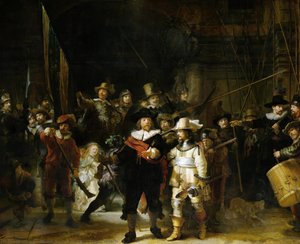 Night Watch - Rembrandt
Rembrandt van Rijn stands as the preeminent figure of the Dutch Golden Age, a master whose technical brilliance defined the essence of the Baroque movement. Born in Leiden in 1606, he moved beyond the modest beginnings of his family to command the artistic landscape of the Dutch Republic. His work is instantly recognizable through his profound mastery of chiaroscuro, where dramatic, theatrical light emerges from deep, murky shadows to sculpt human emotion and physical volume. Unlike the static portraits of his contemporaries, Rembrandt’s compositions possess a restless, living energy, driven by a tactile application of paint that gives his subjects a palpable, three-dimensional presence.
His monumental masterpiece, The Night Watch (1642), exemplifies this Baroque dynamism. In this scene, he eschews formal, stiff arrangements for an asymmetrical, mid-motion assembly of the Kloveniers civic militia. Through a sophisticated interplay of illumination and darkness, he pulls the viewer into an organized chaos of glinting weaponry and vibrant uniforms. Whether through his heavy impasto or his delicate intaglio etchings, Rembrandt’s ability to capture the psychological depth of the human condition ensures his place as a cornerstone of Dutch Baroque art.
Johannes Vermeer
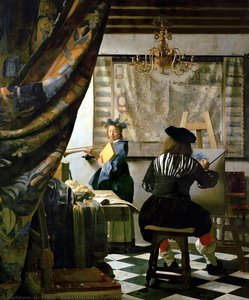 The Art of Painting - Johannes Vermeer
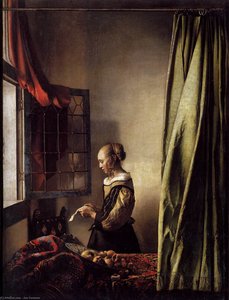
Johannes Vermeer, born in Delft in 1632, stands as a luminous pillar of the Dutch baroque movement. While many of his contemporaries focused on the dramatic, sweeping theatricality often associated with the era, Vermeer mastered a more intimate, reflective form of the Baroque. He utilized the movement's signature preoccupation with light and shadow to elevate quiet, domestic scenes into profound visual meditations. His upbringing in a household of textile weavers and art dealers provided him with an innate understanding of texture and pigment, which he later translated into his unparalleled ability to capture the play of light on fabric and stone.
His masterpiece, The Art of Painting, serves as a quintessential example of his technical brilliance. In this work, he employs a sophisticated chiaroscuro to define the artist’s studio, using soft, diffused illumination to create a sense of depth and stillness. The composition, featuring a model in blue against a backdrop of a map of the Low Countries, demonstrates the meticulous realism and structural harmony that define his legacy. Through his mastery of light, Vermeer transformed the everyday into the extraordinary, securing his place among the most significant Dutch baroque painters.
Gerrit Dou
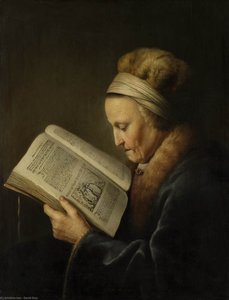 Old Woman Reading a Bible - Gerrit Dou
A master of the Leiden fijnschilder style, Gerrit Dou brought a level of microscopic precision to the Dutch Baroque movement that remains unparalleled. His journey into the heart of the Golden Age began in the studio of Rembrandt, where he absorbed the dramatic interplay of light and shadow that defines the era. However, Dou’s path was uniquely shaped by his father’s profession as a glazier. This early intimacy with glass and light allowed him to master the delicate manipulation of luminosity, a skill he would later refine through an almost obsessive devotion to detail.
In his evocative work, Old Woman Reading a Bible, Dou exemplifies the Baroque penchant for theatricality through a controlled, intimate lens. Rather than the sweeping grandiosity seen in some contemporaries, Dou utilizes a shallow, focused perspective to pull the viewer into a moment of profound spiritual contemplation. The painting showcases his technical virtuosity; the texture of a weathered shawl and the crisp edges of parchment are rendered with such meticulous care that the brushstrokes become nearly invisible. Through this masterful application of chiaroscuro, he transforms a quiet, domestic scene into a powerful meditation on time and devotion.
Jan Steen
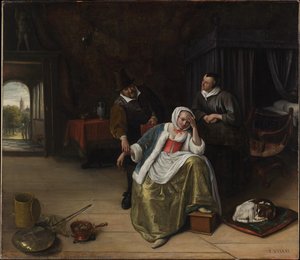 The Lovesick Maiden - Jan Steen
Jan Steen stands as a quintessential figure of the Dutch Baroque, a master who transformed the era's penchant for dramatic lighting into a vehicle for the "human comedy." While many of his contemporaries focused on grand allegories, Steen utilized the movement's characteristic chiaroscuro to illuminate the psychological complexities of everyday life. His work is instantly recognizable through its vibrant, often chaotic compositions, masterful brushwork, and a unique ability to balance boisterous humor with profound moral undertones.
Born in Leiden around 1626, Steen was raised in a household steeped in the social realities of the tavern and the brewery, an upbringing that deeply informed his genre paintings. After registering with the Leiden Guild of Saint Luke in 1648, he moved through the major urban centers of the Dutch Republic, likely absorbing the technical foundations of masters such as Jan van Goyen and Adriaen van Ostade. His ability to manipulate light and shadow to sculpt figures from the gloom is perfectly exemplified in his 1660 masterpiece, The Lovesick Maiden. In this work, Steen employs the theatricality of the Baroque to turn a domestic scene into a profound psychological drama, using light to guide the viewer through a landscape of subtle social anxiety and emotional vulnerability.
Gabriel Metsu
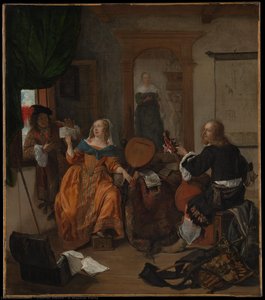 A Musical Party - Gabriel Metsu
Gabriel Metsu stands as a versatile and essential figure among the Dutch baroque painters, distinguished by his refusal to be confined to a single genre. While many of his contemporaries focused exclusively on one subject, Metsu moved fluidly between grand historical narratives, intimate portraits, and delicate still lifes. This stylistic flexibility allowed him to capture the multifaceted nature of the seventeenth-century Netherlands, from the high-stakes drama of courtly life to the quietude of a domestic interior. His ability to navigate these diverse themes places him firmly within the baroque movement, as he utilized the period's characteristic focus on light and human interaction to elevate everyday scenes into theatrical, emotionally resonant compositions.
His mastery of the genre is perhaps most evident in his 1659 work, A Musical Party. In this captivating tableau, Metsu employs a sophisticated use of perspective and a warm, ochre-dominated palette to invite the viewer into a refined social gathering. Through meticulous brushwork, he captures the subtle nuances of courtship and leisure, demonstrating the technical precision and observational depth that defined the Golden Age. Whether depicting a dandy with a songbook or a gentleman tuning a viol, Metsu’s work remains a testament to the era's profound interest in the interplay of light, texture, and human connection.
Pieter de Hooch
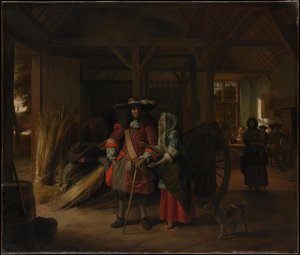 Paying the Hostess - Pieter de Hooch
Pieter de Hooch stands as a preeminent master of the Dutch Baroque, distinguished by his ability to transform the quietude of domesticity into a theatrical study of light and space. While many of his contemporaries focused on grand historical narratives, de Hooch found drama in the subtle interplay of shadows and the structured geometry of the home. His work is instantly recognizable through a sophisticated use of light that filters through windows to illuminate textured surfaces, and his celebrated see-through-doorway technique, which creates a profound sense of spatial depth and interconnectedness between rooms.
Born in Rotterdam in 1629, de Hooch received his formal training in Haarlem under the landscape painter Nicolaes Berchem. His professional journey eventually led him to Delft, where he became a pivotal figure of the Delft School. In his 1670 masterpiece, Paying the Hostess, we see the quintessential Baroque tension between public and private life. Through meticulous brushwork and a controlled palette, he captures a fleeting social transaction within an inn, elevating a mundane moment into a profound observation of human interaction and the luminous elegance of the Dutch Golden Age.
Jan Lievens
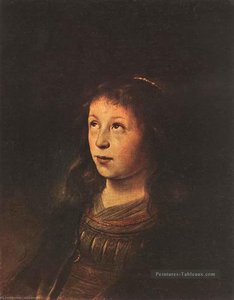 Portrait of a Girl - Jan Lievens
In his 1630 Portrait of a Girl, Jan Lievens demonstrates the profound psychological depth and dramatic chiaroscuro that define the Dutch Baroque movement. The work captures a young subject against an impenetrable, dark background, using luminous highlights to sculpt her features and create a sense of three-dimensional presence. This masterful command of light and shadow serves to isolate the figure, intensifying the viewer's connection to her melancholic gaze and the delicate textures of her attire.
Born in Leiden in 1607, Lievens was a precocious talent who established his independence as an artist by age twelve. His career was marked by significant royal patronage, including the attention of Maurice of Nassau, Prince of Orange. A defining chapter of his life was his five-year collaboration with Rembrandt van Rijn in Amsterdam, a period of intense technical experimentation that helped shape his distinctive style. By age thirty-one, his reputation had ascended to the British court, cementing his status as a figure of European significance. His ability to blend meticulous detail with the theatricality of the Baroque era makes him a vital representative of the Golden Age, specializing in works that balance physical likeness with an evocative, inner life.
Cornelius van Poelenburgh
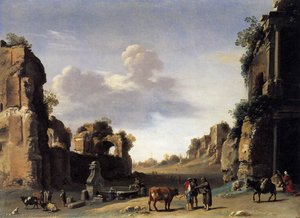 View of the Campo Vaccino - Cornelius van Poelenburgh
A central figure in the Dutch Baroque movement, Cornelius van Poelenburgh (1594–1667) bridged the gap between the meticulous traditions of the Netherlands and the luminous, classical grandeur of Italy. Trained in Utrecht under the esteemed Abraham Bloemaert, his artistic trajectory was fundamentally altered by his travels to Rome. This exposure allowed him to become a leading representative of the first generation of Dutch landscape painters active in Italy, infusing his work with an idealized, Romanesque elegance that set him apart from his contemporaries.
His mastery is most evident in his small-scale, intimate compositions, where he often utilized copper to achieve an extraordinary level of detail and luminosity. In his representative work, View of the Campo Vaccino (1620), he captures the Roman Forum not merely as a topographical site, but as a theatrical stage where the crumbling ruins of antiquity meet a soft, atmospheric light. This ability to blend mythological or biblical narratives—such as the figures in his Satyrs Spying on Nymphs—within a highly structured, classical landscape defines his contribution to the Baroque era. Through his delicate brushwork and command of light, van Poelenburgh transformed the landscape into a vessel for spiritual and historical contemplation.
Hendrick Terbrugghen
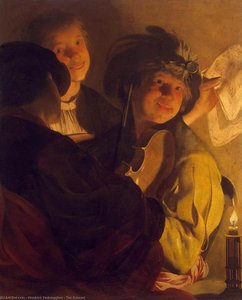 The Concert - Hendrick Terbrugghen
A central figure of the Utrecht Caravaggisti, Hendrick Terbrugghen brought the dramatic intensity of the Italian Baroque to the Netherlands. Born in 1588 in Overijssel, his early life was shaped by the courtly atmosphere of Utrecht, where his father served the House of Orange. This sophisticated environment provided a foundation for his formal training under the Mannerist master Abraham Bloemaert, a period that prepared him for his eventual embrace of the revolutionary chiaroscuro style.
Terbrugghen’s mastery lies in his ability to manipulate light and shadow to create theatrical, emotionally charged compositions. His work is defined by a rich coloration and a profound sense of depth, qualities that allowed him to bridge the gap between Mannerist elegance and the raw, direct naturalism of the Baroque era. In his representative work, The Concert, one observes the sophisticated interplay of light that characterizes his approach to musical and social scenes. His influence was significant enough to resonate through the Dutch Golden Age, leaving a legacy that informed the techniques of subsequent masters, including Rembrandt van Rijn. Through works such as his Annunciation and The Singing Lute Player, Terbrugghen remains a vital link in the evolution of Dutch Baroque painting."
Gerard van Honthorst
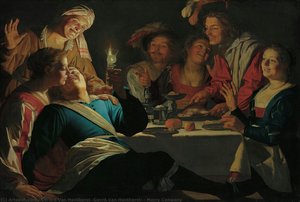 Merry Company - Gerard van Honthorst
Gerard van Honthorst stands as a luminous figure among Dutch baroque painters, a master who bridged the gap between the intense Caravaggism of Italy and the intimate sensibilities of the Netherlands. Born in 1592, his early training under Abraham Bloemaert provided a rigorous foundation, but it was his transformative journey to Rome that defined his legacy. By embracing the dramatic use of tenebrism—the stark, theatrical contrast between light and impenetrable shadow—he earned the evocative nickname “Gherardo delle Notti” (Gerard of the Nights). This ability to sculpt form through light became a hallmark of the Dutch Baroque, allowing him to translate religious and secular scenes into deeply emotional experiences.
His 1622 masterpiece, “Merry Company,” exemplifies this nocturnal mastery. In this work, Honthorst moves beyond mere imitation of Caravaggio to create a distinctly Dutch atmosphere of social intimacy. The painting utilizes a theatrical, directional light to carve figures out of the darkness, casting velvety shadows that swallow the periphery of the tavern setting. Through meticulous attention to texture—from the glint of pewter to the warmth of skin—Honthorst captures a fleeting, melancholic moment of human connection, cementing his status as a premier architect of light within the Dutch Golden Age.
Conclusion
The legacy of these masters lies in their ability to transform a canvas into a stage of light and shadow. From the intimate, quiet interiors of Vermeer and De Hooch to the dramatic, psychological depth achieved by Rembrandt and Lievens, the Dutch Baroque movement redefined how humanity perceives light, texture, and emotion. Whether through the genre scenes of Jan Steen or the theatrical chiaroscuro of Honthorst, these artists captured the essence of a golden age, leaving behind a visual language that continues to resonate across centuries.
At Mus3ums.com, we invite you to bring this profound sense of history into your own living space. Our artisans specialize in creating museum-quality, hand-painted oil reproductions that honor the specific brushwork and tonal complexity of these Dutch masters. By choosing a bespoke commission, you are not merely decorating a wall; you are acquiring a piece of heritage, meticulously crafted on cotton canvas to ensure the soul of the original remains intact. Explore our full collection and discover how these timeless masterpieces can transform your home through the artistry of hand-painted oils.