
Introduction
German romantic painters emerged during a transformative era in the late 18th and early 19th centuries, a period defined by a profound shift from Enlightenment rationalism toward the primacy of individual emotion and the sublime power of the natural world. Moving away from the rigid structures of Neoclassicism, these artists sought to capture the spiritual essence of the landscape, often portraying nature as a vast, untamable force that reflects the internal complexities of the human soul. This movement was deeply intertwined with the cultural awakening of the German-speaking lands, emphasizing a sense of longing, introspection, and a deep connection to the mystical qualities of the forest, the mountain, and the sea.
The works of this period are characterized by a unique tension between meticulous detail and atmospheric abstraction. Whether through the dramatic, fog-shrouded vistas of the North German plains or the intimate, symbolic compositions of the Dresden school, these painters utilized light and shadow to evoke a sense of the infinite. Their ability to translate metaphysical concepts into visual form allowed them to transcend mere landscape painting, turning the canvas into a space for philosophical inquiry and emotional resonance.
Today, the legacy of these masters remains vital, as their exploration of the relationship between humanity and the environment continues to resonate in a modern world often disconnected from the natural landscape. Their influence can be seen in the evolution of modern expressionism and the ongoing dialogue regarding the sublime. The following profiles examine ten essential figures of this movement, ranging from the profound spiritualism of Caspar David Friedrich to the detailed genre scenes of Carl Spitzweg, providing a comprehensive overview of the artists who defined the German romantic aesthetic.
Caspar David Friedrich
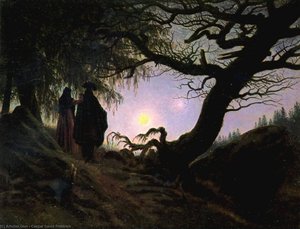
In Man and Woman Contemplating the Moon (1824), the viewer is invited into a nocturnal realm of profound stillness. This work exemplifies the mastery of Caspar David Friedrich, a central figure among German Romantic painters, by utilizing the landscape as a vessel for spiritual and emotional inquiry. His approach moved beyond mere topographical accuracy, seeking instead to capture the "internal weather" of the human spirit through the lens of the sublime.
Born in Greifswald in 1774, Friedrich’s artistic vision was deeply influenced by a sensitivity to mortality and a dual interest in art and theology. His technique often employed Rückenfiguren—figures seen from behind—to serve as proxies for the viewer, facilitating a shared moment of contemplation. His palette, dominated by muted blues, grays, and deep blacks, creates an atmospheric tension between the finite human presence and the infinite natural world. Whether depicting the chilling Arctic in The Sea of Ice or the misty heights of his most famous compositions, Friedrich’s work remains a definitive expression of German Romanticism, where the wildness of nature serves as a mirror to the soul's most intimate reflections.
Carl Spitzweg
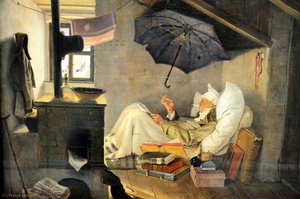 The Poor Poet - Carl Spitzweg
Carl Spitzweg (1808–1885) occupies a unique position within the German Romantic movement, offering a gentle, often humorous counterpoint to the era's more turbulent and sublime expressions. While many of his contemporaries focused on the overwhelming power of nature, Spitzweg turned his gaze toward the quiet, introspective corners of human existence. His transition from a pharmacy apprentice to a celebrated painter allowed him to develop a highly personal style, characterized by a meticulous attention to detail learned from studying Flemish masters. This focus on the individual and the emotional nuances of everyday life firmly roots his work in the Romantic tradition of prioritizing feeling and subjective experience.
His most iconic work, The Poor Poet (1839), serves as a definitive example of his ability to capture the melancholic soul of the artist. Through a masterful use of chiaroscuro, he depicts a solitary figure in a cluttered attic, using light and shadow to explore themes of intellectual isolation and the bittersweet beauty of contemplation. By elevating the mundane to the level of profound emotional study, Spitzweg bridged the gap between the Biedermeier era's domesticity and the deeper, existential yearnings of German Romanticism."
Ludwig Van Beethoven
 Quartet for two violins, viola and cello (A minor) op. 132 - Ludwig Van Beethoven
While primarily recognized as a titan of music, Ludwig van Beethoven (1770–1827) embodies the very essence of the German Romantic movement through his profound emphasis on raw emotion and the internal struggle of the human spirit. Much like the Romantic painters of his era who sought to capture the sublime power of nature, Beethoven’s work transitioned from Classical order into a tempestuous landscape of feeling. His life was a testament to this shift; despite the isolation brought by his increasing deafness, he dismantled established musical structures to prioritize personal expression over rigid tradition.
His 1825 masterpiece, Quartet for two violins, viola and cello (A minor) op. 132, serves as a sonic parallel to the intense, melancholic depth found in German Romanticism. Composed during a period of physical frailty and deep introspection, the work reflects a grappling with mortality and faith. The piece is characterized by a brooding, haunting atmosphere and a complex five-movement structure that defies conventional sonata cycles. Through this composition, Beethoven achieved the Romantic ideal: transforming personal suffering into a universal language of dramatic tension and spiritual yearning.
Emanuel Leutze
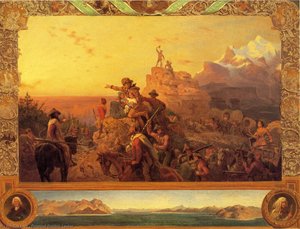 Westward The Course of Empire Takes Its Way - Emanuel Leutze
Emanuel Gottlieb Leutze (1816–1868) represents a fascinating bridge between European academic rigor and the burgeoning narratives of the New World. His inclusion in the canon of German Romanticism is rooted in his formative years at the prestigious Kunstakademie Düsseldorf. It was here that he absorbed the aesthetic philosophies of the movement, specifically the dramatic composition and emotional intensity championed by figures like Karl Friedrich Lessing. This training allowed him to master the ability to infuse historical events with a sense of sublime, sweeping emotion.
A defining aspect of Leutze's life was his ability to synthesize these German traditions with his experiences in America. This duality is masterfully captured in his 1861 masterpiece, Westward The Course of Empire Takes Its Way. In this work, the Romantic preoccupation with the power of nature and the relentless momentum of human spirit is redirected toward the American frontier. Rather than focusing on the wildness of untamed forests, Leutze utilizes the movement's characteristic dramatic lighting and grand scale to depict the unstoppable procession of pioneers. Through his brush, the westward expansion becomes an epic, emotional saga, echoing the dramatic intensity found in the works of his German contemporaries while documenting a new era of history.
Carl Blechen
 The Interior of the Palm House on the Pfaueninsel Near Potsdam - Carl Blechen
Carl Blechen (1798–1840) stands as a transformative figure within German Romanticism, bridging the gap between the movement's traditional obsession with sublime nature and the emerging realities of a modernizing world. While many of his contemporaries sought refuge in idealized landscapes, Blechen’s work is distinguished by a pioneering interest in the interplay between natural beauty and the encroaching industrial age. His style is characterized by a vibrant, energetic brushwork and a sophisticated sensitivity to light, a skill he refined during a transformative journey to Italy between 1828 and 1829. This period allowed him to master the art of plein air sketching, capturing atmospheric effects with a precision that often bordered on nascent realism.
A profound example of his ability to harmonize structured design with organic life is his 1834 oil on canvas, The Interior of the Palm House on the Pfaueninsel Near Potsdam. In this work, Blechen explores the tension between the architectural lines of Karl Friedrich Schinkel’s Moorish-style conservatory and the lush, cascading textures of tropical flora. The composition uses light to filter through dense greenery, illuminating both the botanical specimens and the figures within, creating a tranquil yet visually complex atmosphere that defines his unique contribution to the Romantic era.
Philipp Otto Runge
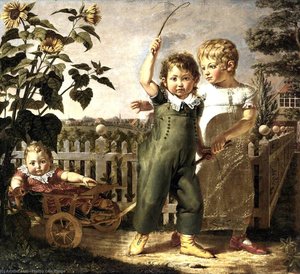
A central figure in the German Romantic movement, Philipp Otto Runge (1777–1810) sought to bridge the gap between the physical world and the spiritual realm through a highly symbolic visual language. His work is defined by a profound preoccupation with the mystical and the cosmic, often drawing inspiration from the philosophical writings of Jakob Böhme. Unlike the more landscape-focused approach of his contemporary Caspar David Friedrich, Runge’s vision was deeply rooted in a complex color theory, famously articulated in his Color Sphere, which explored the emotional and spiritual resonance of the chromatic spectrum.
His masterpiece, The Hülsenbeck Children (1805), serves as a luminous testament to his ability to infuse naturalistic scenes with a sense of divine purity. In this work, the artist utilizes refined brushwork and layered glazes to create a soft, glowing atmosphere, capturing the innocence of childhood within a serene rural setting. Through his meticulous use of light and shadow, Runge transformed the simple intimacy of family life into a profound meditation on nature and existence, cementing his legacy as a pioneering visionary of the Romantic era.
Karl Robert von Planitz
 Igreja e Morro de Nª Senhora da Gloria (Rio de Janeiro) [Nossa Senhora da Glória Church and Hill] - Karl Robert von Planitz
Karl Robert von Planitz (1804–1847) represents a unique intersection within the German Romanticism movement, bridging European sensibilities with the exoticism of the New World. While his lineage connects him to the German tradition, his artistic legacy is defined by his profound documentation of the Brazilian landscape during the 19th century. His work embodies the Romantic preoccupation with the sublime power of nature and the emotional resonance of vast, untamed vistas, often juxtaposing architectural structures against the overwhelming scale of the natural environment.
In his representative work, Igreja e Morro de Nª Senhora da Gloria (Rio de Janeiro) (1840), von Planitz demonstrates the meticulous attention to detail and atmospheric light characteristic of the era. The composition captures a serene equilibrium between the man-made grandeur of the church and the verdant, undulating hills of the Rio coastline. His ability to render the interplay of sunlight on the water and the rhythmic vitality of maritime life reflects the Romantic desire to capture the ephemeral essence of a specific place and time. Through his precise brushwork, the landscape transcends mere topography to become a contemplative study of light, shadow, and the quiet majesty of the natural world.
Carl Gustav Carus
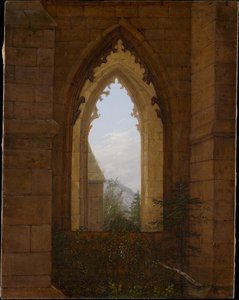 Gothic Windows in the Ruins of the Monastery at Oybin - Carl Gustav Carus
Carl Gustav Carus (1789–1869) represents the profound intersection of scientific inquiry and the emotional depth characteristic of German Romanticism. A true polymath, Carus was not merely a painter but also a distinguished physician, botanist, and geologist. His unique perspective allowed him to view the natural world as a living, breathing organism, bridging the gap between the analytical rigor of the Enlightenment and the spiritual yearning of the Romantic era. His intellectual life was deeply intertwined with the cultural currents of his time, notably through his connection to Goethe at Jena University, which placed him at the epicenter of German Romantic thought.
His work often explores the sublime through the lens of atmospheric landscapes and psychological depth, a quality that would later influence thinkers like Darwin and Jung. In his 1828 masterpiece, Gothic Windows in the Ruins of the Monastery at Oybin, Carus exemplifies the movement's fascination with the passage of time and the restorative power of nature. By juxtaposing the decaying stone of Gothic architecture with ethereal, shifting light, he captures the tension between earthly mortality and spiritual transcendence. Through this synthesis of clinical observation and poetic vision, Carus remains a vital figure in the history of German Romanticism.
Franz Krüger
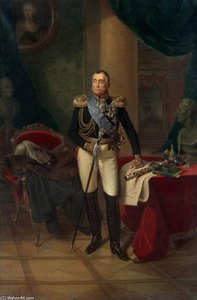 Portrait of Prince Pyotr Volkonsky - Franz Krüger
Franz Krüger (1797–1857) occupied a unique position within the German Romanticism movement, bridging the gap between the era's intense emotionalism and a burgeoning interest in precise, historical realism. While many of his contemporaries focused on the sublime, untamed landscapes of nature, Krüger directed the Romantic fascination with individual character and the spirit of an age toward the social and military structures of Prussia. His work is defined by a profound psychological depth that moved beyond the stiff formalities of traditional portraiture, capturing the vital essence of his subjects.
Often referred to by the moniker "Pferde-Krüger" due to his unparalleled ability to render the muscular tension and anatomical grace of horses, his technical mastery was forged through direct observation in the Prussian royal stables. This dedication to life-like accuracy is masterfully displayed in his 1850 work, Portrait of Prince Pyotr Volkonsky. In this composition, Krüger utilizes a sophisticated orchestration of light and setting to document the opulence of the aristocracy. By blending the meticulous detail of a realist with the dramatic, atmospheric sensibilities of the Romantic period, Krüger transformed mere documentation into a profound study of status, duty, and the rigid elegance of nineteenth-century high society.
Carl Rottmann
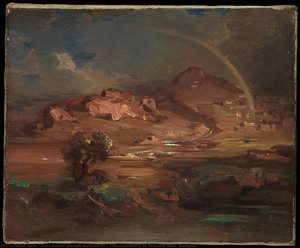 The Cemetery at Pronoia near Nauplia - Carl Rottmann
Carl Rottmann (1797–1850) stands as a pivotal figure among German Romantic painters, distinguished by his ability to transcend mere topographical sketching in favor of the sublime. While many of his contemporaries focused on intimate or domestic scenes, Rottmann sought the monumental. His work is characterized by an expansive, sweeping vision that captures the vastness of the natural world, often imbuing rugged terrains with a sense of mythic presence and spiritual weight. A visitor can recognize a Rottmann landscape by its dramatic use of light and shadow, which serves to evoke awe and a sense of historical gravity rather than simple clarity.
His stylistic evolution moved from classical precision toward a deeply emotive, atmospheric approach, heavily influenced by his travels through the Bavarian Alps, Italy, and Greece. This is masterfully demonstrated in his work, The Cemetery at Pronoia near Nauplia. In this piece, Rottmann utilizes a bruised, turbulent sky and swirling clouds to create a meditation on mortality and memory. By blending topographical accuracy with an intense, melancholic atmosphere, he successfully bridged the gap between the tangible landscape and the realm of the imagination, a hallmark of the Romantic movement.
Conclusion
The German Romantic movement represents a profound shift in the history of European art, moving away from the rigid structures of Neoclassicism toward a deep, often melancholic exploration of the human psyche and the sublime power of the natural world. From the spiritual, landscape-driven meditations of Caspar David Friedrich to the more narrative and genre-focused approaches of Carl Spitzweg and Emanuel Leutze, these artists collectively redefined how emotion and national identity could be expressed through pigment and light. Whether through the atmospheric intensity of Carl Blechen or the intricate, symbolic compositions of Philipp Otto Runge, this group of painters captured a sense of longing and awe that continues to resonate in the modern era.
For those seeking to bring this era of profound emotion into a contemporary space, our full collection offers a way to connect with these historical masters. At Mus3ums.com, we specialize in preserving this legacy through museum-quality, hand-painted oil reproductions that honor the original brushwork and tonal depth of these German masters, allowing you to live with their sublime visions every day.


