A Life Shaped by Thread and Myth
Aleksander Promet began his creative life far from the canvas, rooted in the industrial rhythm of Kreenholm. Born to blue-collar workers at the Krenholm Manufacturing Company, his early training was practical and precise. Between 1897 and 1904, he studied at the Saint Petersburg Art and Industry Academy, where he focused on the intricate discipline of textile design. This foundation in pattern and structure would later inform the compositions of his graphic work.
A government scholarship briefly carried him to London, but the pull of the broader European art scene proved stronger. He moved to Paris, immersing himself in the international art community, though this period of wandering ended when his scholarship was cancelled in 1906. Returning to Estonia, he established a workshop in Tartu, marking the start of a career deeply tied to his homeland's identity.
The Language of Folklore
Promet’s artistic direction was defined by an interest in the ancient and the local. While he moved through various cities—teaching in Tallinn, working as a freelancer in Petrograd, and living in Paldiski—his subject matter remained anchored in Estonian tradition. He became a founding member of the Estonian Art Association in 1907, and his first major exhibition in 1909 gained attention specifically for its use of folk motifs.
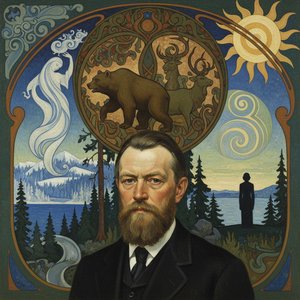
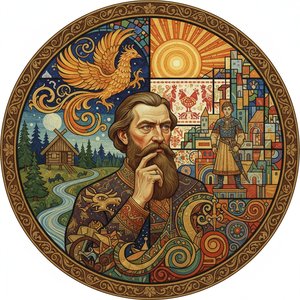
His work often looked backward to the legends of the past. He produced an extensive series of paintings based on the national epic, Kalevipoeg, translating oral tradition into visual form. Even his landscapes were rarely mere observations of nature; they were imbued with the weight of mythology. This focus set him apart from the Neo-Romantic approach favored by the "Young Estonia" group, as he maintained an apolitical stance even while associated with left-wing publishers.
Technique and Final Years
The artist’s hand was versatile, moving between the delicate application of watercolor and the heavier textures of gouache and pastel. His works, such as Nuttev naine, utilized paper and gouache to capture specific character studies, while other pieces like Ussikuningas employed a mix of pastel and watercolor to build depth. These varied media allowed him to navigate between the fine detail required for graphic art and the broader strokes needed for mythic storytelling.
After years of movement through Petersi, Tõrva, and Paldiski, he settled in Tallinn in 1925. He spent his final decade there as a freelance artist and lecturer, continuing to work until his death in 1938. His life left behind a distinct body of work that remains held in collections such as the Art Museum of Estonia and the Tartu Art Museum.
Q&A
Aleksander Promet의 출생 도시와 국가는 어디인가요?
Aleksander Promet은(는) Estonia Narva에서 태어났습니다.
Aleksander Promet 작가의 다른 활동명이나 알려진 이름이 있나요?
Aleksander Promet은(는) Александр Промет(으)로도 알려져 있습니다.
Aleksander Promet 작가의 국적은 어디인가요?
Aleksander Promet은(는) Estonia 출신입니다.