The Man from Cremona
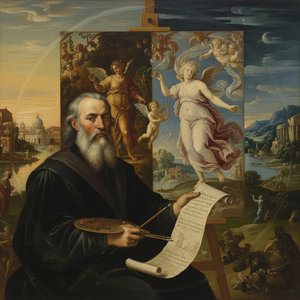
Giovan Battista Trotti lived a life deeply rooted in the traditions of Northern Italy. Born in Cremona around 1555, he carried the nickname Il Malosso, a name linked to his birthplace. His early years were shaped by the workshop of Bernardino Campi. By inheriting this studio, Trotti did more than learn a trade; he absorbed a specific way of seeing the world through detail and balance. He was a student who listened closely, yet he possessed an inquisitive nature that led him to look toward the works of Correggio for inspiration, particularly in how light and perspective could create depth.
His path was not one of solitary wandering but of deep connection to the local landscape. He moved between Cremona, Parma, and Piacenza, finding work as a painter, architect, and designer. This versatility allowed him to touch many different lives through his art. He even married the niece of his teacher, Campi, weaving himself into the very fabric of the artistic community that raised him.
A Life of Service and Stone
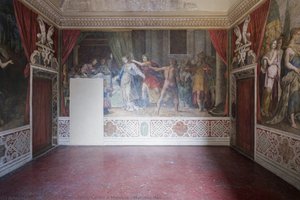
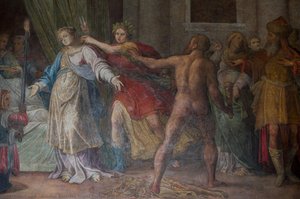
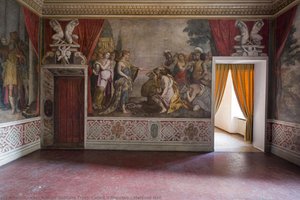
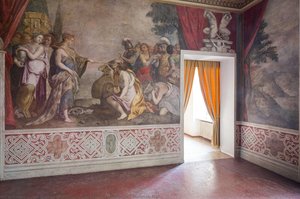
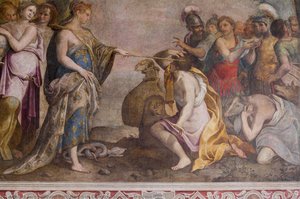
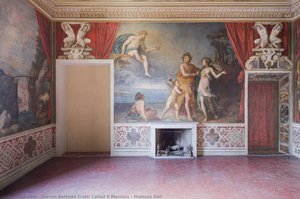
Trotti’s work often found its home in the grand spaces of the powerful. He worked for the Farnese family, leaving his mark on the architecture and interiors they inhabited. In Parma, he contributed to the Malosso Hall, a space where he painted mythological figures within large architectural settings. His ability to design both the surface of a wall and the structure itself made him a rare figure in his era. He understood how a room should feel before he ever picked up a brush.
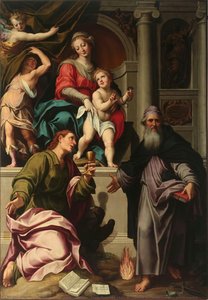
His religious commissions were equally significant, often placed in prominent churches where they could be seen by many. In Piacenza, he worked on the Church of San Francesco and Sant'Agostino. His hands shaped altarpieces and frescoes that brought religious narratives into the physical space of the viewer. Some of these works, like his depictions for the Palazzo Farnese, used complex architectural layers to guide the eye toward spiritual subjects.
The Marks He Left Behind
While many remember him for his large-scale paintings, his smaller, more intimate drawings offer a glimpse into his daily process. These sketches were practical tools, used to plan his larger architectural and decorative schemes. They show a man focused on the mechanics of composition and the careful placement of figures. Collectors today look at these works to see the preparation behind the finished walls.
The legacy of Trotti is found in the lasting presence of his work across several Italian cities. His paintings, such as those featuring the Beheading of Saint John the Baptist or the Immaculate Conception, remain in museums and churches like the Musei Civici di Palazzo Farnese. He was a man who built upon the foundations of those before him, adding his own layer of movement and emotion to the late Renaissance and early Baroque periods.
Q&A
Giovan Battista Trotti Called Il Malosso의 다른 이름이나 별칭에는 무엇이 있나요?
Giovan Battista Trotti Called Il Malosso은(는) Giovanni Battista Trotti, Giovan Battista Trotti (Il Malosso)(으)로도 알려져 있습니다.
Giovan Battista Trotti Called Il Malosso 작가의 국적은 어디인가요?
Giovan Battista Trotti Called Il Malosso은(는) Italy 출신입니다.
Giovan Battista Trotti Called Il Malosso은(는) 어느 시대의 작품을 남겼나요?
Giovan Battista Trotti Called Il Malosso은(는) Renaissance 시대에 활동했습니다. 이 시기는 역사적 맥락 속에서 작가의 예술적 위치를 보여줍니다.