A Visionary of Line and Legacy: The Life of Martel Schwichtenberg
Justine Adele Martha Schwichtenberg, known more widely to the art world as Martel Schwichtenberg, was an artist whose creative reach extended far beyond the boundaries of a single medium. Born in Hanover, Germany, in 1896, her life was a tapestry woven from the threads of avant-garde experimentation and the practical demands of industrial design. Her early training at the Kunstgewerbeschule in Düsseldorf provided her with a rigorous foundation in applied arts, yet it was her unique ability to marry aesthetic elegance with functional clarity that would define her career. Long before the concept of "corporate identity" became a staple of modern marketing, Schwichtenlyberg was pioneering its use, most notably through her nearly thirty-year association with the Bahlsen biscuit company. Her hand shaped the visual language of the brand, creating iconic packaging and even developing a logo that remains a testament to her enduring graphic sensibility.From the Studios of Berlin to the Heart of the Avant-Garde
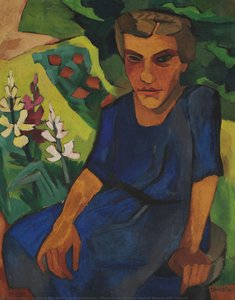
As the 1920s dawned, Schwichtenberg’s journey led her to the electric atmosphere of Berlin, a city then pulsating with radical artistic movements. Settling in Charlottenburg, she established herself not merely as a designer but as a vital participant in the era's most progressive circles. Her membership in the Werkbund and the revolutionary Novembergruppe placed her at the epicenter of German Expressionism and modernism. During these formative years, her work began to reflect the bold, emotive energy of the age, incorporating influences from the graphic intensity of the Bridge movement. She moved seamlessly between the meticulous world of architectural elements—such as stained-glass windows for factory buildings—and the intimate, soulful realm of portraiture and woodcuts. Her presence in Berlin’s elite galleries, including the Flechtheim, signaled her ascent into the upper echelons of the European art scene, where she captured the likenesses of the very avant-garde luminaries who defined her generation.Exile, Tragedy, and the Enduring Spirit
The trajectory of Schwichtenberg’s life was irrevocably altered by the political storms gathering over Germany. In 1933, seeking refuge from the rising tide of Nazism, she emigrated to South Africa, a move that would lead to both profound isolation and unexpected creative expansion. In Johannesburg, her artistry found new landscapes; she collaborated on large-scale murals for the House of Broadcasting and documented her surroundings through hundreds of luminous watercolors. Yet, the shadow of the past followed her; her work Die Pommernfraun was infamously included in the Nazi exhibition of "Degenerate Art," a cruel irony for an artist who had championed the new. The final chapter of her life was marked by profound loss when, in 1938, a devastating fire destroyed her home and studio, consuming nearly four hundred of her precious works. Though she passed away in 1945, shortly after the conclusion of the war, the legacy of Martel Schwichtenberg remains etched in the history of modern design and German expressionism—a story of a woman who navigated the complexities of identity, industry, and art with unparalleled grace.질의응답
Justine Adele Martha Schwichtenberg의 다른 이름이나 별칭에는 무엇이 있나요?
Justine Adele Martha Schwichtenberg은(는) Martel Schwichtenberg라는 다른 이름으로도 알려져 있습니다.
Justine Adele Martha Schwichtenberg의 출생 도시와 국가는 어디인가요?
Justine Adele Martha Schwichtenberg은(는) Germany의 Hanover에서 태어났습니다.
Justine Adele Martha Schwichtenberg 작가의 출신 국가는 어디인가요?
Justine Adele Martha Schwichtenberg은(는) Germany에서 태어났습니다.