The Painter of the Shtetl
Born Mane Leyzerovich Kats in Kremenchuk, Ukraine, in 1894, the man who would become Emmanuel Mané-Katz lived a life shaped by the shifting borders of the Russian Empire and the artistic currents of Europe. His father envisioned a life of religious scholarship, perhaps a path toward the rabbinate, but the young artist sought the studios of Paris instead. This departure from tradition led him to the heart of the School of Paris, where he moved through a landscape of profound change. During the First World War, he returned to Russia to teach and exhibit in Petrograd, only to find himself caught in the turbulence of the October Revolution. By 1921, the necessity of escape brought him back to Paris, where he moved within a circle of Jewish artists including Chaim Soutine and Marc Chagall.
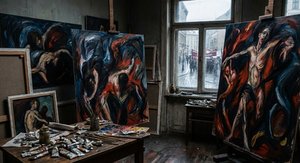
His early work possessed a classical, somber quality, reflecting a more restrained approach to his subjects. However, as the years progressed, his aesthetic underwent a significant transformation. He moved away from those darker tones toward a palette defined by bright, primary colors. This shift coincided with a deepening focus on his spiritual and cultural roots. While he maintained a residence in Paris, he often spoke of Eretz Yisrael as his true spiritual home, a sentiment reflected in his frequent travels to Mandate Palestine starting in 1928.
A Visual Language of Tradition
The imagery in his paintings often centered on the lived experience of the Jewish people, drawing from the traditions of the Eastern European shtetl. His canvases became repositories for specific cultural archetypes and scenes:
- Hassidic characters and rabbis captured in moments of quiet contemplation.
- Jewish musicians providing a rhythmic pulse to his compositions.
- The figures of beggars and yeshiva students navigating their environments.
- Scenes from the shtetl that bridged the gap between his past and his present.
In 1931, his ability to translate these themes into a formal language was recognized when his painting The Wailing Wall was awarded a gold medal at the Paris World's Fair. His work functioned as a bridge between the heavy, textured realities of his upbringing and the modern movements of the mid-century.
The Legacy in Haifa
The later years of his life were marked by a profound connection to the land he had long visited. He eventually settled in Israel, leaving behind a substantial collection of his own paintings and a vast array of Jewish ritual art. This collection was gifted to the city of Haifa, where his work found a permanent home in a museum on Mount Carmel. The building, provided by the mayor Abba Hushi, serves as a repository for his evolving style, from his early somber oils to his later, more colorful expressions. His influence extended beyond his own canvases, as he donated works to the Glitzenstein Museum in Safed, contributing to the artistic vitality of that quarter during the 1950s and 1960s.
Klausimai ir atsakymai
Kokie kiti Emanuelas Manė-Katzas vardai yra žinomi?
Emanuelas Manė-Katzas taip pat žinomas (a) pavadinimais Manė-Katzas, Mane Leyzerovich Kats, Mané-Katz.
Kuriame istoriniame laikotarpyje kūrė Emanuelas Manė-Katzas?
Emanuelas Manė-Katzas kūrė Modernizmas laikotarpiu. Šis laikotarpis leidžia įvertinti kūrybinę veiklą istoriniame kontekste.
Iš kokios šalies yra Emanuelas Manė-Katzas?
Emanuelas Manė-Katzas gimė Ukraina.