The Unseen Messenger: Early Christian Symbols and the Absence of Flight
 Celestial Messengers: Tracing the Evolution of Angelic Iconography in Western Art History
The Abstract Origin: Wingless Messengers in Early Christian Art Celestial Messengers: Angels in Painting – A Historical & Artistic Exploration The Genesis of Angelic Representation: From Ancient Roots to Early Christian Art Wikipedia: Angels in art A...
In the quiet, subterranean depths of the mid-third-century Catacombs of Priscilla in Rome, a different kind of presence resides. To look upon these early layers of Christian iconography is to encounter a divinity that does not yet demand spectacle. Here, the concept of the divine messenger was far more abstract than the feathered figures we recognize today. The angels depicted in these frescoes often lack any physical markers of flight; they appear as young men, grounded and human, echoing the biblical descriptions of Gabriel found in the Book of Daniel.
This absence of wings was a deliberate theological choice rather than a limitation of skill. Artists sought to represent angels as pure spirits, unburdened by the weight of physical form or the biological necessity of movement. The focus remained on the role of the messenger—the delivery of divine news through presence rather than ornament. In some instances, even more stripped-back symbols like the dove or the Hand of God substituted for a winged figure, emphasizing that the essence of the message mattered far more than the anatomy of the sender. It is a period of understated symbolism that reminds us how much meaning can be found in what is left unsaid.
Borrowing from Antiquity: The Classical Influence on Divine Form
As time progressed, the visual vocabulary of the divine began to borrow heavily from the established imagery of the ancient world. The transition toward the winged beings we recognize today was not an isolated invention but a continuation of a much older aesthetic lineage. In classical Greece, figures such as Nike, the personification of victory, and Eros already possessed wings to signify their ability to traverse different realms. Similarly, in ancient Assyria, the colossal winged bulls known as lamassu served as protective guardians at palace entrances.
As Christianity moved into a more prominent role within society, artists naturally adopted these existing symbols of power and transcendence. This blending of traditions allowed for a new, recognizable language of flight to emerge. The ethereal presence that had once been purely spiritual began to take on a physical, albeit supernatural, form. By utilizing the wings of the classical world, the artist could communicate the ability of a messenger to move between the earthly and the divine, bridging the gap between ancient myth and emerging faith.
Portals of Gold: The Byzantine Legacy and the Russian Icon
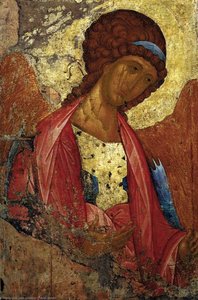
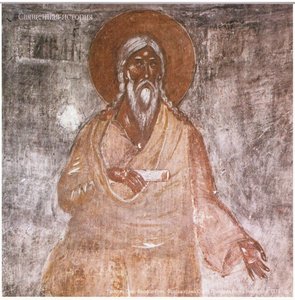 Theophanes The Greek
A Luminary of Byzantium: The Life and Legacy of Theophanes the Greek The name Theophanes the Greek evokes a world steeped in incense, shimmering gold leaf, and profound spiritual contemplation. Born in Constantinople around 1340, though often associa...
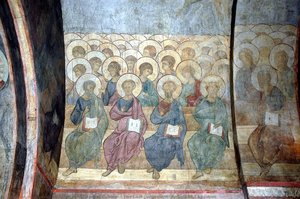
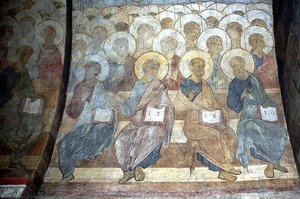
The movement of history is often marked by the movement of people, and few shifts were as transformative for art as the migration of Byzantine masters toward the north. In the late 14th century, figures like Theophanes the Greek brought the shimmering, incense-heavy world of Constantinople to the burgeoning centers of Russia. This era was defined by a profound spiritual architecture, where icons were crafted not merely as objects of beauty but as portals to the divine.
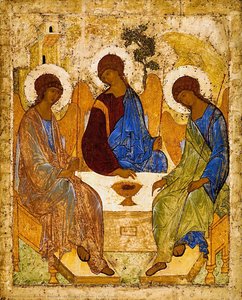
Theophanes introduced a new level of dynamism and psychological depth to Russian religious art, a legacy that would find its most profound expression in his pupil, Andrei Rublev. While Theophans brought the sophisticated techniques of the Byzantine tradition, Rublev infused them with a uniquely Russian sensibility—a palpable sense of humility and emotional resonance. In works like the Trinity icon, we see a departure from more static traditions toward an intimate depiction of divine unity. Through the meticulous application of gold leaf and the use of egg tempera on wood panels, these artists created a luminosity that suggested the very presence of grace, turning painted surfaces into windows for contemplation.
Distilling Nature: Mondrian’s Radical Break Toward Abstraction
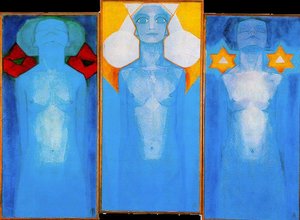 Evolution
Evolution by Piet Mondrian Piet Mondrian’s Evolution, created in 1911, stands as a pivotal moment in the artist's artistic journey—a decisive break from his earlier landscapes and Impressionistic tendencies toward a radical embrace of abstraction. Me...
Moving away from the sacred and into the structural, the early 20th century brought a different kind of transformation. In 1911, Piet Mondrian began to move away from his earlier landscapes and Impressionistic tendencies, seeking instead to distill the essence of nature into its purest visual elements. His work, Evolution, marks this decisive break. Measuring 178 x 85 cm, this oil painting on canvas exemplifies the Fauvist movement’s bold experimentation with color and form.
Mondrian’s process was one of reduction. He moved from capturing the beauty of the Dutch countryside to exploring the relationship between color and geometric abstraction. In Evolution, three women are set against distinct backgrounds of blue, yellow, and white. The composition is structured through horizontal and vertical lines—the foundational elements that would later define his Neoplasticist style. This was not a decorative exercise; it was an attempt to find universal order. By using colors that represent fundamental harmonies, Mondrian sought to mirror concepts found in Eastern philosophy, creating a visual tension that underscored the painting’s thematic concerns of growth and change.
Electric Rebellion: Reimagining Icons Through Pop Art and Neon Chaos
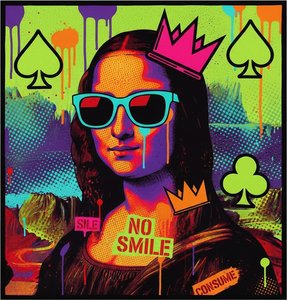
The trajectory of art history does not always move toward simplicity; sometimes, it moves toward a deliberate, high-tension fragmentation. In the contemporary era, artists like Caroline Pelletier reimagine classical iconography through the lens of modern urban rebellion. This approach, often categorized as Aggressive Confrontational Pop, replaces the quietude of the past with the raw energy of street art and digital-age anarchy.
In works such as Neon Sovereignty, the structured elegance of a centralized portrait collides with the spontaneous decay of weathered textures. Using a hyper-saturated palette of acid green, electric cyan, and hot pink, the artist utilizes heavy halftone patterns and liquid drip vectors to create a sense of instability. Here, the weight of monumental symbols—crowns and spades—is disrupted by the pulse of contemporary culture. It is a visual experience where the nostalgia of the past is intentionally fractured by the neon glow of the present, offering a fresh perspective on how we interpret symbols in an age of digital chaos.
The Anatomy of Progress: Tracing Human Resilience through Medical History
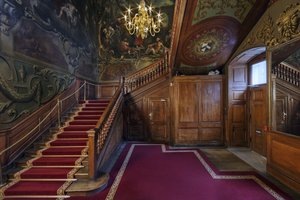 Barts Hospital
A Journey Through Time: The Barts Hospital Museum Nestled within the historic heart of St Bartholomew’s Hospital in London, the Barts Hospital Museum offers a profoundly moving and unexpectedly captivating experience – a journey through nearly nine c...
Beyond the canvas and the icon, history is also recorded in the evolution of human understanding and the tools used to preserve life. Institutions like the Barts Hospital Museum in London offer a profound intersection where medical science meets visual storytelling. Within these halls, one finds a narrative of resilience that spans nearly nine centuries, from the early surgical tools crafted from bone and metal to the intricate anatomical models of the Victorian era.
This history is not merely clinical; it is deeply intertwined with art. The presence of watercolor paintings by surgeons like Henry Tonks brings a unique sensitivity to the documentation of the human form, using light and color to illuminate subjects that might otherwise seem purely scientific. Even the architecture of these spaces, such as the Tudor-era Henry VIII Gate, acts as a silent participant in this story of metamorphosis. As we trace the evolution of medical knowledge through observation and dissection, we see a parallel to the artistic process itself: a steady, persistent effort to understand the underlying structures of our existence and to find meaning within the complexities of change.

 Neon Sovereignty: A Fragmented Iconography of Chaos and Electric Permanence