



Introduction
British realist painters emerged as a profound response to the shifting social landscapes of the United Kingdom, turning their gaze away from idealized mythologies and toward the unvarnished truth of everyday life. During a period marked by intense industrialization and profound social change, these artists sought to capture the essence of the human condition through the depiction of ordinary people, labor, and the natural world in their most authentic states. Rather than embellishing their subjects to fit a romanticized standard, they embraced the grit, the quiet dignity of manual work, and the subtle nuances of light and shadow that define our lived reality.
This movement represents a pivotal moment in art history where the focus shifted from the grandiosity of the past to the immediate, tangible present. By documenting the textures of rural landscapes and the honest expressions of the working class, these painters provided a visual record of a nation in transition. Their commitment to accuracy and sincerity allows us to connect with the past not through legend, but through the shared, recognizable experiences of humanity.
Today, the legacy of these artists remains vital for anyone seeking art that resonates with truth and substance. Their works offer a timeless window into the soul of the British Isles, reminding us that there is profound beauty in the mundane and the unadorned. In the following sections, we examine the lives and contributions of ten significant figures—including Richard Ansdell, James Aumonier, and Walter Greaves—whose mastery of the realist tradition continues to define the aesthetic integrity of the genre.
Herbert Arnould Olivier
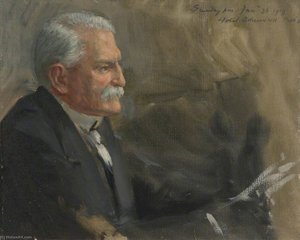 Baron Sidney Costantino Sonnino (1847–1922), Italian Foreign Minister (preparatory study for 'The Supreme War Council in Session at Versailles on 3rd July 1918' and 'Armistice Meeting 3rd and 4th November 1918') - Herbert Arnould Olivier
Herbert Arnould Olivier (1861–1952) stands as a profound voice among British realist painters, distinguished by his ability to capture the unvarnished essence of both the natural world and the human condition. His commitment to realism is most evident in his transition from the serene, atmospheric landscapes of the Sussex Downs to the stark, heavy realities of wartime documentation. Rather than idealizing his subjects, Olivier sought to portray the weight of existence, whether through the subtle shifts of light in the English countryside or the psychological depth of a statesman.
This dedication to truthful representation is masterfully realized in his 1919 preparatory study, Baron Sidney Costantino Sonnino (1847–1922), Italian Foreign Minister (preparatory study for 'The Supreme War Council in Session at Versailles on 3rd July 1918 and 'Armistice Meeting 3rd and 4th November 1918'). In this work, Olivier moves away from the grandiosity of historical spectacle to focus on the quiet, contemplative dignity of the individual. Through a sophisticated use of light and shadow, he captures the profound responsibility etched upon the subject's face, proving that realism lies not just in the accuracy of a likeness, but in the honest portrayal of the human spirit amidst global upheaval.
James Francis Danby
 A Boat and Breakwater by the Seashore at Sunset - James Francis Danby
Born in Bristol in 1816, James Francis Danby was immersed in a profound artistic legacy as the son of Francis Danby. His life was a quiet, dedicated observation of the natural world, specifically the fleeting transitions of light across the English countryside. He belongs to the group of British realist painters through his commitment to depicting the landscape exactly as it appeared, eschewing idealization in favor of the atmospheric truth of the moment. Rather than seeking the sublime through fantasy, he found his purpose in the subtle, honest shifts of sunrise and sunset.
In his 1871 work, A Boat and Breakwater by the Seashore at Sunset, this realist sensibility is captured through a masterful interplay of light and shadow. The composition utilizes a low horizon to grant the sky an immense presence, making the solitary boat appear fragile against the vastness of the atmosphere. His technical skill is evident in the thick, impastoed brushwork that gives the sand and waves a tactile reality. By focusing on the precise instant when the light fails and the tide pulls away, Danby captures a sense of profound stillness and the quietude of the coast, grounding his work in the tangible, unadorned reality of the maritime environment.
Richard Ansdell
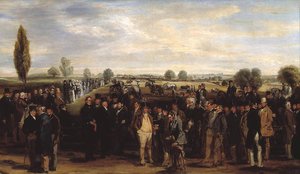 A Ploughing Match - Richard Ansdell
Richard Ansdell (1815–1885) stands as a quintessential figure among British realist painters due to his unwavering commitment to the unvarnished depiction of rural life and animal subjects. His journey began in Liverpool, where, after the loss of his father, he was raised by the Liverpool Blue Coat School. His technical foundation was built under W.C. Smith and further expanded during a formative period as a sign painter in the Netherlands, an experience that sharpened his observational precision.
Ansdell’s work is defined by its ability to capture the raw energy of the English countryside without idealization, a core tenet of the Realism movement. He specialized in the textures of livestock, the tension of wild encounters, and the social rituals of the working class. His masterpiece, A Ploughing Match, serves as a profound example of this approach. In this work, he moves beyond mere documentation to capture the communal spirit and the physical labor of a traditional agricultural event. Through his meticulous attention to light, shadow, and the dynamic arrangement of figures, Ansdell transformed ordinary rural scenes into compelling, high-stakes narratives of Victorian existence.
Thomas Faed
 Worn Out - Thomas Faed
Thomas Faed (1826–1900) stands as a preeminent figure in Scottish genre painting, a master whose work captures the profound emotional weight of Victorian life. His place within the Realism movement is defined by his ability to elevate the ordinary, transforming domestic scenes and rural existence into soulful narratives. Rather than idealizing his subjects, Faed focused on the quiet, often melancholic realities of the human condition, utilizing a tender realism to explore themes of family, fatigue, and spiritual connection.
A visitor can recognize a Faed original through his masterful handling of light and his ability to convey complex internal states through subtle gestures—a downward gaze or the soft glow of a hearth. His brushwork serves to ground his subjects in a tangible, lived-in world, whether in the rugged landscapes of Galloway or the intimate interiors of a Highland home. In his evocative work <Worn Out, he exemplifies this talent, depicting a father and child surrendered to sleep in the grey, dawn light of a Highland interior. Through such compositions, Faed captures the stillness of a life shaped by labor and the quiet dignity of the everyday.
William George Richardson Hind
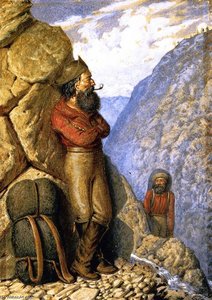 Miners in the Leather Pass, Rocky Mountains - William George Richardson Hind
William George Richardson Hind (1833–1889) stands as a vital figure in the realist tradition, bridging the gap between meticulous scientific observation and evocative narrative art. Born in Nottingham, England, Hind’s work is defined by a commitment to documenting the world exactly as it appeared, eschewing romanticized embellishment in favor of topographical and social accuracy. His transition from a Drawing Master in Toronto to a chronicler of the Canadian frontier allowed him to capture the raw, unvarnished essence of the Gold Rush era and the profound presence of Indigenous communities.
His dedication to the realist movement is masterfully displayed in his 1862 work, Miners in the Leather Pass, Rocky Mountains. In this evocative piece, Hind moves beyond mere illustration to capture a quiet, authentic moment of human existence within a vast, untamed wilderness. Through delicate yet precise application, he depicts travelers amidst rugged, rocky terrain, their gear scattered as they pause in the shadow of the mountains. The composition emphasizes the scale of the landscape against the tangible, everyday reality of the men, grounding the viewer in a specific, historical moment of exploration and survival.
Francis Montague Holl
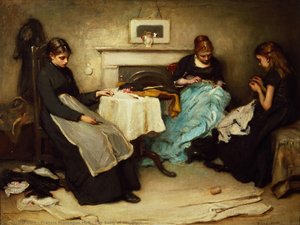 The Song of the Shirt - Francis Montague Holl
Francis Montague Holl stands as a profound voice within the British realist movement, distinguished by his ability to transform the quiet, often overlooked struggles of the Victorian era into compelling visual narratives. Born in 1845 into a family of esteemed engravers, Holl’s technical precision was deeply informed by his lineage and his formal education at the Slade School of Fine Art. Under the influence of John Ruskin, he embraced a commitment to observing nature and human existence with unyielding honesty, a core tenet of the realist tradition that eschewed grandiosity in favor of the intimate and the true.
His mastery of social realism is most poignantly captured in his 1874 work, The Song of the Shirt. This somber oil painting serves as a powerful window into the grueling realities of labor and poverty in nineteenth-century London. Through a masterful use of light and shadow, Holl depicts the weary dignity of needle-women working in a modest interior, turning a scene of domestic toil into a profound commentary on the human condition. By focusing on the lived experience of the working class rather than idealized subjects, Holl solidified his place as a vital chronicler of the social fabric of his time."
James Giles
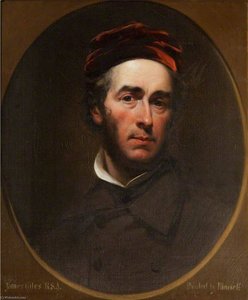 Self Portrait in a Maroon Coat and Crimson Beret - James Giles
James Giles (1801–1870) stands as a significant figure among British realist painters due to his commitment to capturing the unvarnished essence of his surroundings. Rather than leaning into the idealized or the fantastical, Giles focused on the atmospheric truth of the Scottish Highlands and the quiet, dignified reality of his subjects. His work is characterized by a profound sense of place, where light and mist are rendered with a sincerity that avoids romantic exaggeration, focusing instead on the tangible textures of the natural world and the human character.
This dedication to truthful representation is masterfully evident in his 1846 work, Self Portrait in a Maroon Coat and Crimson Beret. In this piece, Giles moves away from the sweeping landscapes of his native Scotland to offer a deeply introspective study of the self. The painting avoids the theatricality often found in contemporary portraiture, opting instead for a steady, serious gaze and a meticulous attention to the tactile qualities of fabric and skin. Through a sophisticated use of light and shadow, he captures a moment of psychological depth, grounding the viewer in the authentic, lived experience of the individual.
James Aumonier
 Gathering Bait - James Aumonier
James Aumonier (1832–1911) was a profound voice in the tradition of British landscape painting, distinguished by his ability to capture the quiet, breathing soul of the English countryside. His work is instantly recognizable through its meticulous attention to texture and the subtle, atmospheric shifts of light, whether rendering a misty morning or the moisture-laden air of a coastal scene. Aumonier’s background in design and his early work with calico patterns gifted him a unique sensitivity to tonal harmony and precision, which he later applied to the grander ambitions of fine art.
As a key figure in the Realism movement, Aumonier eschewed the idealized for the authentic. He focused on the dignity of ordinary existence, imbuing his landscapes with a sense of moral contemplation and the rhythmic reality of rural labor. In his representative work, Gathering Bait (1878), he presents a quiet, observational study of maritime routine. The painting captures individuals absorbed in the specific, repetitive tasks of fishing, grounded by the presence of birds in flight and at rest. Through such depictions, Aumonier moved beyond mere topography to document the lived, unforced moments of the natural and human world.
Walter Greaves
 Thomas Carlyle, 1795 - 1881. Historian and essayist - Walter Greaves
Walter Greaves (1846–1930) embodied the British realist tradition through his profound, visceral connection to the working life of the River Thames. Born into a family of Chelsea boat builders, his childhood was steeped in the tactile realities of timber, tar, and the rhythmic pulse of London's docks. This upbringing allowed him to bypass romanticized idealization, instead capturing the authentic, unvarnished essence of maritime life and the people who navigated it. His early years as a shipwright and boatman provided a firsthand understanding of the river's character, a perspective that defined his contribution to the Realism movement in the United Kingdom.
His ability to render the weight of human presence is exemplified in his 1879 work, Thomas Carlyle, 1795 - 1881. Historian and essayist. In this portrait, Greaves moves away from the sweeping atmospheres of the river to focus on the quiet, somber dignity of the individual. Using a muted, earthy palette of charcoal and deep browns, he captures the sitter with a restrained, observant lens. The stark contrast of the white beard against the dark, textured background emphasizes the gravity of the subject, proving that Greaves could apply his realist precision to both the bustling waterways and the intimate, psychological depth of a human face.
James Lynwood Palmer
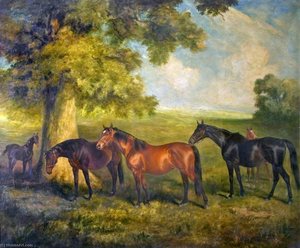 'Jean's Folly', 'Cherry Lass' and 'Black Cherry' - James Lynwood Palmer
In his 1913 masterpiece, 'Jean's Folly', 'Cherry Lass' and 'Black Cherry', James Lynwood Palmer presents a pastoral symphony of equine grace, where the boundaries between animal and nature dissolve into a harmonious whole. This work exemplifies his ability to balance rigorous anatomical accuracy with a delicate, emotive touch, capturing a sense of profound serenity within a sun-dappled meadow.
Born in Market Rasen, Lincolnshire, in 1868, Palmer established himself as a vital figure in the British Realism movement through his profound psychological interpretation of his subjects. Rather than relying on the idealized, heroic poses common in traditional equestrian art, he focused on the inherent tension and palpable energy of the horse. His realism is defined by this commitment to truth; he captured the nervous majesty and the fleeting, vulnerable emotions of racehorses, rendering their muscular strength and velvety textures with meticulous precision. His technique often utilized dramatic lighting and expressive brushwork to contrast the solid, grounded presence of the animals against an ethereal, flickering landscape. By eschewing commercial exhibition in favor of private commissions for breeders and sportsmen, Palmer maintained the artistic freedom necessary to document the authentic, unvarnished essence of the equine spirit.
Conclusion
The legacy of these British realist painters lies in their shared commitment to the unvarnished truth of the human experience and the natural world. From the meticulous attention to detail in the landscapes of Richard Ansdell to the profound, everyday dignity captured by artists like James Aumonier and Walter Greaves, each painter contributed a unique lens through which to view the reality of life in the United Kingdom. Whether through the quiet observation of rural labor or the atmospheric textures of the changing seasons, these masters moved away from idealized romanticism to embrace the authentic, the tangible, and the sincere.
For those looking to bring this sense of historical depth and grounded beauty into their own environments, Mus3ums.com offers a way to connect with these masters. You can explore our full collection to find your favorite subjects. We invite you to transform your living space by living with these works through our museum-quality, hand-painted oil reproductions, each meticulously crafted to preserve the soul and brushwork of the original masterpieces.


