The Enigmatic Shadow of Pisa: The Life and Legacy of Buffalmacco
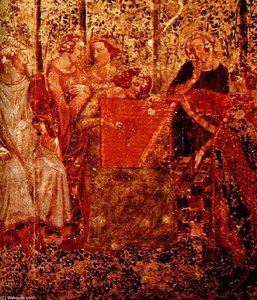
In the quiet, hallowed corridors of the Camposanto Monumentale in Pisa, there exists a haunting dialogue between the living and the dead, whispered through the pigments of a master whose true identity remains partially veiled by the mists of time. Bonamico di Martino da Firenze, known more evocatively to history as Buffalmacco, was not merely a painter of his era; he was a chronicler of the soul’s fragility. Emerging into the artistic consciousness of Italy during the early fourteenth century, Buffalmacco navigated a world poised on the precipice of profound change, bridging the gap between the rigid, symbolic traditions of the medieval period and the burgeoning naturalism that would eventually ignite the Renaissance.
While the biographical archives of the 1300s offer only fragmented glimpses into his early years, scholars often trace the lineage of his genius to the vibrant workshops of Florence. It is widely believed that he may have been shaped by the formidable influence of Maestro Andrea Pisano, a figure whose commitment to expressive realism and anatomical clarity provided the foundational vocabulary for Buffalamico’s later triumphs. This Florentine training infused his work with a sense of structural integrity and a burgeoning interest in the human form, allowing him to move beyond the flat, ethereal icons of the Byzantine tradition toward something far more visceral and grounded.
A Symphony of Mortality: The Camposanto Masterpieces
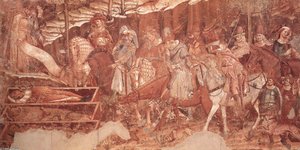
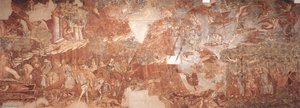
The true magnitude of Buffalmacco’s contribution to Western art is found within the monumental frescoes that adorn the walls of Pisa’s cathedral cemetery. These works, commissioned under the watchful eye of Bishop Ranieri Corsini, serve as a profound meditation on the memento mori—the inescapable reality of death. His most celebrated achievement, the Triumph of Death, remains one of the most powerful and unsettling compositions in the history of Italian art. In this sprawling narrative, the artist does not merely depict an event; he orchestrates a cosmic drama where the inevitability of mortality intersects with the vanity of earthly riches.
To witness these frescoes is to experience a masterful use of color and composition designed to stir the deepest human anxieties and reflections. Buffalmacco utilized a palette of striking, vibrant reds and deep, celestial blues to guide the viewer’s eye through scenes of both sudden tragedy and divine judgment. His technique was characterized by:
- Anatomical Precision: A remarkable ability to render the human figure with a sense of weight and presence, suggesting a life lived within a tangible, physical space.
- Emotional Naturalism: The use of expressive gestures and facial expressions that convey a spectrum of human emotion, from the terror of the dying to the indifferent cruelty of fate.
- Symbolic Complexity: A sophisticated layering of theological motifs, where every element—from the decay of a fallen noble to the presence of skeletal figures—serves as a sermon on the fleeting nature of existence.
The Architect of Gothic Realism
Buffalmacco’s historical significance lies in his role as a pivotal transitionary figure. He took the solemn grandeur of the Pisano Gothic style and infused it with a narrative urgency that felt profoundly human. Unlike the distant, static deities of earlier centuries, his figures inhabit a world of movement and consequence. This shift toward a more observational and empathetic way of seeing laid the groundwork for the revolutionary shifts seen later in the works of Giotto and his successors.
His legacy is not found in a vast catalog of surviving canvases, but in the enduring emotional resonance of his frescoes. Through his brush, the Danse Macabre became more than a religious warning; it became a shared human experience. Even today, as we stand before the weathered walls of the Camposanto, Buffalmacco’s vision continues to command our attention, reminding us that art possesses the unique power to capture the eternal within the ephemeral, and to find profound meaning in the very shadow of our own mortality.