A Witness in Gouache: The Poignant Legacy of Teofila Reich-Ranicki
The history of twentieth-century art is often told through the lens of grand movements and aesthetic revolutions, yet some of its most profound contributions emerge from the quiet, desperate necessity of survival. Teofila Reich-Ranicki, born Teofila Langnas in 1920 in the vibrant industrial city of Łódź, Poland, occupied a space where art and testimony became inseparable. Her life, shaped by the shadows of the Holocaust, transformed her from a promising student of the fine arts into a vital visual chronicler of human suffering and resilience. Before the world was consumed by war, she stood on the precip de an education at the École des Beaux-Arts in Paris, a dream that would be irrevocably shattered by the outbreak of hostilities.
As the German occupation tightened its grip on Poland, Teofila found herself confined within the walls of the Warsaw Ghetto. It was here, amidst the unimaginable deprivation of the Holocaust, that her brush became a tool for both preservation and plea. Her marriage to Marcel Reich-Ranicki, who would later become Germany's most formidable literary critic, took place in the heart of this darkness in July 1942. During these harrowing years, her artistic output was not merely an expression of style but a desperate form of communication. She produced numerous watercolours at the behest of the ghetto commissioner, Heinz Auerswald, works that were intended to serve as a bridge to the outside world, perhaps even to secure the release of Jewish children from the clutches of deportation.
The Art of Memory and the Umschlagplatz
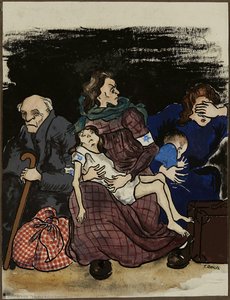
Teofila’s work is characterized by a haunting, visceral quality that transcends mere documentation. Her most celebrated and devastating achievement is the gouache painting Umschlagplatz, czyli poczekalnia przed odjazdem do Treblinki. In this piece, she captures the chilling atmosphere of the deportation site—the waiting area where thousands were gathered before being sent to the death camps. Through the medium of gouache, she achieved a depth of texture and a somber palette that mirrors the heavy, suffocating reality of the era. Her technique does not shy away from the grim; instead, it uses light and shadow to evoke the psychological weight of the Umschlagplatz, turning a historical site into an eternal monument of grief.
Beyond the singular impact of her most famous work, her broader oeuvre includes:
- Watercolours of the Ghetto: Delicate yet heavy with meaning, these works documented the daily struggles and the fragile humanity maintained under occupation.
- Gouache Testimonies: Using more opaque and layered pigments, she created lasting visual records that serve as powerful indictments of the atrocities witnessed.
- Reflective Narratives: In her later years, her role as a translator and occasional author allowed her to weave her visual experiences into a broader literary context, ensuring the voices of the lost were heard.
A Lasting Resonance in Art History
After surviving the horrors of the Holocaust and eventually settling in Frankfurt, Germany, Teofila Reich-Ranicki continued to live a life defined by intellectual and cultural engagement. While she moved into the realms of translation and reflection, her artistic legacy remained anchored in the trauma and triumph of her youth. Her work stands as a bridge between the personal and the historical, connecting the individual experience of a survivor to the collective memory of a continent. She passed away in 2011, leaving behind a body of work that refuses to let the world forget.
The significance of Teofila Reich-Ranicki lies in her ability to transmute terror into art. Her paintings are not merely relics of a tragic past; they are active participants in the ongoing dialogue about human rights, memory, and the enduring power of the creative spirit. Through her eyes, we do not just see the history of the Warsaw Ghetto—we feel its pulse, its pain, and its profound, unyielding will to endure.