Early Life, Family and Artistic Training
Durham, 1788. George Robson enters a world shaped by the commerce of the north. He is the second child and the eldest son of John Robson, a wine merchant hailing from Etterby, near Carlisle. His family life is rooted in this regional trade, far from the metropolitan centers that will later define his professional life. The lineage is established, and the path is set by the quiet industry of his father's business.
Artistic instinct meets formal structure in the hands of Mr. Harle. In Durham, this instructor provides the foundational skills that George Robson requires to translate sight into form. These early lessons form the bedrock of his technical ability. He moves from these initial studies toward a more determined pursuit of the craft. By 1806, the transition begins. He leaves for London with only £5 in his pocket, a meager sum for a young man seeking to establish himself in the competitive landscape of the English art scene.
Career in London and Professional Recognition
London, 1806. Robson arrives with only £5 in his pocket, an ambitious arrival into the heart of the Regency art scene. The transition from his early instruction in Durham to the competitive atmosphere of the capital is swift. By 1807, his presence is felt at the Royal Academy, where he gains his first significant recognition. He moves through the city's galleries, exhibiting landscapes at the Bond Street Gallery of the Associated Painters in 1810, a group of artists focused on the nuances of British scenery.
The momentum of his career reaches a peak in November 1819. He is elected president of the Society of Painters in Oil and Watercolors, a position he holds for one year. This leadership role marks his established status within the professional community. Even as encroaching glaucoma begins to limit his ability to participate in evening sketching sessions, his influence remains. He maintains his connection to the artistic circle as an honorary member of the Sketching Society.
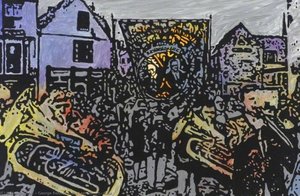
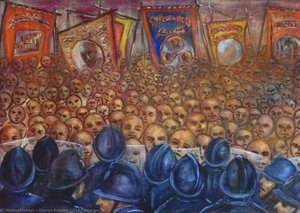
- Marching Out, about 2001
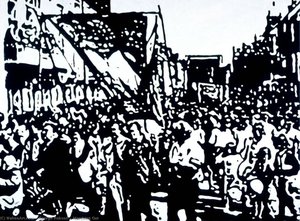
- Durham Miners' Gala, about 2002
- Following the Banner on Gala Day, about 2002
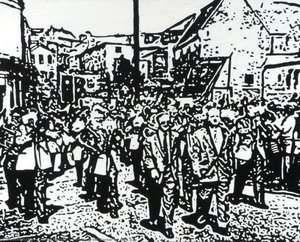
- Confrontation, about 2006
Landscapes of the Scottish Highlands
The Scottish landscape becomes the central focus of Robson's output. Between 1813 and 1820, he maintains a rigorous pace, contributing twenty drawings every year to the Society's exhibition. His gaze settles heavily upon the Perthshire Highlands. This region provides the rugged terrain and mountain forms that define his most productive period.
In 1814, this focus culminates in the publication of Scenery of the Grampians. The volume contains forty mountain vistas. These works capture the scale of the terrain through broad effects of light and shade. He moves through the wilder corners of Britain, sketching subjects in the summer to develop into finished watercolors for London exhibitions. His work often features the high peaks of Snowdonia and the hills of Wales, but the Highland mountains remain his primary subject.
- Scenery of the Grampians (1814)
Technique and Artistic Style
The core of Robson’s talent lies in the treatment of mountain scenery. He manipulates broad effects of light and shade to define the ruggedness of the terrain. His watercolors do not merely record topography; they are imbued with Romantic sensibilities. Through a masterful use of light and color, he conveys a sense of emotion and grandeur that moves beyond simple representation. The atmosphere is heavy with the weight of the landscape.
His approach to composition often relies on the interplay of light and shadow to create depth. This technique allows him to capture the specific character of the Scottish Highlands and the Welsh hills. Even as his vision began to fail due to encroaching glaucoma, his ability to translate the sublime qualities of nature into a visual medium remained intact. He focused on the atmospheric perspective, using washes to build the texture of the mountains.
This specific command over atmosphere earned him significant critical attention. He received an unusual degree of praise from the influential critic John Ruskin, who noted the quality of atmosphere and texture in his finest works. Robson’s ability to render the quiet, serious qualities of a landscape remains a defining feature of his technical legacy. He captures the essence of the natural world through precise, deliberate application of color.
Spørsmål og svar
Hvilke andre navn eller pseudonymer bruker George Robson?
George Robson er også kjent under navnene George Fennell Robson.