
Introduction
The 19th century in the United Kingdom was a period of profound transformation, where the rhythmic pulse of the Industrial Revolution met a deep, often nostalgic, longing for the natural world and the spiritual sublime. This era produced a diverse movement of artists who sought to capture the shifting light of the English countryside, the dramatic intensity of the sea, and the intricate, symbolic depths of human emotion. From the sweeping, atmospheric landscapes that defined a nation's identity to the meticulous, jewel-like detail of the Pre-Raphaelite movement, these painters navigated the tension between tradition and the burgeoning modern age.
What unites these masters is a shared mastery of light and a commitment to storytelling through canvas. Whether through the turbulent, swirling skies of Romanticism or the lush, botanical precision of later Victorian works, these artists redefined how the world was perceived. Their influence persists in contemporary art, as their ability to evoke profound sentiment through texture and color continues to resonate with modern sensibilities. By examining the legacies of these visionaries, we gain insight into a pivotal moment when art moved from the rigid constraints of neoclassicism toward the expressive freedom of the modern era.
The following selection explores ten essential figures who shaped this golden age, ranging from the masters of light and landscape to the poets of color and form.
William Blake
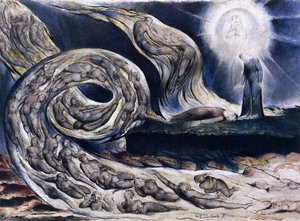 The Lovers' Whirlwind, Francesca da Rimini and Paolo Malatesta - William Blake
A visionary whose influence spanned the transition into the modern era, William Blake remains a singular figure among 19th century British painters. Born in London in 1757, his creative spirit was ignited by childhood visions of angels, a mystical temperament that would define his unique contribution to the Romantic movement. His technical foundation was forged through a rigorous apprenticeship under the engraver James Basire, where the mechanics of printmaking and the study of Gothic architecture at Westminster Abbey deeply informed his aesthetic language.
Blake’s work often transcends mere representation, seeking instead to capture the turbulent intersection of the spiritual and the physical. This is profoundly evident in his monumental work, The Lovers' Whirlwind, Francesca da Rimini and Paolo Malatesta. Painted in the early decades of the 19th century, this piece exemplifies the era's fascination with the sublime and the psychological. Through a swirling vortex of spectral forms and dramatic chiaroscuro, Blake transforms a tragic tale of passion into a visceral, cosmic struggle. His ability to merge poetic narrative with intense, emotive imagery ensures his place as a cornerstone of the British Romantic tradition.
John Constable
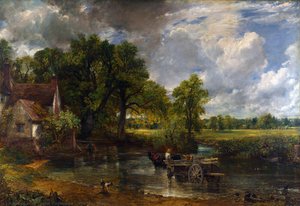 The Hay Wain - John Constable
A central figure of the Romantic movement, John Constable (1776–1837) redefined the landscape tradition during the 19th century. Born in East Bergholt, Suffolk, his artistic vision was deeply intertwined with the rhythms of the River Stour, where his father operated as a prosperous corn and coal merchant. This intimate connection to the Dedham Vale landscape provided the emotional foundation for his work, transforming the local topography into a profound exploration of nature.
After beginning his formal training at the Royal Academy Schools in 1799, Constable moved away from the idealized, staged landscapes of his predecessors. Instead, he focused on the authentic, atmospheric nuances of the English countryside. His 1821 masterpiece, The Hay Wain, stands as a quintessential vision of this era, capturing a harmonious blend of rural life and the shifting light of the Stour Valley. Through expressive brushwork and a sophisticated handling of color, he moved beyond mere topography to evoke the very soul of the landscape. His ability to capture the dynamic tension of billowing clouds and the tranquil movement of water solidified his status as a premier painter of the United Kingdom in the 19th century."
Dante Gabriel Rossetti
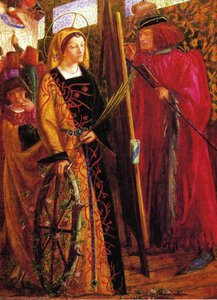 Saint Catherine - Dante Gabriel Rossetti
A central figure of the 19th century British art scene, Dante Gabriel Rossetti (1828–1882) redefined the boundaries of visual storytelling by merging the precision of painting with the soul of poetry. Born in London to an Italian scholar, his intellectual upbringing allowed him to transcend the rigid academic conventions of his era. As a leader of the Pre-Raphaelite movement, he sought a direct, emotional connection to his subjects, often treating the canvas as a visual counterpart to his own literary sonnets.
His masterpiece, Saint Catherine (1857), serves as a profound testament to this era's fascination with medieval aesthetics and spiritual symbolism. In this work, Rossetti moves beyond mere depiction to create a dreamlike, opulent atmosphere through a rich palette of deep reds and golden yellows. The composition captures a sense of quiet strength and mystery, characteristic of the Romantic spirit that permeated the United Kingdom's artistic output during the 1800s. By integrating complex narratives with intense, sensual beauty, Rossetti ensured his place among the most influential painters of the 19th century, leaving behind a legacy where art and literature are inextricably entwined.
J. M. W. Turner
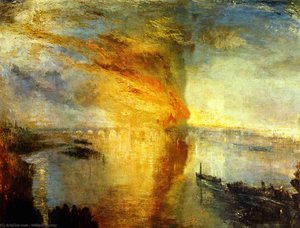 The Burning of the Houses of Parliament - J. M. W. Turner
A titan of the Romantic movement, J. M. W. Turner stands as a central figure among 19th century British painters. Born in London in 1775, his journey from the son of a barber and art dealer to a master of the Royal Academy Schools reflects a profound evolution of talent. His early training under topographical draughtsman Thomas Malton and his work for architects provided a rigorous foundation in perspective and structure, which he eventually transcended to explore the sublime forces of nature.
Turner’s work is defined by a revolutionary approach to light and atmosphere, moving far beyond the precise topographical traditions of the eighteenth century. His masterpiece, The Burning of the Houses of Parliament (1835), serves as a quintessential example of his ability to capture historical drama through elemental power. In this work, he utilizes a vibrant, dynamic palette of fiery oranges and deep reds, contrasted against turbulent, billowing smoke to evoke a sense of awe and chaos. Through his expressive brushwork and mastery of light and shadow, Turner transformed the landscape into a vessel for intense emotion, leaving an indelible mark on the trajectory of British art.
Marianne North
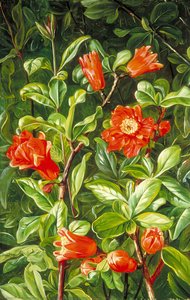 Flowers of the Pomegranate, Painted in Teneriffe - Marianne North
A quintessential figure of the Victorian era, Marianne North (1831–1890) represents the adventurous spirit of 19th century British painters. While many of her contemporaries focused on domestic landscapes or traditional portraiture, North broke societal constraints by embarking on self-funded global expeditions. Between 1871 and 1885, she traveled across six continents and 17 countries, documenting exotic flora in situ to create a massive botanical record.
Her technical evolution was marked by a shift from watercolor to the heavy, opaque medium of oil painting, a discipline she refined under the instruction of Valentine Bartholomew in 1867. This mastery of oil allowed her to capture the intense, saturated colors of tropical environments with unprecedented realism. Her representative work, Flowers of the Pomegranate, Painted in Teneriffe (1875), exemplifies this approach. In this piece, she utilizes vibrant hues to depict the fiery blossoms of the pomegranate, showcasing the meticulous detail and direct observation that defined her career.
By merging scientific rigor with a lush, painterly aesthetic, North secured her place among the notable artists of the United Kingdom during this transformative century, leaving behind a legacy of botanical masterpieces that capture the world's most elusive floral wonders.
Thomas Cole
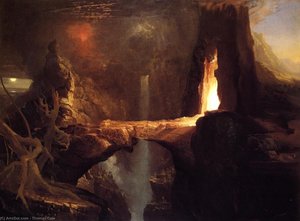 Expulsion. Moon and Firelight - Thomas Cole
Born in Lancashire, England, in 1801, Thomas Cole represents a vital link in the lineage of 19th century painters from United Kingdom. Although his creative legacy is inextricably tied to the American wilderness following his emigration in 1818, his artistic foundations and early life in the United Kingdom provided the essential perspective that would later define his unique vision. As a largely self-taught artist, Cole moved away from the structured traditions of European academic training to develop a visual language that captured the spiritual resonance of the untamed natural world.
His mastery of the Romantic movement is vividly realized in his 1828 work, Expulsion. Moon and Firelight. This piece serves as a profound invocation of the sublime, utilizing dramatic chiaroscuro to navigate the tension between shadow and radiance. Through meticulous brushwork, Cole captures the rugged textures of jagged rocks and cascading waters, creating a scene that evokes both awe and primal mystery. By founding the Hudson River School, he transformed the landscape into a medium for profound allegory, ensuring his place as a transformative figure of the 19th century.
John Everett Millais
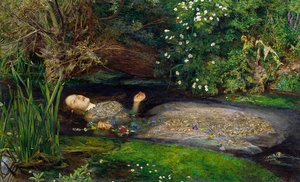 Ophelia (Cropped) - John Everett Millais
A true prodigy of the Victorian era, John Everett Millais (1829–1896) stands as a central figure among 19th century British painters. His extraordinary talent was evident from childhood; he entered the Royal Academy Schools at just eleven years old, becoming the youngest student ever admitted. This early immersion in formal training provided the foundation for a career that would eventually challenge the established traditions of the art world.
Millais is most famously recognized as a founder of the Pre-Raphaelite Brotherhood, a movement that rejected the idealized, polished styles of the past in favor of a more sincere, direct, and hyper-realistic approach to the natural world. His work is defined by a breathtaking attention to detail and a vibrant use of color that sought to reclaim the clarity of art produced before the era of Raphael.
His masterpiece, Ophelia (1852), remains one of the most iconic images of the 19th century. In this poignant work, Millais captures a melancholic scene of a woman submerged in a shallow pool, surrounded by lush, meticulously rendered vegetation. Through this combination of technical brilliance and emotional depth, Millais secured his legacy as a transformative force in British art history."
Alfred Munnings
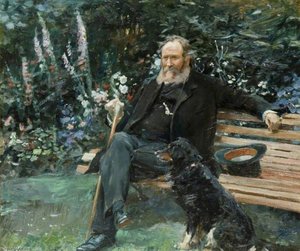 Daniel Tomkins and His Dog - Alfred Munnings
Born in 1878, Alfred Munnings represents the late-century transition of British art, bridging the gap between Victorian traditions and a modern, impressionistic sensibility. His roots in the Suffolk countryside, specifically near Mendham Mill, provided a lifelong connection to the rhythms of rural life. This upbringing, characterized by the constant presence of horses and the labor of the mill, fundamentally shaped his artistic vision. His early training began at the age of fourteen with an apprenticeship in a Norwich printing house, a period that instilled in him a disciplined approach to visual composition.
Munnings is celebrated as a master of equine Impressionism, known for his ability to capture the vitality of horses and the serene atmosphere of the English landscape. His representative work, Daniel Tomkins and His Dog, painted in 1898, serves as a profound early testament to his talent. This piece captures a quiet, intimate moment of companionship, reflecting his dedication to depicting the dignity of ordinary rural existence. Through his vibrant brushwork and keen observation, Munnings immortalized the vanishing traditions of the British countryside, securing his legacy as a vital figure in the evolution of United Kingdom painting at the close of the 19th century.
John Lavery
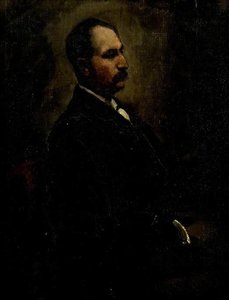 Stephen Alley - John Lavery
Born in North Belfast in 1856, Sir John Lavery emerged as a pivotal figure among 19th century British painters, bridging the gap between academic tradition and the burgeoning Impressionist movement. His artistic journey began with foundational training at the Haldane Academy in Glasgow, followed by studies at Heatherley's School in London and the Académie Julian in Paris. This diverse education allowed him to master the interplay of light and form, a skill he refined while working as a photographer's assistant, which deeply influenced his perception of visual depth.
Lavery’s place in the 19th century British canon is cemented by his association with the Glasgow School and his ability to capture the social elegance of the era. His representative work, Stephen Alley (1890), serves as a profound example of his mastery. In this portrait, Lavery utilizes a sophisticated monochromatic palette to depict a gentleman in formal attire, blending meticulous academic precision with the subtle, atmospheric nuances of Impressionism. Through his ability to render light and shadow with such sensitivity, Lavery transformed portraiture into a study of quiet contemplation and social standing, securing his legacy as a master of late Victorian art.
Edward Burne-Jones
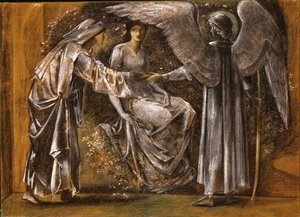 The Heart of the Rose - Edward Burne-Jones
In his evocative 1890 masterpiece, The Heart of the Rose, Edward Burne-Jones invites the viewer into a realm of profound allegory and Pre-Raphaelite romanticism. This work, inspired by the poetry of William Morris, presents a delicate encounter between an ethereal woman and an angelic figure, all set against a backdrop of mysterious, shadowed silhouettes. His technique is characterized by a rich, velvety palette and a meticulous attention to symbolic storytelling, where every gesture and object carries a weight of spiritual or romantic significance.
Born in Birmingham in 1833, Burne-Jones rose from a childhood shaped by the craftsmanship of his father’s frame-making trade to become a central figure in the late 19th-century British art scene. His journey from the industrial landscape of the United Kingdom toward the academic environments of Oxford allowed him to develop a signature style that favored medievalism and dreamlike, mythological subjects over the stark realism of his era. As a prominent artist of the 19th century, his work often explores themes of longing and enchantment, utilizing a sophisticated interplay of color and texture to bridge the gap between the earthly and the divine.
Conclusion
The 19th century was a transformative era for British art, a period where the romanticism of Turner and Constable met the intricate, symbolic depths of the Pre-Raphaelites. From the ethereal visions of William Blake to the lush, botanical precision of Marianne North, these artists collectively captured the shifting soul of a nation, moving from the sublime power of nature to the delicate nuances of human emotion and domestic life. Whether through the dramatic light of a landscape or the intense gaze of a portrait, these masters defined a visual language that continues to resonate across centuries.
At Mus3ums.com, we invite you to bring this rich heritage into your own living space. Our artisans specialize in creating museum-quality, hand-painted oil reproductions that preserve the tactile beauty and authentic brushstrokes of these legendary works. You can explore our full collection to find the perfect masterpiece and experience the enduring legacy of these British masters through art that breathes with life and texture.


