Introduction
Born from the intellectual fervor of the Enlightenment and a profound reverence for antiquity, Italian neoclassical painters sought to reclaim the grace, order, and clarity of the classical past. Emerging in the late 18th and early 19th centuries, this movement represented a deliberate departure from the perceived excesses of the Baroque and Rococo styles. Instead, these artists looked toward the disciplined compositions and idealized forms of ancient Greek and Roman art to express a new era of reason and civic virtue.
The cultural landscape of Italy during this period was defined by the archaeological rediscoveries of Pompeii and Herculaneum, which provided a direct visual language for artists to emulate. Through a focus on precise outlines, balanced symmetry, and a restrained use of color, these masters transformed the canvas into a stage for moral storytelling and heroic idealism. Their work was not merely decorative; it was a visual manifestation of the philosophical shift toward structure and logic that reshaped European thought.
Today, the legacy of these painters endures in the very foundations of Western visual aesthetics. Their ability to harmonize human emotion with mathematical precision continues to influence how we perceive beauty and proportion in both fine art and classical architecture. By studying their techniques, we gain insight into the moment art transitioned from the theatricality of the old world to the structured elegance of the modern age.
The following selection explores the diverse expressions of this movement, ranging from the architectural precision of Piranesi to the refined portraiture of Batoni, showcasing the masters who defined the Italian neoclassical spirit.
Giovanni Battista Piranesi
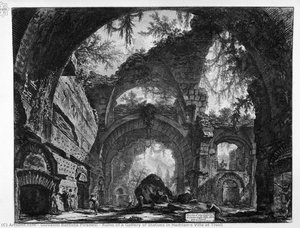 Ruins of a Gallery of Statues in Hadrian`s Villa at Tivoli - Giovanni Battista Piranesi
Born in 1720 near Venice, Giovanni Battista Piranesi stands as a monumental figure among Italian Neoclassical painters, specifically through his profound obsession with the structural logic and grandeur of antiquity. His work embodies the Neoclassical movement's core mission: a deliberate return to the balanced, clear, and awe-inspiring forms of ancient Greek and Roman civilization. Unlike those who merely sketched ruins, Piranesi approached the classical world with the precision of an architect and the soul of a visionary, translating the physical weight of stone into dramatic, etched narratives.
His technical mastery was forged through a rigorous apprenticeship under Giuseppe Vasi, the preeminent etcher of Roman views, which allowed him to master the intricate details of topographical printmaking. This expertise is vividly realized in his 1756 masterpiece, Ruins of a Gallery of Statues in Hadrian’s Villa at Tivoli. In this evocative etching, he captures the melancholy of imperial decay, using light and shadow to transform architectural vestiges into immersive, psychological landscapes. By merging the meticulous accuracy of a designer with a heightened sense of drama, Piranesi helped define the visual language of the Neoclassical era, ensuring that the majesty of the ancient world remained etched into the modern consciousness.
Antonio Canova
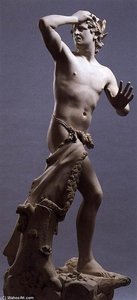 Orpheus - Antonio Canova
In his 1776 work Orpheus, Antonio Canova captures a profound sense of melancholic urgency, marking a pivotal moment in his artistic evolution. This sculpture, originally destined for the gardens of Villa Falier, depicts the legendary musician in a state of desperate movement, his body leaning toward the shadows of the underworld. Through the masterful use of Carrara marble, Canova achieves a luminous, polished sheen that breathes life into the stone, transforming cold material into a vessel for raw human emotion.
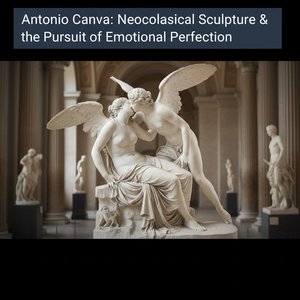
As a preeminent figure of the Italian Neoclassical movement, Canova moved beyond the decorative flourishes of the Rococo to embrace the calm balance and idealized forms of antiquity. His ability to infuse classical mythology with deep psychological intensity distinguishes his work from the rigidness of his contemporaries. Whether rendering the delicate musculature of a hero or the graceful curves of figures like Cupid & Psyche, his technique remains unparalleled. His training at the Accademia di Belle Arti di Venezia and his early exposure to stone carving allowed him to master the interplay of light and shadow, ensuring his legacy as a sculptor who could capture the very soul of his subjects through the purity of marble.
Pompeo Batoni
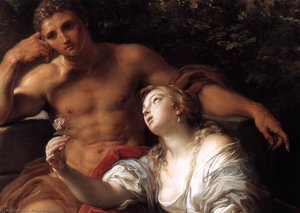 Hercules at the Crossroads (detail) - Pompeo Batoni
A pivotal figure in the transition from the late Baroque to the disciplined clarity of the new era, Pompeo Batoni (1708–1787) stands as a cornerstone of Italian Neoclassicism. After moving to Rome in 1727 and training under masters like Agostino Masucci, Batoni developed a style that moved away from excessive ornamentation toward the balanced ideals of classical antiquity. His work became the visual language of the Grand Tour, where he captured the European elite against the timeless backdrop of Roman ruins, effectively bridging the gap between Rococo grace and Neoclassical restraint.
His mastery of moral narrative is profoundly illustrated in Hercules at the Crossroads (1748). In this work, Batoni moves beyond mere mythological illustration to explore the psychological depth of human choice. By depicting Hercules in a state of intense contemplation rather than action, the artist emphasizes the intellectual and ethical dimensions central to Neoclassical thought. Through the use of dramatic lighting and a focus on virtuous ideals, Batoni’s compositions reflect the era's fascination with the dignity of the human spirit and the structured beauty of the ancient world.
François Gérard
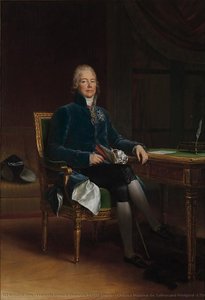 Charles Maurice de Talleyrand Périgord (1754–1838), Prince de Bénévent - François Gérard
Born in Italy, François Gérard emerged as a preeminent figure of the Neoclassical era, bridging the gap between the rigid discipline of the late 18th century and the opulent elegance of the Napoleonic period. As a distinguished student of Jacques-Louis David, Gérard inherited the movement's core principles of anatomical precision and structural clarity. However, his work is uniquely characterized by a sophisticated grace that often softened the severe edges of pure Neoclassicism, making him the preferred portraitist for the European aristocracy and the imperial court.
His mastery of the genre is exemplified in the 1808 portrait, Charles Maurice de Talleyrand Périgord (1754–1838), Prince de Bénévent. In this work, Gérard demonstrates his ability to blend Neoclassical rigor with a sense of psychological depth and luxurious texture. The painting captures the sitter with a monumental stillness, utilizing sharp, decisive lines to define the subject's features while simultaneously celebrating the tactile richness of his attire. Through his ability to harmonize historical gravitas with refined aesthetic beauty, Gérard remains a vital link in the evolution of Neoclassical art.
Vincenzo Camuccini
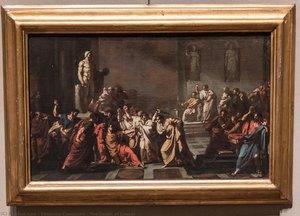 The Death of Caesar - Vincenzo Camuccini
Vincenzo Camuccini stands as a monumental figure in the landscape of early 19th-century Roman art, embodying the very essence of the Neoclassical movement. His work is defined by a rigorous adherence to the ideals of Greco-Roman antiquity, characterized by a disciplined, sculptural precision and a profound respect for historical narrative. Having been shaped by the traditions of the old masters and the guidance of his brother Pietro, Camuccini rose to become the premier academic painter of his era, bridging the gap between classical antiquity and the dramatic sensibilities of his time.
His mastery of this style is most vividly realized in his 1806 masterpiece, The Death of Caesar. In this work, Camuccini achieves the Neoclassical ideal of balancing intense theatricality with controlled restraint. Rather than depicting mere carnage, he choreographs the assassination as a solemn, high tragedy. The composition utilizes a studied architectural system and a dramatic interplay of light and shadow to elevate the scene, treating the figures with the dignity of an ancient frieze. Through this meticulous approach, Camuccini transforms a moment of political rupture into a timeless study of order, duty, and classical grandeur.
Antonio Zucchi
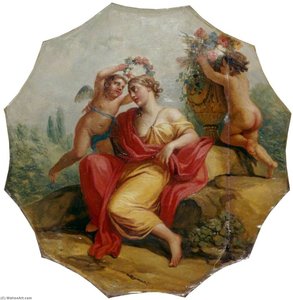 Spring - Antonio Zucchi
In his 1769 work Spring, Antonio Zucchi demonstrates a masterful command of light and grace, transforming a scene of idyllic repose into a luminous tableau. This piece, characterized by its delicate interplay of warmth and cool tones, exemplifies the artist's ability to evoke profound emotion through subtle shifts in color. Zucchi’s technique often blended the soft textures of pastel with the precision of oil, allowing him to capture the ethereal glow of a landscape or the gentle features of mythological figures with remarkable sensitivity.
As a prominent figure among Italian neoclassical painters, Zucchi’s work embodies the movement's pursuit of balanced composition and classical clarity. His style seamlessly integrated the decorative elegance of Venetian frescoes with the structured ideals of the Neoclassical era. Renowned for his mythological scenes and veduta landscapes, he also made a significant impact on English decorative arts through his collaborations with Robert Adam. His life and artistry, marked by his marriage to the celebrated Angelica Kauffmann, reflect the international reach of the Italian Neoclassical tradition, where classical themes were reimagined with a refined, sophisticated sensibility.
Johann Baptist von Lampi the Elder
 Portrait of Catherine II - Johann Baptist von Lampi the Elder
Born in Rome in 1751, Johann Baptist von Lampi the Elder represents the sophisticated intersection of Italian heritage and the disciplined rigor of the Neoclassical movement. His work is characterized by a seamless synthesis of the dramatic flair inherited from his father, the decorative painter Matteo Lampi, and the restrained, clear outlines essential to the Neoclassical aesthetic. A visitor can immediately recognize his hand through a polished, luminous brushwork that masterfully renders the tactile textures of silk, fur, and cold marble, often set against deep, dramatic shadows.
His inclusion in this group of Italian Neoclassical painters is rooted in his formative training in Verona and his ability to adapt the classical ideals of balance and order to the grand scale of imperial portraiture. His Portrait of Catherine II serves as a definitive example of this mastery. In this composition, the Empress is framed by heavy crimson drapery and classical architectural elements, utilizing light to emphasize her imperial regalia. Through the use of allegorical symbols—such as books representing knowledge and a statue of Truth—Lampi elevates the portrait from a mere likeness to a powerful statement of enlightened, structured governance.
Andrea Appiani
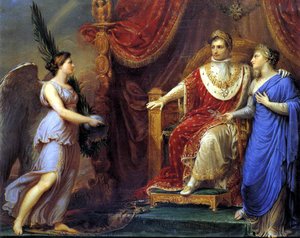 Allegory on the Peace of Pressburg - Andrea Appiani
Andrea Appiani (1754–1817) stands as a cornerstone of the Italian Neoclassical movement, embodying the era's shift toward the balanced ideals and refined aesthetics of antiquity. Born in Milan, his artistic journey was shaped by rigorous training under masters such as Carlo Maria Giudici and Antonio de' Giorgi, alongside significant anatomical studies at the Ospedale Maggiore. This deep understanding of the human form, combined with a fascination for classical beauty, allowed him to transcend mere portraiture and become a premier painter of monumental frescoes and allegorical compositions.
His status as a defining Neoclassical figure is most vividly realized in his 1808 masterpiece, Allegory on the Peace of Pressburg. In this work, Appiani elevates historical politics to the realm of the divine, utilizing a sophisticated pyramidal composition to frame Napoleon Bonaparte. By blending the earthly reality of the Treaty of Pressburg with ethereal, mythological symbolism, Appiani captures the quintessential Neoclassical pursuit: the marriage of contemporary power with the timeless grace of Greco-Roman tradition. His ability to infuse scenes of imperial authority with a sense of calm, luminous elegance remains a testament to his mastery of the medium.
Giovanni Battista Cipriani
 The Education Of Achilles - Giovanni Battista Cipriani
Giovanni Battista Cipriani (1727–1785) represents a vital link between the dramatic traditions of the Italian Baroque and the emerging clarity of the Neoclassical era. Born in Florence and trained under the guidance of Ignatius Hugford and Anton Domenico Gabbiani, Cipriani developed a sophisticated technical mastery that he eventually brought to the vibrant artistic circles of Georgian England. His work is a quintessential example of the Neoclassical movement's fascination with antiquity, as he frequently utilized Greco-Roman mythology to create elegant, balanced compositions that resonated with the Enlightenment-era elite.
A primary example of his ability to harmonize art with architecture is The Education of Achilles. Painted around 1776 for Lansdowne House, this work demonstrates his command of the pyramidal structure, a hallmark of classical stability. The scene, depicting the centaur Chiron instructing the young hero, utilizes a controlled, rhythmic descent of the gaze to emphasize the hierarchy of mentorship. Set within an intimate grotto against a soft, receding seascape, the painting showcases the stylistic intersection of dramatic movement and the disciplined, clear outlines characteristic of the Neoclassical transition.
Domenico Andrea Maria D'Arco Anderson
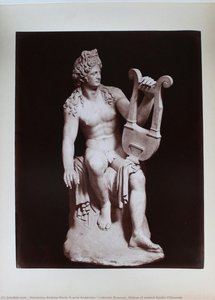 Ludovisi Museum. Statue of seated Apollo Citharode - Domenico Andrea Maria D'Arco Anderson
Domenico Andrea Maria D'Arco Anderson represents a fascinating intersection between the classical ideals of the Neoclassical movement and the dawn of photographic technology. While many of his contemporaries focused on the revival of ancient aesthetics through traditional painting, Anderson captured the essence of Neoclassicism through the innovative calotype process. By utilizing this paper-based method, he achieved a soft, painterly texture that echoed the refined lines and balanced compositions of classical antiquity, effectively bridging the gap between the era of traditional lithography and the modern photographic age.
His work is deeply rooted in the veneration of Roman history and the sculptural perfection of the past. In his representative work, Ludovisi Museum. Statue of seated Apollo Citharode, Anderson demonstrates his mastery of light and form. The photograph isolates the muscular physique and intricate drapery of the seated deity against a stark, dramatic black background. This composition emphasizes the idealized proportions and serene repose central to Neoclassical thought, transforming a stone masterpiece into a profound study of shadow and classical grace. Through his lens, the monumental beauty of Rome was preserved with a meticulous, atmospheric clarity that honored the very history the Neoclassical movement sought to celebrate.
Conclusion
The legacy of Italian neoclassical painters lies in their profound ability to bridge the gap between the grandeur of antiquity and the evolving sensibilities of the modern era. From the architectural precision of Piranesi to the idealized elegance found in the works of Batoni and Canova, these masters collectively redefined the visual language of order, clarity, and emotional restraint. Whether through the dramatic historical narratives of Camuccini or the delicate grace of Appiani, each artist contributed a unique facet to a movement that sought to elevate the human spirit through the timeless principles of balance and proportion.
For those looking to bring this era of sophisticated beauty into a contemporary setting, Mus3ums.com offers a way to experience these masterpieces firsthand. Our artisans specialize in creating museum-quality, hand-painted oil reproductions that capture the authentic texture and soul of these historical treasures. We invite you to explore our full collection and discover how these timeless Italian works can transform your living space into a sanctuary of classical elegance.