Introduction
Spanish neoclassical painters emerged during a transformative era when the dramatic intensity of the Baroque gave way to a renewed devotion to the order, clarity, and restraint of classical antiquity. As the Enlightenment swept through the Iberian Peninsula, these artists moved away from excessive ornamentation, seeking instead to capture the calm balance and precise outlines found in ancient Greek and Roman ideals. This movement was not merely a change in aesthetic preference but a profound cultural shift toward reason, structure, and the pursuit of timeless beauty.
The works of this period reflect a sophisticated synthesis of tradition and modernity, characterized by a mastery of light and a disciplined approach to composition. Artists such as Vicente López Portaña and Mariano Salvador Maella became central figures in this evolution, defining a visual language that emphasized noble simplicity and intellectual rigor. Their canvases often served the evolving tastes of the Spanish court and the rising enlightened classes, bridging the gap between historical grandeur and the emerging modern sensibility.
Today, these painters remain vital to our understanding of art history, offering a window into a period of intense intellectual awakening. Their ability to harmonize human emotion with geometric precision continues to influence how we perceive balance and proportion in visual design. By examining the lives and techniques of these masters, we gain a deeper appreciation for the disciplined elegance that defines the Spanish neoclassical spirit.
The following selection explores the diverse talents and stylistic nuances of the most significant figures who shaped this movement, tracing the evolution of a style that sought to bring light, logic, and classical grace to the Spanish canvas.
Vicente López Portaña
 The Good Shepherd - Vicente López Portaña
A central figure in the Spanish Neoclassical movement, Vicente López Portaña (1772–1850) defined the visual identity of the Spanish court during a period of profound transition. His mastery of the Neoclassical style—characterized by technical precision, clear composition, and a return to classical order—allowed him to rise as a premier portraitist, eventually serving as court painter to Ferdinand VII. His academic foundation was impeccable, beginning with training under Father Antonio de Villanueva and culminating in a prestigious apprenticeship under Mariano Salvador Maella at the Academia Real de Bellas Artes de San Fernando.
López Portaña’s work is distinguished by a sophisticated ability to capture the dignity and social standing of the elite through controlled light and smooth, polished surfaces. In his representative work, The Good Shepherd (c. 1800), we see this technical virtuosity applied to a spiritual subject. The painting utilizes a dramatic chiaroscuro effect, where light strikes the creamy texture of the lamb's wool and the man's soulful face, emerging from a deep, atmospheric background. This work exemplifies the Neoclassical penchant for balanced, focused compositions and the use of earthy, resonant tones to create a sense of timeless, quiet devotion.
Mariano Salvador Maella
 D Pedro López de Lerena, I Count of Lerena - Mariano Salvador Maella
Mariano Salvador Maella Pérez stands as a cornerstone of the Spanish Neoclassical movement, a master whose career bridged the transition from late Baroque traditions to the disciplined clarity of the Enlightenment. His artistic identity was forged in the academic crucibles of Madrid and Rome, where he moved away from decorative excess toward the sculptural grace and anatomical precision characteristic of Neoclassicism. His ability to harmonize profound anatomical accuracy with a sense of monumental calm made him a preferred choice for the Spanish Crown, eventually serving as a chamber painter to King Charles IV.
In his representative work, D Pedro López de Lerena, I Count of Lerena, Maella exemplifies the Neoclassical ideal of dignified portraiture. The composition is defined by a rigorous balance and a controlled use of light that carves the subject out of a deep, saturated background. By utilizing a palette of navy blue and vermilion red against heavy green drapery, Maella emphasizes the sitter's political authority and intellectual stature. The inclusion of symbolic elements, such as the scroll and scholarly books, serves to elevate the subject through the Neoclassical lens of civic virtue and administrative order, showcasing the movement's focus on clarity, structure, and the celebration of human reason.
José Álvarez Cubero
 Apollo - José Álvarez Cubero
A master of form and anatomical precision, José Álvarez Cubero stands as a pivotal figure among Spanish Neoclassical painters and sculptors. His work embodies the movement's core principles through a profound commitment to the calm balance and idealized proportions of antiquity. Having studied under Miguel Verdiguier and at the Academy of San Fernando, Cubero’s artistic identity was truly forged in the cultural crucibles of Paris and Rome. It was there that he absorbed the elegance of Antonio Canova, translating the grace of classical mythology into a visual language of restraint and symmetry.
His representative work, Apollo, serves as a quintessential example of this Neoclassical mastery. In this depiction, the Greek deity is rendered with a serene, contemplative expression, captured in a graceful contrapposto stance that emphasizes naturalistic movement through a stable, balanced composition. The precision of the musculature and the symbolic inclusion of the laurel wreath highlight his ability to marry physical realism with divine idealism. Whether capturing the heroic spirit of The Defence of Zaragoza or the delicate features of a portrait bust, Cubero’s legacy remains defined by this pursuit of classical perfection and structural harmony.
Agustín Esteve
 Manuel Godoy - Agustín Esteve
Agustín Esteve y Marqués (1753–1830) stands as a pivotal figure in Spanish Neoclassicism, embodying the movement's commitment to formal clarity and disciplined composition. His work is characterized by a sophisticated balance between the rigid academicism of the era and a subtle, atmospheric sensitivity. A student of the Academia de Bellas Artes de San Carlos in Valencia, Esteve’s style was deeply informed by the Greco-Roman ideals of Anton Raphael Mengs, which emphasized idealized forms and structural equilibrium—hallmarks of the Neoclassical tradition.
A visitor can recognize Esteve’s hand through his mastery of psychological presence and his ability to render textures with meticulous precision. His brushwork often achieves a smooth, polished finish that highlights the tactile quality of fabrics and the subtle play of light on skin. In his representative work, Manuel Godoy (1804), this technique is on full display. The portrait utilizes a controlled, dark background to push the subject forward, emphasizing the authority of the sitter. Through the use of deep navy blues, striking red accents, and the glint of gold embroidery, Esteve captures the essence of aristocratic dignity and the structured elegance that defined the Spanish court during this period.
Antonio Carnicero
 Tomasa de Aliaga, widow of Manuel Pablo Salcedo - Antonio Carnicero
Antonio Carnicero y Mancio stands as a vital bridge between the dramatic flourishes of the late Baroque and the disciplined clarity of the Neoclassical era. Born in Salamanca in 1748, his artistic identity was forged through rigorous training at the Royal Academy of Fine Arts of San Fernando in Madrid and a transformative period in Rome. It was during his Italian sojourn, studying under masters like Giovanni Battista Piranesi, that he embraced the Neoclassical ideals of structured composition and balanced light, which would define his mature style as a court artist to Charles IV.
His mastery of the Neoclassical aesthetic is vividly realized in his portraiture, where he replaced excessive ornamentation with a profound focus on texture and dignified presence. In his work Tomasa de Aliaga, widow of Manuel Pablo Salcedo, Carnicero demonstrates this technical precision through a sophisticated depiction of mid-to-late eighteenth-century attire. The painting showcases his ability to render delicate lace, silk bows, and the heavy sheen of gold with a clarity that honors the subject's social standing. Beyond portraits, his ability to capture the scientific curiosity of his age—seen in his depictions of early hot air balloon ascents—marks him as a quintessential painter of the Enlightenment.
Juan Antonio de Ribera
 Allegory of Night - Juan Antonio de Ribera
A visitor can immediately recognize the hand of Juan Antonio de Ribera through his disciplined approach to form and his ability to balance historical gravity with a certain atmospheric stillness. His work is defined by a structural clarity and a focus on the weight of the human figure, a direct inheritance from his training under Francisco Bayeu and the legendary Jacques-Louis David. This academic foundation firmly places him within the Spanish Neoclassicism movement, as his compositions eschew excessive ornament in favor of the order, balance, and clear outlines characteristic of the era's return to classical ideals.
His mastery of the genre is particularly evident in his allegorical works, where he uses light to define both physical presence and abstract concepts. In his representative work, Allegory of Night, Ribera utilizes a dramatic, nocturnal palette of charcoal greys and deep blues to create a sense of celestial movement. The piece features a winged female figure illuminated by a single, divine light source, demonstrating the smooth, polished finish and controlled brushwork that defined his career in Madrid. Whether depicting the solemnity of Wamba renouncing the Crown or the ethereal grace of his allegories, Ribera’s art remains a testament to the structured elegance of the Neoclassical tradition.
Rafael Tejeo
 Don Pedro Benítez and his daughter María de la Cruz - Rafael Tejeo
Rafael Tejeo Díaz (1798–1856) stands as a distinguished figure among Spanish neoclassical painters, embodying the movement's commitment to order, clarity, and the idealized grace of antiquity. His artistic journey began in Murcia, where an early fascination with classical sculpture was ignited by the works of Santiago Baglietto. This foundational interest in Greco-Roman forms led him to the Real Academia de Bellas Artes de San Fernando in Madrid, where he refined his discipline under the guidance of José Aparicio and Fernando Brambila.
A transformative five-year period in Rome elevated Tejeo's mastery, as he absorbed the harmonious compositions of Raphael and the precision of Guido Reni. This academic rigor is evident in his monumental murals and his sophisticated portraiture. In his notable work, Don Pedro Benítez and his daughter María de la Cruz (1820), Tejeo demonstrates the quintessential neoclassical focus on dignified repose and structural elegance. Through smooth brushwork and a muted, earthy palette, he captures the textures of silk and lace with an academic realism that avoids dramatic distortion, favoring instead a sense of timeless, quiet stability that defines the neoclassical spirit.
Luis de la Cruz
 Portrait of María Francisca de Braganza - Luis de la Cruz
A master of the intimate scale, Luis de la Cruz (1776–1853) represents the refined elegance of Spanish Neoclassicism through his extraordinary precision and technical discipline. While his contemporaries often focused on large-scale canvases, de la Cruz achieved his greatest renown as a miniaturist, often working on ivory to capture the likenesses of the Spanish court with a clarity that defined the era's aesthetic ideals. His ability to balance the formal dignity of his subjects with a delicate, luminous touch makes his work instantly recognizable.
His journey began in the Canary Islands, where he trained under his father, Manuel Antonio de la Vera Cruz, before moving to Madrid in 1815. His rise through the social strata led him to become a painter to King Ferdinand VII, a position that allowed him to execute highly sought-after portraits used as diplomatic gifts across Europe. His work is characterized by a meticulous attention to texture, from the sheen of silk to the sparkle of gemstones.
In his Portrait of María Francisca de Braganza, painted in 1825, this Neoclassical precision is on full display. The work utilizes a controlled, dramatic light to sculpt the subject's features against a muted background, emphasizing the intense reds of her attire and the sharp, brilliant details of her rubies and pearls. Through such works, de la Cruz transformed personal likenesses into powerful symbols of dynastic status.
Francisco Bayeu Y Subias
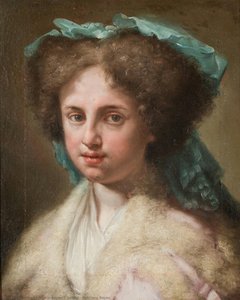 Feliciana Bayeu - Francisco Bayeu Y Subias
A central architect of the Spanish Neoclassical aesthetic, Francisco Bayeu y Subías (1734–1795) transitioned from the emotive traditions of the Baroque toward the luminous, structured clarity demanded by the Enlightenment. After his early training under José Luzán, his style underwent a profound evolution at the Academia Real de Bellas Artes de San Fernando. Influenced by the monumentalism of Anton Raphael Mengs and the theatrical brilliance of Giovanni Battista Tiepolo, Bayeu mastered the art of balancing historical gravity with an idealized, graceful restraint. This commitment to anatomical precision and noble simplicity firmly establishes him among the premier Spanish neoclassical painters.
His technical mastery led him to the Royal Palace, where he became a vital figure in the courtly splendor of 18th-century Spain. In his evocative portrait Feliciana Bayeu, we see this mastery applied to a more intimate scale. The work captures his daughter with a striking, steady gaze, utilizing a palette of soft pink and deep blue that dissolves the boundary between the subject and the atmospheric sky. Through a delicate, bocetística brushwork, Bayeu achieves a structural clarity that defines the roundness of her features, bridging the gap between formal courtly portraiture and the quiet, nostalgic reality of a father's gaze.
Ramón Bayeu
 Ferdinand VII as a Boy - Ramón Bayeu
Born in Zaragoza in 1744, Ramón Bayeu y Subías was a central figure in the Spanish artistic landscape, deeply influenced by a familial legacy of talent alongside his brothers, Francisco and Manuel. While his early training was rooted in the traditions of the Spanish Baroque, his artistic trajectory shifted decisively toward the Neoclassical movement. This transition was solidified by his transformative journey to Italy following a prestigious win at the Real Academia de Bellas Artes de San Fernando in 1766. Immersed in the classical splendor of Rome and Florence, Bayeu embraced the Neoclassical ideals of balanced composition, idealized beauty, and a restrained, clear palette, moving away from the dramatic intensity of his predecessors.
His mastery is particularly evident in his prolific work as a cartonista, designing elaborate tapestry cartoons for the Royal Factory. A profound example of his portraiture is Ferdinand VII as a Boy (1792). In this oil on canvas, he captures the young Prince of Asturias with a sense of poised dignity. Through meticulous detail—from the shimmering embroidery of his blue suit to the insignia of the Order of the Golden Fleece—Bayeu utilizes a controlled, Neoclassical precision to elevate a royal likeness into a timeless symbol of lineage and duty.
Conclusion
The Spanish neoclassical movement represents a profound shift toward order, clarity, and the timeless ideals of antiquity, leaving behind the dramatic excesses of the previous era. From the courtly elegance of Vicente López Portaña to the structured compositions of Mariano Salvador Maella, these artists collectively redefined the visual language of a nation, blending classical rigor with a distinct Spanish sensibility. Whether through the precise portraiture of Agustín Esteve or the grand, balanced narratives of the Bayeu brothers, this group of masters established a legacy of poise and intellectual depth that continues to resonate in the history of European art.
At Mus3ums.com, we invite you to bring this era of refined beauty into your own living space. Our skilled artists specialize in creating museum-quality, hand-painted oil reproductions that capture the authentic texture and luminous clarity of these neoclassical masterpieces. You can explore our full collection to find the perfect piece for your home and experience the enduring grace of Spanish art through the tactile depth of real brushstrokes on canvas.