Early Life and Artistic Training
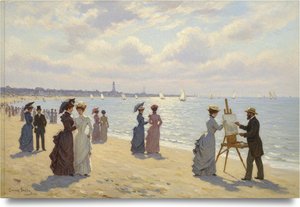
Sydney, Australia, 1927. Carl Cheek enters a world that will eventually provide the foundation for his visual language. His early years are defined by a specific fixation: the watercolor landscape. He watches the way light moves across a scene, a fascination fueled by the Impressionists. The influence of Eugène Boudin is particularly heavy here. Cheek studies the atmospheric depictions of the French painter, learning how to translate fleeting light and color onto paper through tonal subtlety and meticulous detail.
This early interest in representational landscapes provides the technical bedrock for his later shifts. He moves into formal training at the National Art School in Sydney. Here, the focus is on the mechanics of the medium. He hones his skills in both watercolor and oil painting, developing a technical proficiency that remains constant even as his subject matter undergoes radical changes. The precision learned in these classrooms becomes the structural backbone of his later, more abstract explorations.
Technique and Artistic Style
The 1950s mark a decisive shift in Cheek’s practice. He moves away from the meticulous detail of his early watercolor landscapes to embrace the radical simplification of color field abstraction. This transition aligns his vision with the minimalist aesthetics of Barnett Newman and Josef Albers. He abandons representational forms in favor of expansive canvases dominated by solid blocks of pigment. The focus shifts entirely to the expressive power of color itself.
His compositions rely on a strict sense of visual harmony and balance. He utilizes geometric shapes, specifically rectangles and squares, to act as the primary structural elements within the frame. These forms organize the space, creating a tension between the edges of the shapes and the surrounding pigment. Through a masterful manipulation of color palettes, he moves from muted earthy tones to intense hues to trigger profound emotional responses in the viewer. The result is an immersive experience that prioritizes contemplation over intellectual detachment.
Key Works and Collections
The breadth of Cheek’s output is significant, encompassing over 500 paintings that lean heavily toward the watercolor medium. These works have moved beyond his native Australia, finding permanent homes in various international collections. His presence in institutional settings is marked by specific holdings in London, where the Royal Free Hospital and Queen Mary hold two works each. Another piece resides in the Tynwald collection in Douglas.
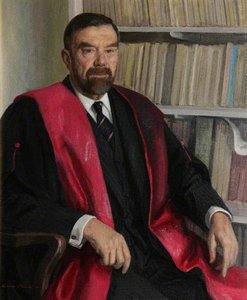
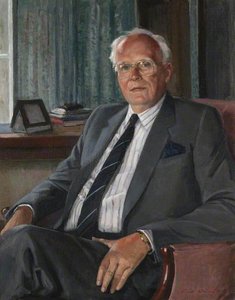
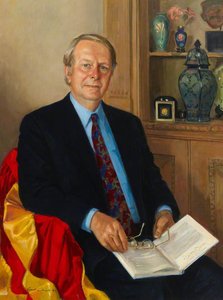
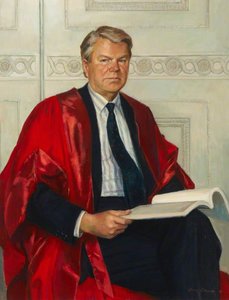
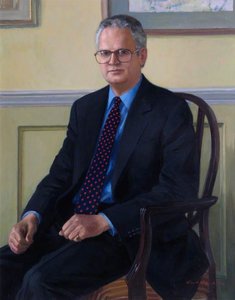
The subject matter of his catalog often intersects with the figures of professional and civic life. In 1991, he painted Professor John Varey, who served as Principal of Westfield College from 1983 to 1989. Around 1990, he captured the likeness of Patrick H. Corkery, a Consultant Orthopaedic Surgeon. These portraits sit alongside his more abstract explorations, demonstrating a versatility in how he approached his subjects.
- Sir William Wells, about 1994
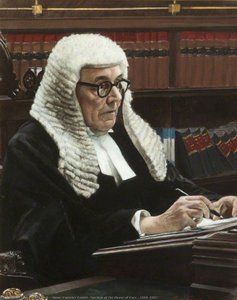
- Henry Knowles Corlett, Speaker of the House of Keys (1960–1962)
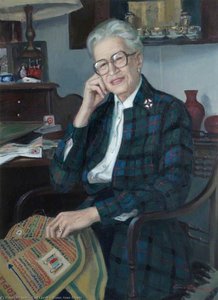
- Dame Anne Bryans
His reach extends to the Isle of Man, where the Tynwald collection preserves his work. Whether through the meticulous rendering of a specific individual or the expansive application of pigment, his paintings remain anchored in the institutions that commissioned or acquired them.
Legacy and Artistic Impact
Carl Cheek’s influence persists through a body of work that remains deeply embedded in the history of mid-century modernism. By the time of his death in 2011, he had established himself as a pioneer of color field abstraction. His practice moved beyond mere representation, focusing instead on the expressive capacity of pigment to facilitate spiritual contemplation. This commitment to the transformative potential of color ensures his presence in the discourse of abstract art.
His canvases continue to resonate with contemporary audiences. The quiet intensity of his compositions invites a specific kind of observation, one that prioritizes the interplay between geometric form and emotional depth. His legacy is defined by this refusal to settle for intellectual detachment, choosing instead to use the minimalist language of rectangles and squares to reach for something more intangible. His work remains a significant point of reference for those studying the intersection of color and spirituality.
Pytania i odpowiedzi
Do jakiej epoki należał/a Carl Cheek?
Carl Cheek tworzył w okresie Modern. Epoka ta osadza twórczość artysty w kontekście historycznym.