Introduction
American realist painters emerged during a transformative era in the United States, capturing the raw, unvarnished essence of a nation in flux. Moving away from the idealized romanticism and dramatic myth-making of previous generations, these artists turned their gaze toward the tangible truth of everyday life. Their work sought to document the grit of urban expansion, the quiet dignity of manual labor, and the subtle complexities of the human condition exactly as they appeared, without the embellishment of grandiosity or artifice.
This movement flourished as the American landscape shifted from agrarian roots to industrial powerhouses, providing a visual record of a society redefining itself. By focusing on ordinary people, authentic light, and the honest textures of the natural and man-made world, these painters established a visual language that was both profoundly local and universally human. Their commitment to accuracy was not merely about photographic likeness, but about capturing the psychological and social reality of their subjects.
Today, these artists remain vital for their ability to ground the viewer in a sense of place and time. Their canvases serve as windows into the soul of a developing nation, offering a profound connection to the lived experiences of those who built the modern world. In an age of digital abstraction, the tactile sincerity of their compositions continues to resonate with a deep appreciation for truth and substance.
The following selection explores the diverse expressions of this movement, highlighting the masters who defined the American realist tradition through their unique perspectives and technical mastery.
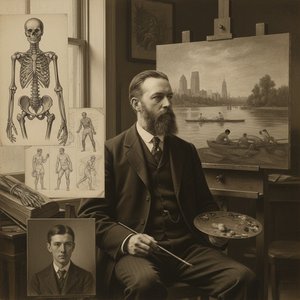
Thomas Eakins
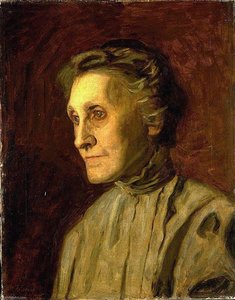 Portrait of Mrs. Helen Mac Knight (Portrait of a Mother) - Thomas Eakins
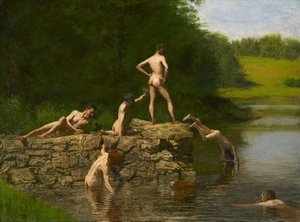
A visitor recognizes a work by Thomas Eakins through his uncompromising commitment to structural truth and anatomical precision. His brushwork avoids the soft, blurred edges of romanticism, opting instead for a disciplined, almost scientific clarity that captures the weight and texture of the physical world. Whether documenting the intensity of a surgical procedure or the quiet dignity of a private moment, his palette remains grounded in the tangible, using light to define form rather than to idealize it.
As a cornerstone of the American realist movement, Eakins rejected the tendency to make his subjects grander or prettier than they truly were. Instead, he focused on the raw, unvarnished reality of human existence, often placing him at odds with the more decorative sensibilities of his era. His life was deeply rooted in Philadelphia, where he studied at the Pennsylvania Academy of the Fine Arts, a foundation that fueled his lifelong obsession with the mechanics of the human body.
In his Portrait of Mrs. Helen Mac Knight (Portrait of a Mother), this dedication to verisimilitude is profoundly evident. The work eschews a romantic veneer, presenting the sitter with a startling immediacy and a quiet, enduring gravitas that elevates the ordinary into something monumental.
Frank Duveneck
 Lady with Fan - Frank Duveneck
In his 1873 work Lady with Fan, Frank Duveneck captures a profound sense of introspection through a somber, muted palette of deep blues and browns. This piece exemplifies the artist's ability to transform a quiet, intimate moment into a powerful study of human emotion. As a central figure in the American Realism movement, Duveneck rejected the idealized, polished aesthetics of the era in favor of an unflinching, direct observation of life. His style was deeply shaped by his time at the Royal Academy in Munich, where he embraced the vigorous, expressive brushwork of the Munich School and the dark, tonal richness reminiscent of Frans Hals.
Born in 1848 in Kentucky, Duveneck’s technical foundation was built through early apprenticeships and a transformative journey to Germany. His work is characterized by a tactile, impastoed surface where thick layers of oil paint create a physical presence on the canvas. By focusing on the raw textures of clothing and the subtle nuances of light and shadow, he brought a sense of unvarnished truth to his subjects, cementing his legacy as a master of American Realist portraiture and genre painting."
Abbott Handerson Thayer
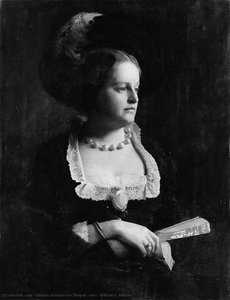 Mrs. William F. Milton - Abbott Handerson Thayer
In his 1881 portrait, Mrs. William F. Milton, Abbott Handerson Thayer demonstrates a profound ability to capture the essence of Victorian refinement through a lens of meticulous observation. This work exemplifies his mastery of light and texture, presenting the subject with a dignity that elevates her social standing into a study of character. Born in Boston in 1849, Thayer received rigorous formal training at the Bolestow school of art in Poland and later at the Académie Julian in Paris, experiences that deeply informed his sophisticated approach to composition.
Thayer belongs to the American realist movement through his commitment to portraying people and their environments with striking accuracy. While his work often features a subtle, innovative blend of impressionistic light, his foundation remains rooted in the truthful representation of his subjects. Whether through his evocative landscapes or his deeply emotive portraits, such as his celebrated The Virgin, he avoids the grandiosity of romanticism in favor of a grounded, palpable reality. His ability to balance the serenity of nature with the dynamism of human presence allowed him to capture the quiet, authentic details of life, securing his legacy as a vital figure in American art history.
George Peter Alexander Healy
 Self-Portrait - George Peter Alexander Healy
George Peter Alexander Healy (1813–1894) stands as a preeminent figure among American realist painters due to his profound ability to chronicle the human character through precise, dignified likenesses. His work is defined by a sophisticated command of light and shadow, often utilizing a dramatic chiaroscuro to pull the subject out of an atmospheric void. Unlike the idealized portraits of previous eras, Healy’s approach leaned into the tangible reality of his sitters, capturing the subtle textures of skin, hair, and fabric with academic precision. This commitment to representing the physical presence and psychological depth of his subjects—ranging from US Presidents to prominent dignitaries—places him firmly within the realist tradition of the 19th century.
In his Self-Portrait (1873), one can observe his mastery of this style. The work is a somber, introspective study where light strikes the face to define bone structure, emerging from a dark, indistinct background. His palette relies on warm, earthy tones and deep blacks, emphasizing the tactile quality of a velvet-like jacket and a crisp white collar. Through his training under masters like Thomas Couture in Paris and Rome, Healy developed a refined technique that prioritized anatomical accuracy and the honest depiction of the individual.
William P Chappel
 Adult Funeral Procession - William P Chappel
William P Chappel stands as a significant figure within the American Realism movement due to his unflinching commitment to documenting the social and physical realities of his era. Rather than idealizing his subjects, Chappel focused on the somber, unvarnished truths of everyday life and the changing urban landscape, a hallmark of the realist tradition that sought to portray the world exactly as it was encountered.
His representative work, Adult Funeral Procession (1870), serves as a profound testament to this dedication. In this piece, Chappel captures a solemn procession moving through a cemetery near Stanton and Chrystie Streets. The composition meticulously details a minister leading a widower and his son, accompanied by mourners and pallbearers distinguished by their white sashes and gloves. The work provides a stark, historical window into the overcrowded cemeteries of nineteenth-century New York, reflecting the real-world urban challenges and burial regulations of the time. Through such precise and unembellished depictions of mourning and civic life, Chappel exemplifies the realist impulse to find profound meaning in the ordinary and the contemporary.
George Bellows
 Nude with Red Hair - George Bellows
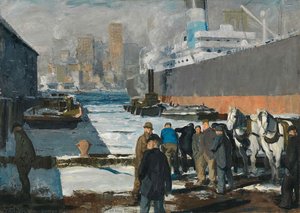
George Bellows stands as a pivotal figure among American realist painters, capturing the raw, burgeoning energy of early 20th-century urban life. A leading member of the Ashcan School, Bellows broke away from academic conventions to document the grit and dynamism of New York City. His work is defined by a profound sense of physicality and movement, a quality deeply influenced by his background as a competitive athlete in baseball and basketball at Ohio State University. This unique perspective allowed him to translate the tension of the human form and the chaos of the city into impactful, large-scale compositions.
While much of his oeuvre is celebrated for its depictions of boxing matches and bustling tenements, his 1920 work, Nude with Red Hair, reveals a different facet of his realist approach. In this piece, Bellows moves away from urban grit toward a more intimate, reflective realism. The painting focuses on the interplay of light and texture, using a controlled yet expressive brushwork to capture the weight of the subject's hair and the soft contours of the body. It remains a masterful study of form, proving that his realist vision could encompass both the public roar of the city and the quietude of private moments.
Jamie Wyeth
 Portrait of Lady - Jamie Wyeth
A descendant of the illustrious Brandywine School, Jamie Wyeth (b. 1946) carries forward a profound American realist tradition through a lens that is both deeply personal and strikingly vivid. While his work shares the thematic DNA of his father, Andrew Wyeth, and grandfather, N.C. Wyeth, Jamie distinguishes himself through a more vibrant palette and a tactile approach to his subjects. His mastery of realism is most evident in his ability to capture the raw essence of the rural landscapes and coastal regions of Maine, often exploring the intricate, sometimes harsh relationship between humanity and the natural world.
His work is instantly recognizable by its meticulous attention to texture and the psychological depth of his subjects, whether they are people, animals, or the rugged terrain of Monhegan Island. In his 1968 work, Portrait of Lady, Wyeth demonstrates this precision through a captivating study of a sheep. The painting elevates a simple animal to a subject of dignity, utilizing masterful light and shadow to render the texture of fur and the serenity of a grassy hillside with profound clarity. Through his evocative portraits and animal studies, Wyeth remains a vital voice in the American realist movement.
Daniel Ridgway Knight
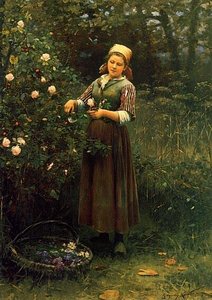 Cutting Roses - Daniel Ridgway Knight
Born in Pennsylvania in 1839, Daniel Ridgway Knight represents a sophisticated branch of American Realism, characterized by his ability to elevate the mundane activities of rural life into scenes of profound serenity. While many of his contemporaries focused on the grit of urban industrialization, Knight sought the quietude of the French countryside. His training at the Pennsylvania Academy of the Fine Arts and his subsequent studies under Jean-François Meissonier in Paris instilled in him a meticulous attention to detail and a commitment to historical accuracy that define his realist approach.
A viewer can instantly recognize a Knight masterpiece by its luminous, soft light and the tranquil presence of peasant women integrated into lush, pastoral landscapes. His brushwork avoids the frantic energy of Impressionism, opting instead for a polished, smooth execution that emphasizes the textures of fabric, skin, and flora. In his celebrated work, Cutting Roses, he achieves a masterful balance between realism and tonalism. The composition captures a quiet, domestic moment—a young girl amidst dense rose bushes—using a palette of deep, earthy tones and gentle light to evoke a sense of timeless, peaceful contemplation. Through this focus on the dignified simplicity of everyday existence, Knight remains a vital figure in the American realist tradition."
Charles Sprague Pearce
 Decapitation of St. John the Baptist - Charles Sprague Pearce
Charles Sprague Pearce (1851–1914) stands as a distinguished figure among American realist painters due to his ability to ground even the most exotic or dramatic subjects in profound human truth and anatomical precision. While many of his contemporaries sought to escape the mundane, Pearce utilized the rigorous academic training he received in the atelier of Léon Bonnat in Paris to capture the raw, unvarnished essence of his subjects. His work is characterized by a commitment to depicting life as it is experienced, whether through the lens of everyday genre scenes or the intense psychological weight of historical narratives.
His mastery of the realist tradition is vividly demonstrated in his 1883 work, Decapitation of St. John the Baptist. In this piece, Pearce moves beyond mere illustration to provide a visceral exploration of suffering and faith. Rather than sanitizing the martyrdom, he focuses on the immediate, heavy reality of the moment, utilizing a sophisticated command of line and tonal complexity to convey the dignity and pain of the scene. This dedication to capturing the palpable intensity of the human condition, combined with his meticulous technical skill, cements his legacy within the American realist movement.
Walter Gay
 The Living Hall (The Frick Collection, New York) - Walter Gay
Born into a prominent New England family in 1856, Walter Gay became a vital link between American sensibility and the grand traditions of Europe. After moving to Paris in 1876, he studied under Léon Bonnat, a period that fundamentally reshaped his creative identity. His technique, refined alongside contemporaries like John Singer Sargent, focused on the sophisticated manipulation of light and atmosphere. Gay’s inclusion in the group of American realist painters stems from his dedication to depicting life with unvarnished, quiet dignity. Rather than idealizing his subjects, he captured the authentic textures of existence, from the humble lives of French peasants to the opulent stillness of grand interiors.
His mastery of light is most profoundly realized in The Living Hall. In this work, Gay moves beyond mere architectural documentation to create a symphony of warmth and texture. He prioritizes the luminous quality of light hitting plush furniture and rich Persian carpets over rigid structural detail. By focusing on the ephemeral quality of air and the tactile reality of a domestic space, Gay achieves a profound sense of realism that celebrates the lived experience of a moment.
Conclusion
The legacy of American realist painters lies in their profound ability to capture the unvarnished truth of the human condition, from the gritty, muscular energy of urban life to the quiet, dignified stillness of a private moment. Whether through the anatomical precision of Eakins or the atmospheric landscapes of Bellows, these artists moved away from idealized romanticism to find beauty in the authentic, the everyday, and the tangible. Their collective contribution redefined the American aesthetic, proving that there is immense power in depicting the world exactly as it is seen.
For those looking to bring this sense of historical depth and honest beauty into their own environments, Mus3ums.com offers a way to honor these masters. You can explore our full collection to find your favorite pieces. We specialize in transforming these iconic works into museum-quality, hand-painted oil reproductions, allowing you to live with the texture, soul, and enduring spirit of American Realism in your own home.