The Moravian Master of Light and Wood
In the heart of the Enlightenment, amidst the rolling landscapes of Moravia, the name Andreas Kaspar Schweigel resonates as a symbol of profound spiritual and artistic devotion. Born in Brno in 1735, Schweigel emerged not merely as a craftsman, but as a visionary who could breathe life into inanimate matter. His journey began within the prestigious halls of Vienna’s Academy of Fine Arts, where he was deeply influenced by the humanist ideals of the sculptor Paul Troger. This formative education instilled in him a reverence for classical proportions and a belief that art should serve as a bridge between the earthly and the divine. Through this lens, Schweigel viewed every chisel stroke as an act of devotion, shaping a legacy that would define the ecclesiastical splendor of his homeland.
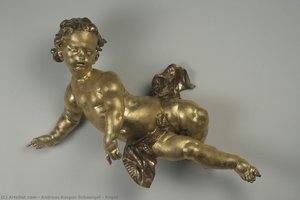
The essence of Schweigel’s artistry lies in his unparalleled mastery of wood and gilding, techniques that allowed him to manipulate light and texture with breathtaking precision. He possessed a rare ability to transform heavy timber into delicate, ethereal forms that seemed to glow from within. By applying meticulous layers of gold leaf—a process known as gilding—he created shimmering surfaces that captured the flickering candlelight of Moravian churches, imbuing his sculptures with a celestial luminosity. His work was never static; it was designed to interact with the atmosphere of the sacred spaces it inhabited, creating an immersive experience for the faithful that blended the tactile reality of carved wood with the transcendent brilliance of gold.
A Legacy Carved in Devotion
The zenith of Schweigel’s sculptural career is perhaps best embodied in his monumental contributions to religious architecture. His most celebrated achievement, the ancient master-altar commissioned for Notre Dame de douleurs near Jägerndorf between 1764 and 1770, stands as a testament to his technical virtuosity and emotional depth. This masterpiece of Baroque sculpture showcases his ability to weave complex theological narratives into intricate physical forms, where every fold of drapery and every anatomical detail serves a higher purpose. His oeuvre, scattered across numerous churches throughout the region, reflects the fervent piety of the 18th century, demonstrating how he translated abstract spiritual concepts into tangible, awe-inspiring artistic expressions.
Beyond the physical beauty of his sculptures, Schweigel was a man of immense intellectual breadth. He was far more than a sculptor; he was a scholar and a guardian of history. In a remarkable feat of cultural preservation, he authored the first comprehensive art history book dedicated to the monuments of Moravia. This pioneering work documented the architectural triumphs of his region, revealing an artist who was deeply invested in the continuity of his culture's heritage. Through this scholarly endeavor, Schweigel ensured that the artistic achievements of his era would not be lost to time, cementing his historical significance as both a creator of beauty and a chronicler of civilization.
Perguntas e Respostas
De onde é Andreas Kaspar Schweigel?
Andreas Kaspar Schweigel nasceu em Czech Republic.
Qual é a cidade e o país de nascimento de Andreas Kaspar Schweigel?
Andreas Kaspar Schweigel nasceu em Brno, em Czech Republic.
What aliases or alternate names does Andreas Kaspar Schweigel have?
Andreas Kaspar Schweigel is also known as Andreas Schweigel.