


Introduction
The 18th century in Austria was a period of profound aesthetic transformation, where the dramatic intensity of the Baroque began to yield to the refined elegance of the Rococo and the structured clarity of Neoclassicism. Centered in a landscape of imperial grandeur and sprawling religious architecture, these painters captured a world in transition. Their work reflects the shifting tides of European thought, moving from the theatrical, emotive compositions used to inspire awe in sacred spaces to the more intimate, light-filled depictions of aristocratic life and the natural world.
This era saw a remarkable convergence of styles, as artists integrated international influences from Italy and France into a distinctively Central European visual language. Whether through the sweeping, celestial frescoes that adorned palace ceilings or the meticulous detail of portraiture and landscape, these masters defined the visual identity of the Habsburg monarchy and its surrounding territories. Their ability to balance technical precision with profound emotional resonance allowed them to master diverse genres, from the sublime to the pastoral.
Today, the legacy of these artists endures through the enduring power of their compositions and their influence on the evolution of European art history. Their works remain vital studies in light, texture, and the human form, offering a window into the sophisticated cultural fabric of the Enlightenment. The following selection explores ten essential figures of this movement, including the masterful works of Martin Johann Schmidt, the delicate touch of Johann Christian Brand, and the expressive landscapes of Josef Ignaz Mildorfer, each representing a unique facet of this golden age of Austrian creativity."
Johann Georg Edlinger
 Count Rumford - Johann Georg Edlinger
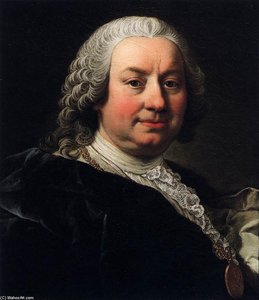
Born in Graz in 1741, Johann Georg Edlinger represents the sophisticated evolution of Austrian portraiture during the 18th century. His journey from the modest beginnings of a gardener's son to the prestigious position of court painter in Munich under Elector Karl Theodor illustrates the social mobility and artistic ambition characteristic of this era. Edlinger’s career, which saw him move from the formative art scenes of Vienna to the Bavarian court, highlights the interconnectedness of Central European artistic hubs during the 1700s.
His technical mastery is defined by a profound Rembrandtian influence, utilizing dramatic chiaroscuro to imbue his subjects with psychological depth. This is masterfully demonstrated in his 1792 work, Count Rumford. In this portrait, Edlinger employs a somber, muted palette where deep blacks and dark browns dominate, allowing the high-contrast white of the sitter's cravat and powdered hair to emerge from the shadows. The presence of an ornate gold star-shaped medal provides a singular, brilliant focal point against the dark attire, capturing the dignified essence of the 18th-century elite through a sophisticated interplay of light and shadow.
Johann Christian Brand
 Parable of the Workers in the Vineyard - Johann Christian Brand
In his 1769 composition, Parable of the Workers in the Vineyard, the viewer is transported into a sun-drenched landscape where communal labor meets the quietude of nature. This work exemplifies the technical brilliance of Johann Christian Brand (1722–1795), an artist who served as a vital bridge between the theatrical grandeur of the Baroque and the intimate, atmospheric whispers of Romanticism. As a prominent figure among 18th century Austrian painters, Brand moved away from staged, monumental drama toward a meticulous realism that celebrated the organic textures of the earth.
Born into an artistic lineage as the son of the esteemed Christian Hilgott Brand and trained at the Vienna Academy, he developed an uncanny ability to capture the ephemeral quality of light filtering through a canopy of trees. His palette is characterized by a luminous, tranquil sensibility, often utilizing soft tones to depict the rolling hills and the Vienna Woods. Rather than relying on harsh chiaroscuro, Brand employed a sophisticated atmospheric perspective to integrate human presence, animals, and the terrain into a cohesive, rhythmic whole. His legacy remains defined by this ability to marry classical precision with a profound sensitivity to the subtle interplay of light and shadow.
- A detailed depiction of agricultural tasks and teamwork.
- The use of atmospheric perspective to establish spatial depth.
- Integration of animal life, including a horse and a dog, into the rural setting.
- A focus on the organic textures of the earth and vegetation.
Josef Grassi
 Portrait of Charlotte Bach Mannteufel - Josef Grassi
Born in Vienna's Leopoldstadt district in 1757, Josef Grassi emerged as a pivotal figure in the landscape of 18th-century Austrian painters. His artistic foundation was laid at the Vienna Academy of Fine Arts, where he transitioned from the meticulous craftsmanship learned from his father, a sculptor, to a sophisticated mastery of portraiture. Grassi’s work is defined by a luminous color palette and a profound ability to capture psychological depth, qualities that allowed him to navigate the transition from Neoclassical precision to a more nuanced, Romantic sensibility.
His 1793 work, Portrait of Charlotte Bach Mannteufel, serves as a masterful testament to his technical prowess. In this oval-shaped bust portrait, Grassi utilizes a refined Neoclassical approach to create a sense of quiet poise. The composition is characterized by a delicate interplay of light and shadow, where a soft illumination from the upper left highlights the subject's features and the luster of her pearls. By employing a restrained palette of creamy whites and deep browns, Grassi achieves a remarkable contrast between the smooth, luminous texture of the skin and the expressive, voluminous folds of her drapery, immortalizing the subject with an enduring sense of grace.
Martin Johann Schmidt
Born in 1718 in Lower Austria, Martin Johann Schmidt—frequently referred to as Kremser Schmidt—stands as a monumental figure among 18th century Austrian painters. The son of a sculptor, Schmidt transitioned from the tactile nature of his father's craft to a mastery of light and color that would define the late Baroque era. His admission to the prestigious Imperial Academy in Vienna in 1768 solidified his status alongside contemporaries like Franz Anton Maulbertsch, marking him as a visionary of the Austrian landscape.
Schmidt’s oeuvre is characterized by a profound ability to bridge complex Baroque drama with emotional accessibility. His large-scale altar paintings transformed ecclesiastical spaces into theatrical environments of light. In his 1765 work, Pietà, he demonstrates a sophisticated command of chiaroscuro, utilizing deep umber and black tones to push the brightly lit, pale form of Christ into the viewer's immediate emotional field. This use of heavy impasto and dramatic tonal values suggests a connection to Northern traditions, specifically the influence of Rembrandt, while his fluid, luminous approach to light subtly foreshadows the arrival of Impressionism. Through his religious and mythological narratives, Schmidt remains a cornerstone of 18th-century Austrian artistic expression.
Balthasar Permoser
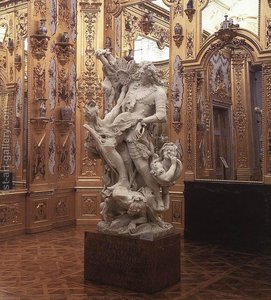 Apotheosis of Prince Eugene - Balthasar Permoser
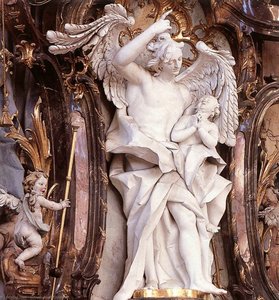
A virtuoso of both stone and spirit, Balthasar Permoser stands as a monumental figure whose career bridged the dramatic intensity of the late Baroque and the graceful nuances of the early Rococo. Born in Kammer bei Waging, his artistic identity was forged through a grand European odyssey. His early training in Salzburg and his subsequent mastery of intricate ivory carving in Vienna provided a foundation of precision that would define his later sculptural achievements. This technical meticulousness was profoundly transformed during a fourteen-year sojourn in Florence, where working in the studio of Giovanni Battista Foggini infused his German roots with the theatricality and warmth of the Italian tradition.
Permoser’s legacy is cemented by his role in shaping the visual splendor of the 18th century, particularly through his monumental contributions to the Zwinger palace in Dresden. His ability to blend structural strength with fluid, emotional grace is epitomized in his 1718 masterpiece, Apotheosis of Prince Eugene. In this breathtaking marble work, Permoser orchestrates a celestial ascent, using the luminous qualities of stone to elevate a historical commander into a realm of divine glory. Through his command of movement and light, he remains a definitive voice among 18th century Austrian painters, leaving behind a legacy of dramatic, narrative-driven art.
Giovanni Antonio Guardi
 Interior: A Sultana taking Coffee in the Harem - Giovanni Antonio Guardi
Born in Vienna in 1699, Giovanni Antonio Guardi represents a vital link between the imperial grandeur of the Habsburg capital and the theatricality of the Venetian Baroque. As a painter born in Austria, his artistic identity was forged through a noble lineage, being the son of the respected painter Domenico Guardi. This heritage allowed him to bridge the cultural currents of the 18th century, eventually establishing a prominent studio alongside his brothers and contributing to the founding of the Accademia Veneziana. His work is characterized by a sophisticated synthesis of scientific precision and dramatic flair, moving away from idealized forms to capture the authentic pulse of life.
In his 1742 oil on canvas, Interior: A Sultana taking Coffee in the Harem, Guardi demonstrates his mastery of the 18th-century fascination with Turquerie. The piece showcases his ability to manipulate light and shadow, using a theatrical chiaroscuro to define the heavy, sculptural folds of billowing drapery. Through a rich palette of deep reds, golden ochres, and cool blues, he creates a staged intimacy that transforms an imagined Eastern setting into a vivid, textured reality, proving his status as a visionary of the Baroque era.
Anton Von Maron
 Kaiserin Maria Theresia (1717-1780) with the Statue of the Friedens - Anton Von Maron
Born in Vienna in 1733, Anton von Maron stands as a quintessential figure among 18th century Austrian painters, representing the sophisticated bridge between Viennese training and the classical grandeur of Rome. After studying at the Academy of Fine Arts in Vienna under Karl Aigen and Daniel Gran, Maron relocated to Italy in 1755, where his career was transformed by the influence of Anton Raphael Mengs. His mastery of form and clarity, further solidified by his marriage into the Mengs family, established him as a premier portraitist for the European aristocracy and Grand Tour travelers.
His ability to blend psychological depth with neoclassical elegance is masterfully captured in his 1772 work, Kaiserin Maria Theresia (1717-1780) with the Statue of the Friedens. In this profound composition, Maron moves beyond mere likeness to explore the intersection of private grief and imperial duty. The Empress is depicted in the somber attire of a widow, her luminous skin contrasting against the dark fabrics of her mourning. Through a sophisticated use of light and shadow, Maron integrates an ethereal sculptural group into the background, elevating a portrait of a sovereign into a powerful allegory of stability and divine purpose.
Martin Knoller
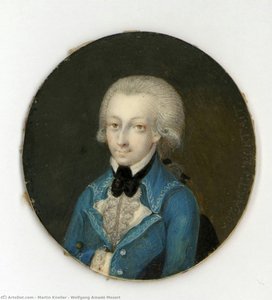
Born in Steineck im Brenner near Innsbruck, Martin Knoller (1725–1804) stands as a significant figure among 18th century Austrian painters, bridging the transition from the dramatic Baroque to the refined elegance of the Rococo. His early training under masters Paul Troger and Michelangelo Unterberger in Salzburg and Vienna provided a rigorous foundation in classical technique. However, it was his 1755 journey to Rome that fundamentally reshaped his artistic trajectory. By engaging with the burgeoning Neoclassical ideals championed by Anton Raphael Mengs, Knoller developed a style characterized by a unique balance of structural clarity and vibrant, emotive energy.
Knoller’s mastery is most evident in his ability to organize complex figure groups within a clear, harmonious composition. He was particularly celebrated for his frescoes and altarpieces, where he utilized a luminous palette to bring religious and secular scenes to life. In his 1773 portrait, Wolfgang Amadé Mozart, this stylistic duality is strikingly apparent. The work captures the composer with a sculptural weight reminiscent of Baroque traditions, yet it is infused with a Neoclassical grace and a sophisticated use of light that reflects the orderly precision of the era's musical genius.
Josef Ignaz Mildorfer
 Allegory of the Immaculate Conception of Mary - Josef Ignaz Mildorfer
A central figure among 18th century Austrian painters, Josef Ignaz Mildorfer (1719–1775) embodied the spiritual grandeur of the Habsburg era. Born in Innsbruck, his artistic foundation was laid by his father, Michael Ignaz Mildorfer, but his creative trajectory was truly defined by his apprenticeship under the renowned Paul Troger. This lineage allowed Mildorfer to master the expressive use of color and naturalistic observation that became his hallmark. His ascent within the Viennese art scene was marked by his membership in the Academy of Fine Arts Vienna in 1745 and his subsequent tenure as a professor, where he became a vital conduit for Baroque ideals. His prestige was further solidified by his appointment as court painter to Princess Eleonora of Savoy.
Mildorfer’s mastery of the celestial is best exemplified in his 1745 work, Allegory of the Immaculate Conception of Mary. In this composition, he captures a moment of divine grace through a rhythmic, upward movement of angels and cherubs swirling through an azure and cream sky. The interplay of light and shadow creates a sense of infinite depth, blurring the boundaries between the earthly and the divine. His ability to render such ethereal, monumental scenes made him a cornerstone of the Austrian Baroque tradition.
Ludwig Guttenbrunn
 Portrait of Princess Ye. Golenishcheva-Kutuzova - Ludwig Guttenbrunn
A master of portraiture and history painting, Ludwig Guttenbrunn (1750–1819) stands as a significant figure among 18th century Austrian painters. His career was defined by an ability to capture the essence of nobility, translating the elegance of figures like Marie Antoinette into exquisite oil works that evoke the grandeur of a bygone era. His work is a testament to the refined aesthetic of the period, blending the grace of the Rococo with the emerging discipline of Neoclassicism.
In his representative work, Portrait of Princess Ye. Golenishcheva-Kutuzova (1797), Guttenbrunn demonstrates a profound command over light and texture. The composition is a study in quiet dignity, where soft light catches the delicate lace of a white gown and the deep, heavy red of a shawl. Through a meticulous application of oil, he renders the tactile quality of silk and the subtle gold accents of a sophisticated interior. This piece exemplifies why he is a cornerstone of the Austrian school of this era; he does not merely record a likeness, but captures the very station and poise of his subjects through a balanced, harmonious use of color and form.
Conclusion
The masters of this era collectively defined a visual language of elegance, ranging from the dramatic religious fervor of Martin Johann Schmidt to the refined, light-filled landscapes and portraits that characterized the Austrian Enlightenment. Whether through the intricate detail of Johann Christian Brand or the grand, theatrical compositions of the Baroque and Rococo transitions, these artists captured the spirit of a changing empire. Each painter contributed a unique layer to the cultural fabric of the 18th century, ensuring that the Austrian aesthetic remained both deeply spiritual and exquisitely sophisticated.
For those looking to bring this historical grandeur into a modern setting, Mus3ums.com offers a way to honor these legacies. You can explore our full collection to find your favorite pieces. We invite you to transform your living space by living with these masterpieces through our museum-quality, hand-painted oil reproductions, each meticulously crafted to preserve the soul and texture of the original works.