




Introduction
The 18th century in Poland was a period of profound cultural transformation, where the artistic landscape served as a mirror to a nation navigating the complexities of Enlightenment ideals and shifting political boundaries. This era saw a fascinating convergence of styles, as artists moved between the dramatic flourishes of the late Baroque and the refined, graceful sensibilities of the Rococo and early Neoclassicism. The painters of this period were not merely decorators; they were visual chroniclers of a society in transition, capturing everything from the grandiosity of aristocratic life to the intimate nuances of portraiture and the evolving landscapes of the Polish countryside.
What unites these masters is their ability to synthesize international trends—often influenced by French, Italian, and German schools—with a distinct local identity. Whether through the delicate precision of printmaking or the sweeping brushstrokes of oil on canvas, these artists captured the spirit of an age defined by intellectual curiosity and a burgeoning sense of national character. Their works provide a vital window into the aesthetics of the Polish Enlightenment, documenting the elegance, the social hierarchies, and the changing light of a bygone era.
Today, these painters remain essential for understanding the roots of Central European visual culture. Their technical mastery and their ability to translate the human condition through light and shadow continue to resonate with modern sensibilities. By exploring the lives and legacies of these ten significant figures, we trace the evolution of a sophisticated artistic tradition that helped shape the visual heritage of the region.
Daniel Nikolaus Chodowiecki
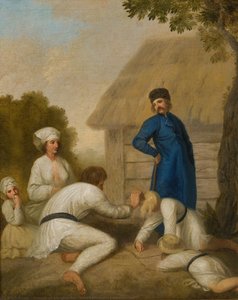
Born in Danzig in 1726, Daniel Nikolaus Chodowiecki stands as a vital figure among 18th century Polish painters, representing a sophisticated bridge between his Polish roots and the artistic life of Berlin. His journey from a young man of Huguenot and Polish ancestry to a prominent member and vice-director of the Berlin Academy of Art highlights a career of immense professional ascent. Chodowiecki’s mastery was most profoundly felt through his etchings, which served as a delicate visual diary of the Zopfstil period, capturing the transition from Rococo elegance to Classical structure.
His work is celebrated for its intimate portrayal of the burgeoning bourgeoisie, often finding beauty in the quiet rhythms of daily life. A quintessential example of his graphic prowess is the 1766 etching titled Illustration for Don Quixote. In this piece, he utilizes a tranquil rural setting, dominated by an ancient oak, to frame a narrative scene that reflects his ability to blend literary themes with a sensitive, observational gaze. Through his thousands of prints, Chodowiecki immortalized the social fabric of his era with an unparalleled, nuanced touch.
Szymon Czechowicz
 Saint Elizabeth - Szymon Czechowicz
Szymon Czechowicz stands as a monumental figure among 18th century Polish painters, bridging the dramatic intensity of the Baroque with the emerging grace of the Rococo. Born in Kraków, his artistic evolution was profoundly shaped by his time in Rome, where he studied at the prestigious Accademia di San Luca under the tutelage of Benedetto Luti. This international training allowed him to infuse Polish sacral art with a sophisticated Roman chiaroscuro, characterized by a masterful command of light and shadow that breathes life into every canvas.
His representative work, Saint Elizabeth (c. 1750), exemplifies the spiritual depth and technical precision that defined his career. In this composition, Czechowicz captures a moment of profound charity, utilizing a high-contrast lighting scheme that emanates from the upper left to illuminate the saint's compassionate features. The figure is draped in a silken yellow gown and heavy blue drapery, rendered with such tactile sensitivity that the textures of lace and fabric feel almost tangible. Through the fluid movement of hands and the symbolic exchange of coins, Czechowicz transforms a scene of social responsibility into a sublime, emotive masterpiece of the 18th century.
Franciszek Smuglewicz
 Offering of a Vestal - Franciszek Smuglewicz
In Offering of a Vestal (1785), a solemn ritual unfolds within a quiet, atmospheric space. The scene centers on a woman draped in luminous white fabric, her presence acting as the primary focal point against a darker, receding background. She sits amidst a group of women dressed in classical attire, all gathered for a sacred purpose. The composition draws the eye toward this central figure, where the light catches the heavy folds of her garments, creating a sense of sculptural weight and stillness. Through a controlled use of chiaroscuro, the light cuts through the darkness to pull the central figure into sharp relief, establishing a reverent, theatrical dignity.
A prominent figure among 18th century Polish painters, Franciszek Smuglewicz (1745–1807) was a master of the Neo-Classical era. After beginning his training in his father's Warsaw workshop, he spent twenty-one years in Rome studying under Anton von Maron, a journey that deeply infused his work with classical ideals. His oeuvre spans from grand historical narratives, such as Kościuszko's Oath, to profound social commentary regarding the liberation of peasants. As a founder of the institute of sketch and painting in Vilnius, his influence shaped generations of artists, cementing his legacy as a pivotal bridge between enlightened classicism and the evolving artistic landscape of the period.
Krzysztof Lubieniecki
 Portrait of a Man in a Wig. - Krzysztof Lubieniecki
Krzysztof Lubieniecki represents a fascinating bridge between the Polish-Lithuanian Commonwealth and the Dutch Golden Age. Born in 1659 in Szczecin, his artistic journey was shaped by the religious migrations of the Polish Brethren, eventually leading him to the prestigious workshops of Amsterdam. His presence in the 18th-century Polish painter group is defined by this unique cultural synthesis, as he carried his Polish heritage into the heart of European Baroque mastery. Having trained under Juriaan Stur in Hamburg and later apprenticed with the portraitist Adriaen Backer, Lubieniecki mastered a style characterized by psychological depth and a sophisticated command of chiaroscuro.
A visitor recognizes his hand through the dramatic interplay of light and shadow and a refined, dignified approach to portraiture. In his representative work, Portrait of a Man in a Wig (1728), this technique is vividly realized. The composition utilizes a trompe l'oeil oval frame to create an intimate sense of depth, drawing the eye to the subject's steady gaze. His palette often features striking color contrasts, such as the brilliant cerulean blue of a coat set against deep, warm drapery, all illuminated by a soft, directional light that captures the tactile texture of silk and powdered hair.
Józef Peszka
 Portrait of Jan Duklan Buchowiecki. - Józef Peszka
In the Portrait of Jan Duklan Buchowiecki, the artist demonstrates a masterful command of Neoclassical precision. The subject is rendered in a three-quarter view, where a heavy, matte black coat absorbs the light, creating a profound contrast against a crisp white cravat and a striking red ceremonial sash. This interplay of light and shadow defines the contours of the face and the tactile textures of the fabric, from the soft powder of the wig to the metallic glint of the star-shaped order on his chest.
Born in 1767, Józef Peszka emerged from the vibrant artistic energy of late 18th-century Kraków. His formative years were shaped by the Austrian master Dominik Oesterreicher, before he refined his academic discipline in Warsaw under Franciszek Smuglewicz. This lineage of Polish training allowed Peszka to marry technical rigor with a deep psychological gravity, a skill famously showcased in his portrait of Hugo Kołłątaj. Beyond the studio, his restless curiosity led him through Lithuania and Russia, where he captured evocative, atmospheric landscapes in watercolor and sepia. Whether navigating the gilded corridors of the nobility or documenting sprawling vistas, Peszka’s work remains a testament to the sophisticated visual identity of the Polish Enlightenment.
Enoch Seeman
 Thomas Howard, 7th Baron Howard of Effingham (1682-1725) and his Wife, Mary Wentworth, Lady Howard of Effingham (d.1718) - Enoch Seeman
In the portrait Thomas Howard, 7th Baron Howard of Effingham and his Wife, Mary Wentworth, Lady Howard of Effingham, we witness the profound ability of Enoch Seeman to capture the quiet stillness of aristocratic life. The composition is a masterclass in chiaroscuro, where the darkness of the background pushes the figures forward, allowing the light to catch the delicate sheen of ermine fur and the translucent texture of lace. This dramatic interplay of light and shadow grants the subjects a startling clarity and a sense of psychological depth.
Born in Gdańsk, Poland, around 1689, Seeman represents the cosmopolitan spirit of 18th-century Polish painters who achieved international acclaim. After moving to England with his father, he became a prominent portraitist of the Georgian era, known for his refined elegance and technical restraint. His work moved away from the flamboyant Baroque style, favoring a muted palette of ochre, deep browns, and subtle greys to convey dignity. By blending his Polish heritage with a sophisticated mastery of light, Seeman’s portraits of the British nobility remain essential studies in the language of status and texture.
Franz Xavier Karl Palko
 St. John of Matha and St. Felix of Valois Ransoming Christian Slaves - Franz Xavier Karl Palko
Born in 1724, Franz Xavier Karl Palko stands as a significant figure among 18th century Polish painters due to his Silesian origins and his profound impact on the visual landscape of Central Europe. His artistic journey began under the guidance of his father, Anton Palko, before he transitioned to the Academy of Fine Arts in Vienna. This foundation allowed him to navigate the major artistic hubs of the era, including Venice, where the influence of Giuseppe Crespi helped shape his mastery of light and form. His career reached a professional zenith when he was appointed a court painter for the Electorate of Saxony, a status that later allowed him to overcome guild disputes in Prague to execute monumental frescoes for the Society of Jesus.
Palko’s work is characterized by a dramatic tension between the sacred and the secular, a hallmark of his contribution to the 18th century Polish artistic tradition. His representative work, St. John of Matha and St. Felix of Valois Ransoming Christian Slaves (1745), exemplifies this intensity. The composition utilizes a powerful chiaroscuro to depict the heavy, terrestrial suffering of captives against a swirling, celestial atmosphere. Through his ability to blend precise portraiture with grand religious narratives, Palko captured the spiritual and social complexities of his time.
Wincenty de Lesseur
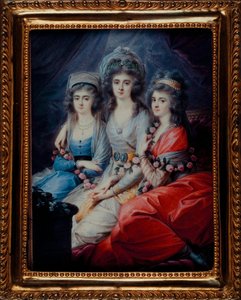 Three sisters, Countesses Thun von Hohenstein - Wincenty de Lesseur
A master of the intimate scale, Wincenty de Lesseur (1745–1813) stands as a quintessential figure among 18th century Polish painters. Born in Warsaw to a French army officer, his artistic journey was shaped by the rigorous training of Marcello and Johanna Bacciarelli. His talent eventually led him to the court of King Stanisław August Poniatowski, where he served as a chamberlain and became a celebrated portraitist of the era's most influential figures.
Lesseur’s technique was defined by a remarkable, needle-like precision. Working primarily on ivory, he employed a pointillistic application of watercolor and gouache, creating a seamless, luminous surface that mimicked the softness of real skin. This method allowed him to capture the quiet prestige of the aristocracy in works of breathtaking delicacy.
In his representative work, Three sisters, Countesses Thun von Hohenstein (1792), Lesseur achieves a sense of frozen time. The composition captures the sisters in a moment of shared intimacy, their gowns rendered with a velvet-like texture through rhythmic, tiny dots of pigment. Whether recreating the masterpieces of Bacciarelli or capturing the likeness of European monarchs, Lesseur’s ability to translate grand social realities into miniature wonders remains a testament to his technical virtuosity.
Michał Stachowicz
 Portrait of Jacek Przybylski - Michał Stachowicz
Born in 1768, Michał Stachowicz represents the profound transition of Polish art from the classical traditions of the late 18th century into the emotional fervor of Romanticism. His formative years in Kraków, shaped by the intellectual environment of his father's bookbinding workshop, provided a unique foundation for a career dedicated to visual storytelling. Trained at the Kraków Painter's Guild under masters like Franciszek Ignacy Molitor and Kazimierz Mołodziński, Stachowicz mastered both the courtly elegance of classical composition and the spiritual depth of religious iconography. This dual expertise allowed him to become a vital chronicler of his nation's identity during a period of immense political upheaval.
His 1794 Portrait of Jacek Przybylski serves as a masterful example of his ability to capture human dignity through sophisticated oil techniques. In this work, Stachowicz utilizes a somber, high-contrast palette to define the subject, employing directional lighting to create a striking three-dimensional volume. The meticulous rendering of the blue coat and the warm textures of the fur collar demonstrates the technical precision characteristic of his era. Through such portraits and his monumental historical scenes, Stachowicz solidified his place among the most significant painters from Poland in the 18th century.
Andrew Thaddeus Bonaventure Kosciuszko
 Letters and Daily Orders of the Commander-in-Chief Tadeusz Kościuszko to General Mokronowski - Andrew Thaddeus Bonaventure Kosciuszko
The Letters and Daily Orders of the Commander-in-Chief Tadeusz Kościuszko to General Mokronowski (1794) serves as a profound testament to the intellectual and strategic weight of this era, offering a rare glimpse into the political and social currents of the 1794 national uprising. While primarily a historical document, it encapsulates the spirit of a man whose life was defined by the intersection of engineering precision and revolutionary fervor. As a prominent figure among 18th century Polish painters and intellectuals, Andrew Thaddeus Bonaventure Kosciuszko represents the era's unique blend of military science and the pursuit of sovereignty.
Born in Poland in 1746, Kosciuszko’s contribution to the 18th-century landscape was as much about the architecture of defense as it was about the art of war. After graduating from Warsaw’s Corps of Cadets in 1765, he refined his technical mastery at the École Polytechnique in France. This rigorous training allowed him to treat terrain as a canvas, designing strategic fortifications and blockades that would impact history across two continents. His legacy is one of structural brilliance and a tireless commitment to the ideals of liberty.
Conclusion
The 18th century was a transformative era for Polish art, a period where the elegance of the Enlightenment met a distinct national identity. From the intricate, narrative precision of Chodowiecki to the grand, dramatic compositions of Czechowicz and Smuglewicz, these masters collectively defined a visual language that bridged the gap between classical tradition and the emerging sensibilities of a modernizing society. Whether through the delicate portraiture that captured the essence of the nobility or the sweeping landscapes that sought to frame the Polish spirit, these artists left an indelible mark on the European canon.
At Mus3ums.com, we invite you to bring this rich historical legacy into your own living space. Our artisans specialize in creating museum-quality, hand-painted oil reproductions that honor the specific brushwork and tonal depth of these masters. By choosing a custom commission or a fine art reproduction, you can transform your home or office with the timeless grace of the full collection of Polish art, allowing these historical masterpieces to become a living part of your contemporary environment.