

Introduction
The 19th century was a period of profound transformation and intense emotional depth for Polish painters, a generation of artists whose canvases were shaped by the turbulent struggle for national identity and a rich, often melancholic, cultural heritage. As the nation navigated complex political shifts, its artists turned to the brush to preserve history, myth, and the very soul of the people. This era saw a remarkable evolution in technique, moving from the grand, dramatic historical compositions that sought to stir the national spirit to the more intimate, atmospheric explorations of light and landscape that anticipated the modern age.
What unites these masters is a shared commitment to storytelling, whether through the epic scale of historical allegories or the subtle, symbolic nuances of Symbolism. Their work serves as a visual chronicle of a culture's resilience, blending academic precision with a deep, poetic sensibility. Today, these painters remain vital because they capture the intersection of personal emotion and collective memory, offering a window into a world where art was not merely decoration, but a powerful vessel for national survival and artistic innovation.
In the following sections, we examine ten essential figures who defined this golden age, ranging from the monumental historical scenes of Jan Matejko to the evocative, dreamlike visions of Jacek Malczewski, guiding you through the diverse movements that shaped the Polish artistic landscape.
Jan Matejko
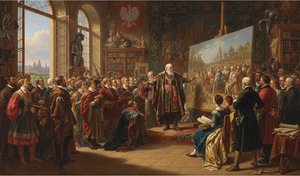
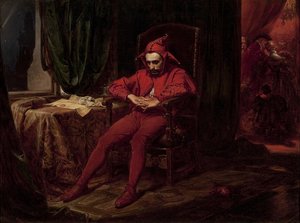
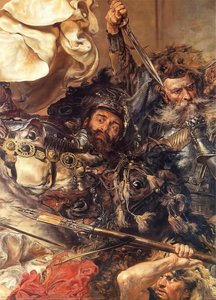
A central figure of 19th century Polish painters, Jan Matejko (1838–1893) dedicated his life to translating the dramatic weight of history into visual narratives. Born in Kraków into a scholarly household, he moved from the rigors of formal schooling to the School of Fine Arts in Kraków, where he studied under Wojciech Korneli Stattler and Władysław Łuszczkiewicz. His training allowed him to evolve from a student of simple form into a master of complex, historical storytelling, capturing the human tension behind monumental events.
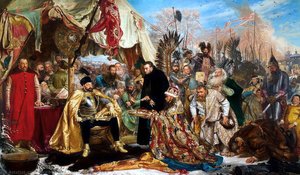
A visitor recognizes a Matejko work by its intense emotional charge and crowded, dynamic compositions. His brushwork favors a rich, vibrant palette—dominated by deep reds, golds, and earthy tones—that breathes life into the luxurious fabrics and intricate patterns of royal attire. In his masterpiece Bathory at Pskov (1872), this technique is on full display. The painting depicts a moment of diplomatic tension during the Livonian campaign, utilizing sunset hues of pink and gold to heighten the psychological depth of the scene. Through his meticulous attention to detail and symbolic grandeur, Matejko transformed the past into a living, breathing spectacle of Romantic Nationalism.
Jacek Malczewski
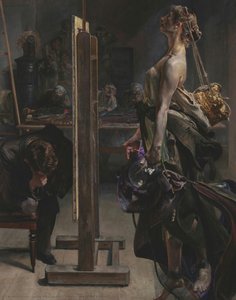 Inspiration of the Painter - Jacek Malczewski
In his 1897 masterpiece Inspiration of the Painter, Jacek Malczewski captures the profound tension between the physical act of creation and the ethereal realm of the muse. The work presents a dimly lit studio where the artist stands in shades of grey, embodying the isolation of the creative struggle, while a woman of otherworldly beauty emerges as a symbolic presence. This interplay of the tangible and the spiritual is the hallmark of Malczewski, the preeminent father of Polish Symbolism.
Born in 1854 in Radom, Malczewski’s artistic identity was forged during the 19th century, a period when his homeland was under Russian control. This era of partition deeply influenced his vision, as he translated the national yearning for independence into a rich visual language of folklore and mythology. His formal training at the Academy of Fine Arts in Kraków under Leon Piccard, followed by studies at the École des Beaux-Arts in Paris, allowed him to blend international technical mastery with a distinctly Polish soul. His palette often evokes a melancholic beauty, utilizing light and shadow to explore themes of heroism, sacrifice, and the elusive nature of inspiration, making him a cornerstone of 19th-century Polish art."
Adolph von Menzel
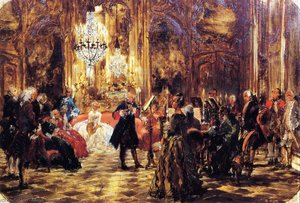 The Flute Concert at Sanssouci (sketch) - Adolph von Menzel
Born in Breslau in 1815, Adolph von Menzel stands as a pivotal figure among 19th century Polish painters due to his origins in what was then a vital cultural hub of the Polish-speaking territories. A master of German Realism, Menzel’s artistic journey was deeply shaped by his early immersion in his father’s lithographic workshop, a practical foundation that instilled in him a profound respect for meticulous detail and technical precision. While he briefly studied at the Berlin Academy of Art in 1833, much of his formidable skill was developed through a largely self-taught, observational approach to the world.
His oeuvre oscillates between grand historical narratives and intimate genre scenes. In his representative work, The Flute Concert at Sanssouci (sketch) (1848), we see a masterful command of light and shadow. The piece captures a moment of cultural elegance, utilizing energetic, gestural brushwork to evoke the vitality of an aristocratic social gathering. This ability to translate the essence of a scene—whether it be the splendor of Frederick the Great's reign or a fleeting musical moment—cemented his reputation as a visual chronicler of his era, ultimately exerting a significant influence on later masters such as Edgar Degas.
Jan Ciągliński
 Portrait of Erazm Piltz - Jan Ciągliński
Jan Ciągliński (1858–1912) stands as a transformative figure among 19th century Polish painters, acting as a vital bridge between the rigorous academic traditions of Warsaw and the luminous, revolutionary currents of Impressionism. Born in Warsaw, his artistic foundation was built under the esteemed Wojciech Gerson, whose disciplined guidance provided the technical precision that would later allow him to masterfully manipulate light and shadow. His journey from the University of Warsaw to the Imperial Academy of Arts reflects the era's shift from strict academicism toward a more emotive, modern sensibility.
A master of psychological depth, Ciągliński’s work often navigates the tension between formal structure and atmospheric freedom. His Portrait of Erazm Piltz (1885) serves as a profound example of his early command over chiaroscuro. In this bust-length composition, he employs a somber, monochromatic palette of deep umbers and blacks, using directional light to carve the subject out of a dark void. This dramatic interplay of light and shadow creates a sense of quiet prestige and intense dignity. His ability to blend scientific observation with an artist's soul eventually influenced significant figures like Bilibin, cementing his legacy as a pioneer who helped redefine the visual language of the late 19th century.
Józef Simmler
 Portrait of Field-Marshal Count Fiodor (Friedrich Wilhelm) Berg - Józef Simmler
A hallmark of Józef Simmler’s artistry is the profound humaneness he breathes into his subjects. A master of the Academic Realist style, his works are instantly recognizable by their deep emotional resonance—moving beyond mere historical documentation to evoke sensations of tenderness, dread, or compassion. His brushwork is characterized by a precise, polished technique that captures the tactile nuances of texture, from the heavy velvet of drapery to the delicate rendering of skin tones.
Born in Warsaw in 1823, Simmler’s development as a leading figure of 19th century Polish painting was shaped by his studies in Dresden, Munich, and Paris. His ability to blend French-inspired costume painting with psychological depth allowed him to create scenes that feel vibrantly alive. His most celebrated masterpiece, Death of Barbara Radziwillowna (1860), remains a cornerstone of the national collection in Warsaw, showcasing his talent for dramatic historical narrative.
In his 1867 work, Portrait of Field-Marshal Count Fiodor (Friedrich Wilhelm) Berg, Simmler demonstrates his command over chiaroscuro. He uses directional light to sculpt the Count’s features from deep shadows, emphasizing the metallic sheen of gold epaulettes and the authoritative presence of a high-ranking official. Through this masterful interplay of light and shadow, Simmler captures the very essence of dignity and historical gravity."
Karl Friedrich Lessing
 Royal Couple Mourning for their Dead Daughter - Karl Friedrich Lessing
Born in Breslau in 1808, Karl Friedrich Lessing stands as a vital link in the history of 19th century Polish painters due to his formative years and early education in the region. A prominent figure of the Düsseldorf School, his work masterfully bridges the gap between historical narrative and the atmospheric depth of Romanticism. Under the guidance of Friedrich Wilhelm von Schadow, Lessing developed a sophisticated command of light and shadow that defined his approach to both landscape and dramatic human scenes.
His profound ability to capture emotional weight is epitomized in his 1830 masterpiece, "Royal Couple Mourning for their Dead Daughter". In this poignant composition, the artist explores the heavy, silent atmosphere of grief. The interplay of somber tones and the striking presence of a red garment creates a visual tension that mirrors the fragility of life. Set against a backdrop of weathered stone and hazy mountain silhouettes, the scene functions as a memento mori, where every detail—from the thoughtful contemplation of the man to the stillness of the environment—invites a deep, melancholic reflection on mortality and the passage of time.
Leon Wyczółkowski
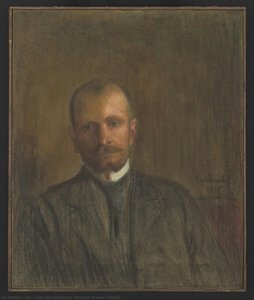 Portrait of Leon Piniński - Leon Wyczółkowski
Leon Wyczółkowski’s Portrait of Leon Piniński is a profound study in psychological depth, capturing the quiet dignity of a prominent scholar through a direct, penetrating gaze. Painted in 1899, this work exemplifies the artist's mastery of light and his ability to transform a simple composition into a window into the human soul. As a central figure of the 19th-century Polish art scene, Wyczółkowski’s career was deeply rooted in the academic traditions of his time, having studied at the Jan Matejko Academy of Fine Arts in Kraków, where he later served as a distinguished professor.
A leading light of the Young Poland movement, Wyczółkowski bridged the gap between meticulous Realism and the atmospheric nuances of Impressionism. His palette often embraced the subtle, earthy tones of the natural world, moving away from the grand historical narratives of the past to find beauty in the everyday. Whether through evocative landscapes or intimate portraits, his work is defined by a sense of melancholic elegance and a sophisticated command of texture. His legacy remains a cornerstone of Polish modernism, celebrated for its ability to capture the fleeting essence of light and life.
Stanisław Wyspiański
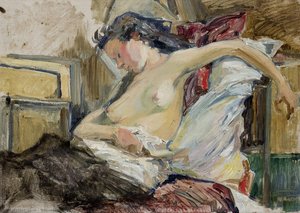 A Woman, semi-nude - Stanisław Wyspiański
A central figure of the Young Poland movement, Stanisław Wyspiański (1869–1907) redefined the artistic identity of his nation through a profound synthesis of Symbolism and Art Nouveau. His work represents the peak of 19th century Polish painters, bridging the gap between academic tradition and the organic, sinuous aesthetics of the Secessionist style. His creative vision was deeply rooted in the cultural heart of Kraków, where he transformed both canvas and sacred architecture through his mastery of light and line.
In his 1895 masterpiece, A Woman, semi-nude, Wyspiański demonstrates the intimate, psychological depth that characterized his approach to the human form. The painting captures a moment of profound introspection, utilizing a striking contrast between the soft textures of white linens and a deep, passionate red blanket. This work exemplifies his ability to imbue domestic scenes with a sense of cosmic and metaphorical weight, a hallmark of the Symbolist movement. Whether through his delicate botanical studies or his breathtaking stained glass windows, Wyspiański’s legacy remains a testament to the expressive power of the 19th century Polish artistic spirit.
Lesser Ury
 The Red Carpet - Lesser Ury
Born in 1861 in Birnbaum, a region that was then part of Prussia and is known today as Międzychód, Poland, Lesser Ury represents the profound artistic bridge between Polish origins and the vibrant Impressionist movements of Central Europe. His journey from a childhood in Poland to the prestigious Kunstakademie Düsseldorf allowed him to absorb the atmospheric nuances of light and urban life, eventually making him a vital figure in the late 19th-century landscape. His work is characterized by a deep sensitivity to the transient nature of modern existence, often capturing the soul of the city through a lens of light and shadow.
In his evocative work The Red Carpet (1894), Ury demonstrates his mastery of the Impressionistic style through a profound meditation on solitude. The composition centers on a woman seated by a large window, her silhouette defined by the soft, diffused light that spills into the room. The heavy, saturated crimson of the carpet provides a striking warmth that contrasts with the muted, grey urban blur visible through the glass. Through thick, tactile impasto brushstrokes, Ury transforms a simple domestic scene into a rhythmic study of texture and light, where the cascading fabric of a garment meets the stillness of a quiet interior.
Jan Antoni Blank
 Self-portrait with family. - Jan Antoni Blank
A prominent figure in the transition toward Romanticism, Jan Antoni Blank represents the refined academic traditions of 19th century Polish painters. His career, spanning the first half of the century, was shaped by a lineage of excellence; he was apprenticed to Józef Kosiński, a former court painter to King Stanisław II August, and later refined his technical mastery in Dresden under the guidance of Josef Grassi. These formative years allowed him to bridge the gap between formal courtly portraiture and the intimate, emotive sensibilities that defined the era.
Blank’s legacy is deeply rooted in the institutional history of Warsaw, where he served as a professor and curator, influencing the next generation of artists during a period of profound social change. His 1825 masterpiece, Self-portrait with family, serves as a quintessential example of his ability to capture domestic stillness. In this oil on canvas, Blank moves beyond mere likeness to document a quiet, triangular composition of familial connection, featuring a woman at a keyboard instrument and children in a structured, intimate setting. The work, now held in the National Museum in Warsaw, exemplifies the delicate rendering and psychological depth characteristic of his contribution to Polish art history.
Conclusion
The 19th century was a transformative era for Polish art, a period where these masters navigated the complexities of national identity through diverse lenses. From the grand, historical narratives of Jan Matejko to the ethereal, symbolic landscapes of Jacek Malczewski, each artist contributed a unique chapter to a rich visual heritage. Whether through the meticulous realism of Adolph von Menzel, the vibrant impressionistic touches of Lesser Ury, or the intricate, decorative mastery of Stanisław Wyspiański, this group of painters captured the soul of a nation in flux. Their collective legacy spans the spectrum of human emotion, from the weight of history to the delicate beauty of the natural world.
For those looking to bring this profound history into their own living spaces, Mus3ums.com offers a way to connect with these masters. You can explore our full collection to find your favorite pieces. We invite you to transform your home or office by living with these masterpieces through our museum-quality, hand-painted oil reproductions, each meticulously crafted to preserve the texture and spirit of the original works.