
Introduction
The 19th century in the Czech lands was a period of profound cultural awakening and stylistic metamorphosis, where the romanticism of the early decades gradually evolved into the sophisticated movements of Art Nouveau and early abstraction. This era saw a unique convergence of Central European traditions, as artists navigated the shifting political landscapes of the Austro-Hungarian Empire to forge a distinct visual identity. From the meticulous detail of historical romanticism to the sweeping, organic lines of the Secessionist movement, these painters captured a nation in the midst of a profound intellectual and aesthetic transformation.
What unites this remarkable group is a shared mastery of light and form, often used to explore themes of national identity, myth, and the delicate balance between naturalism and symbolism. As the century progressed, the works of these masters moved away from strictly academic constraints, embracing new ways of perceiving color and space that would eventually influence the broader European avant-garde. Their ability to translate the soul of the Bohemian landscape and the complexity of human emotion into pigment ensures their enduring relevance in the modern era.
Today, the legacy of these creators continues to resonate through their influence on graphic design, architecture, and modern fine art. By examining the lives and techniques of these masters, we gain insight into a pivotal moment when art became a powerful vehicle for cultural expression. The following selection highlights ten essential figures who defined this golden age, ranging from the legendary decorative mastery of Alphonse Mucha to the pioneering spirit of František Kupka, offering a journey through the very heart of Czech artistic evolution.
Alphonse Mucha
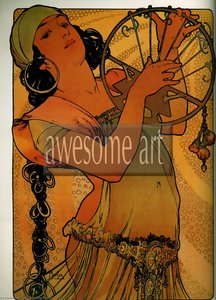
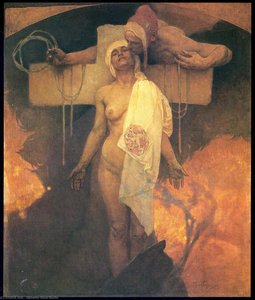
 Salammbô - Alphonse Mucha
Born in 1860 in Moravia, Alphonse Mucha stands as a monumental figure among 19th century Czech painters. Although his career reached its zenith in Paris, his artistic soul remained deeply rooted in his Czech heritage, a connection that would later manifest in his profound nationalist works. After studying at the Academy of Fine Arts in Prague, Mucha moved to France in 1887, eventually defining the Art Nouveau movement through a style characterized by flowing, organic lines and idealized feminine beauty.
His reputation was cemented through high-profile collaborations, most notably with the actress Sarah Bernhardt, whose posters launched him into international stardom. A quintessential example of his mastery is the 1896 lithograph Salammbô. In this work, Mucha employs a sophisticated, curvilinear technique to depict a central female figure in a trance-like state, adorned with intricate Byzantine-inspired jewelry. The composition utilizes a warm, saturated palette of reds, oranges, and creams, creating a velvety texture that exemplifies the elegant, romantic aesthetic of the era. From his early training in the Czech lands to his global influence, Mucha’s ability to blend traditional motifs with modern decorative forms remains unparalleled.
František Kupka
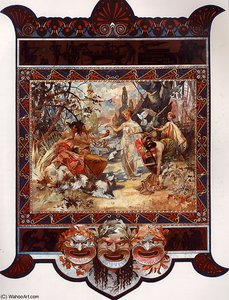
 The Lotus Soul - František Kupka
Born in 1871 in Opočno, within the borders of the Czech lands, František Kupka represents a pivotal evolution in the trajectory of 19th-century Czech painters. His early academic training at the Academy of Fine Arts in Prague and later in Vienna provided a foundation in historical and patriotic themes, yet his artistic soul sought a reality beyond the physical. This spiritual hunger, fueled by an interest in theosophy and Eastern philosophy, eventually propelled him toward the avant-garde circles of Paris.
A pioneer of Orphism, Kupka moved away from the literalism of his contemporaries to explore the rhythmic interplay of light and color. His representative work, The Lotus Soul (1898), serves as a profound bridge between the Symbolist movement and his later abstraction. In this triptych, he utilizes a palette of cool blues and sap greens to create an ethereal, mystical atmosphere. The composition transitions from luminous, organic forms reminiscent of water lilies to ceremonial human rituals, demonstrating a sophisticated command of flattened perspective and spiritual narrative. Through his mastery of oil on canvas, Kupka transformed the visual language of his era, turning light itself into a structural element of modern art.
Adalbert Stifter
 Im Gosautal - Adalbert Stifter
Born in 1805 in the Bohemian village of Oberplan, Adalbert Stifter stands as a quintessential figure among 19th century Czech painters due to his profound ability to capture the quiet, moral essence of the natural world. His artistic vision was deeply rooted in the landscapes of his youth, a connection forged through a childhood shaped by the rhythms of rural life in what is now the Czech Republic. Moving from his early education at the Benedictine Gymnasium in Kremsmünster to studying law in Vienna, Stifter eventually found his true calling in the intersection of science, literature, and the visual arts, becoming a master of the Biedermeier movement.
In his representative work, Im Gosautal (c. 1834), Stifter’s devotion to the alpine landscape is vividly realized. The composition features a rustic wooden chalet anchored against a backdrop of towering mountains and dense pine forests. A small stream flows through the foreground, guiding the viewer's eye toward distant glaciers and snowfields. Through deliberate, textured brushstrokes in oil on canvas, he captures a sense of profound stillness. The presence of three figures near the chalet provides a human scale to the vast, serene terrain, illustrating the tranquil harmony between man and the rugged Bohemian-Austrian wilderness.
Joseph Maria Olbrich
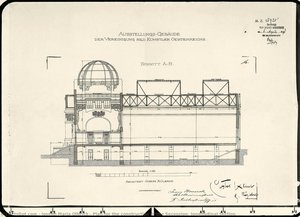 Plan for the construction of the Secession, longitudinal section - Joseph Maria Olbrich
The Plan for the construction of the Secession, longitudinal section serves as a profound blueprint for modernity, capturing the precise moment when architectural tradition began to dissolve into the fluid elegance of the new century. This meticulous drawing reveals the skeletal ambition of a structure designed to house the avant-garde, showcasing a grand facade and a magnificent dome that command respect through their monumental scale. Through these stark lines, one senses the rhythmic dialogue between functional space and artistic expression.
Born in Troppau in 1867, Joseph Maria Olbrich is a quintessential figure of the 19th-century Czech artistic landscape, representing the vital bridge between academic historicism and the organic vitality of Art Nouveau. His journey from the construction traditions of his father to the prestigious Academy of Fine Arts Vienna allowed him to master classical principles before ultimately revolutionizing them. Influenced by his apprenticeship with Otto Wagner and his travels through Italy and North Africa, Olbrich moved toward the Jugendstil aesthetic, characterized by flowing, rhythmic lines. His legacy is defined by this transition, transforming the rigid structures of the 1800s into the breathing, living forms of the Secession movement.
Gabriel von Max
 The Court Actor Alois Wohlmuth - Gabriel von Max
Born in Prague, Gabriel von Max stands as a singular, visionary figure among 19th century Czech painters. His artistic identity was forged through a unique intersection of academic rigor and esoteric curiosity. After receiving foundational training from his father, a sculptor, he moved to the Prague Academy of Arts, where his intellect was shaped by subjects ranging from Darwinism to Asiatic philosophy. This profound intellectual depth allowed him to transcend traditional academicism, leading him to develop a style characterized by mystical allegories and a psychological intensity that critics often termed unglücksmalerei, or "unhappiness painting." His work is defined by a haunting, melancholic beauty and a preference for dark, dramatic palettes that explore the mysteries of existence and the human condition. A masterful example of his ability to capture psychological presence is his 1893 oil painting, The Court Actor Alois Wohlmuth. In this bust-length portrait, Max utilizes a naturalistic approach to depict the subject in a moment of quiet reflection, using light to illuminate the forehead and hand against a deep, shadowed background. Through such works, Max remains a vital representative of the 19th century Czech artistic tradition, blending meticulous technical skill with a deep, spiritual yearning.
Joseph von Führich
 The Good Samaritan - Joseph von Führich
A central figure among 19th century Czech painters, Joseph von Führich (1800–1876) embodied the spiritual and technical rigor of the Nazarene movement. Born in the region of Pless, his artistic journey was defined by a devotion to reviving the purity of early Renaissance masters. His training at the Academy of Fine Arts Vienna under Leopold Kupelwieser provided him with a formidable foundation in draughtsmanship and the emotive power of religious oil painting, eventually earning him the prestigious imperial stipend in 1845.
Führich’s work is characterized by a profound sense of divine sincerity, often turning away from the fleeting light of nature to explore eternal, scriptural truths. This is masterfully demonstrated in his work The Good Samaritan. In this composition, the artist utilizes a sophisticated chiaroscuro to illuminate the pale, vulnerable skin of the reclining figure against a rugged, earthy landscape. The interaction between the caregiver and the injured man is anchored by precise, graceful lines that guide the viewer through a narrative of profound mercy. Through a palette of ochre and sienna, set against a backdrop of distant, jagged mountains, Führich achieves a sense of expansive stillness that elevates a human encounter into a moment of sublime, dramatic devotion.
Jakub Schikaneder
 Monreale - Jakub Schikaneder
A master of atmosphere, Jakub Schikaneder captures the melancholic soul of the late nineteenth century through his evocative, misty landscapes and intimate genre scenes. A prominent figure among 19th century Czech painters, he was born in Prague and deeply integrated into the Bohemian cultural fabric. His style is instantly recognizable by its delicate, small brushstrokes and a dreamlike, soft-focus quality that seems to dissolve the boundaries between reality and memory. Influenced by the Munich School and the mentorship of Gabriel von Max, Schikaneder’s work often navigates the delicate intersection of Realism and Symbolism, favoring a muted, tonal palette that emphasizes solitude and quietude.
His 1893 work, Monreale, serves as a profound example of his technical mastery. In this composition, Schikaneder utilizes a monochromatic approach to depict a gathering within a heavy stone archway. Rather than relying on vibrant color, he employs meticulous, precise strokes to simulate the effect of dim light and atmospheric mist. The interplay of deep shadows and the soft, blurred edges of the figures create a sense of stillness, transforming a simple architectural setting into a hauntingly beautiful meditation on human presence and historical weight.
Max Kurzweil
 Lady in Yellow Dress - Max Kurzweil
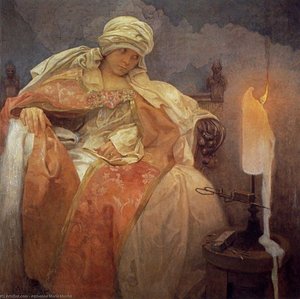
In his evocative 1899 work, Lady in Yellow Dress, the artist demonstrates a profound mastery of color and psychological stillness. The composition features a woman seated upon a couch, her silhouette defined by the luminous, floral-patterned yellow fabric of her attire. This square-format oil on canvas, currently held in the Wien Museum, exemplifies the transition from academic precision to the expressive, dreamlike sensibilities that defined the late 19th century.
Born in Bohemia, Max Kurzweil (1867–1916) represents the vital intersection of Czech origins and the Viennese avant-garde. His journey from the landscapes of Bisenz to the Academy of Fine Arts in Vienna, and later to the Académie Julian in Paris, allowed him to synthesize classical foundations with the fleeting light of Impressionism. As a co-founder of the Vienna Secession in 1897, Kurzweil became a pivotal figure in breaking away from conservative academicism. His signature style often married the textured palettes of Impressionism with the haunting, symbolic depth of Symbolism, frequently exploring the melancholic nuances of the human psyche through portraits and landscapes that resonate with an unsettling, emotional intensity.
Josef Navrátil
 In the Garden Restaurant - Josef Navrátil
In his evocative work In the Garden Restaurant, created around 1850, Josef Navrátil captures a delicate moment of social leisure. The composition depicts a woman seated at a table, her attire accented by a hat and a flower, amidst a relaxed gathering of figures in a communal dining space. This piece exemplifies the artist's ability to render intimate, atmospheric scenes that define the social fabric of his era.
A prominent figure among 19th century Czech painters, Navrátil (1798–1865) was a master of decorative and historical art. Trained by his father and later at the Academy of Fine Arts in Prague, he specialized as a painter-decorator. His legacy is etched into the very architecture of the Czech lands, most notably through his extensive wall paintings in Prague Castle and his monumental decoration of twenty rooms in the imperial castle at Zákupy. His technical versatility allowed him to move seamlessly between historical, genre, and allegorical subjects. Despite facing physical hardship later in life, his influence endured, eventually inspiring the likes of photographer Josef Sudek and earning him a permanent place in the history of Czech art.
Maximilian Pirner
 Fairies by the Brook - Maximilian Pirner
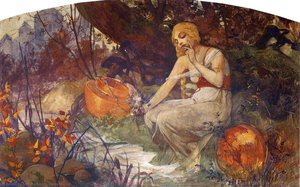
In his 1895 masterpiece Fairies by the Brook, Maximilian Pirner captures a nocturnal, supernatural realm that defines his unique contribution to the 19th century Czech painters. This evocative oil on canvas presents a dense, wooded glade where luminous, ethereal nymphs emerge from a dark, organic landscape. The composition utilizes a dramatic chiaroscuro, contrasting pale, delicate skin against a somber palette of deep greens, blacks, and shadowy browns to create a sense of profound mystery.
Born in Sušice, Bohemia, Pirner’s artistic journey is deeply rooted in the Czech lands, having refined his craft at the Academy of Fine Arts in Prague before moving to Vienna. His association with the Vienna Secession and the Mánes Union of Fine Arts allowed him to move beyond academic traditions into the realm of Symbolism. His work is characterized by a haunting, sinuous grace, often blending classical mythology with themes of mortality and melancholy. Through meticulous brushwork and a mastery of light, Pirner transformed the romanticism of his youth into a sophisticated, mystical language that remains a cornerstone of Bohemian Symbolist art.
Conclusion
The 19th century was a transformative era for Czech art, a period where the romanticism of Adalbert Stifter met the burgeoning modernism of František Kupka and the intricate, decorative elegance of Alphonse Mucha. From the meticulous portraiture of Jakub Schikaneder to the sweeping landscapes and historical narratives that defined the national identity, these masters collectively bridged the gap between classical tradition and the avant-garde movements that would eventually reshape the European landscape. Each artist contributed a unique visual language, whether through the play of light, the precision of line, or the emotional depth of color, ensuring that this generation left an indelible mark on the history of art.
At Mus3ums.com, we invite you to bring this rich heritage into your own living space. Our artisans specialize in creating museum-quality, hand-painted oil reproductions that capture the authentic texture and soul of these masterpieces. Whether you are a seasoned collector or looking for a statement piece for your home, you can explore our full collection and find a work that resonates with your aesthetic. Experience the tactile beauty of real brushstrokes and transform your walls with the timeless elegance of Czech art history.


