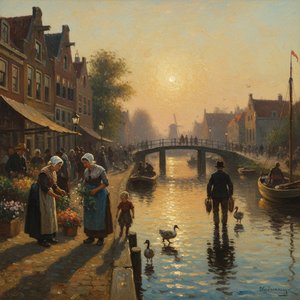
The Quiet Observer of the Low Countries
Anton Dirckx lived a life shaped by the light and water of the Netherlands. Born in Rotterdam, he spent his years moving through the coastal landscapes of Rotterdam, Den Haag, and Voorburg. His hands were often stained with the ink of an etcher or the pigments of a watercolorist. He studied at the Academie voor Beeldende Kunsten in Rotterdam, a place where he first learned to translate the physical world onto a surface. Later, he traveled to Italy, seeking the specific quality of light that defines the Mediterranean, a pursuit that would inform the way he handled color and shadow in his later works.
His work was not about grand gestures but about the steady observation of a changing environment. He looked closely at the way ships sat in the harbor of Rotterdam and how the bulb fields changed under the Dutch sky. He was a man of many techniques, moving between the precision of etching and the fluid, spontaneous nature of watercolor. His presence in the art world was marked by his membership in the ‘Arti et Amicitiae’ in Amsterdam, a sign of his place among his peers in the Dutch art scene.
A Life in Landscapes and Lines
The subject matter of his work followed the rhythms of the land and the sea. He found his focus in the details of the everyday, capturing the movement of water and the stillness of the city. His technical repertoire included:
- Oil painting on canvas and panel
- Watercolor for lighter, more fluid studies
- Etching and graphic work for detailed line studies
He often worked alongside Adriaan de la Rivière, their collaborations reflecting a shared interest in the textures of the natural world. Whether he was painting a cityscape or a harbor scene, his focus remained on the atmosphere of the place. He captured the specific mood of a harbor at a certain hour, or the way light hit a field of flowers.
The Final Years and Lasting Impressions
By the time he reached the end of his life in Den Haag, his style had settled into a clear, impressionist approach. He did not seek to change the world through his art, but rather to record it as it appeared to him. His paintings, such as his depictions of ships in the Rotterdam harbor, show a commitment to the actual appearance of light and shadow. He died in 1927, leaving behind a body of work that remains a record of the Dutch landscape and its maritime life during a specific era of his time.
Вопросы и ответы
К какой исторической эпохе относится Anton Dirckx?
Anton Dirckx работал в эпоху Modern. Этот период позволяет определить место творчества художника в истории.
Откуда Anton Dirckx?
Anton Dirckx родился в Netherlands.
Где и в каком году родился Anton Dirckx?
Anton Dirckx родился в Rotterdam в 1878 году.