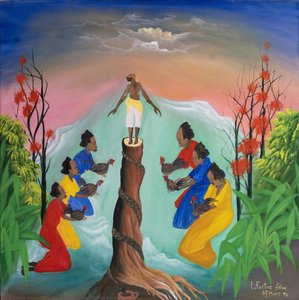
The Sacred Vision of Felix Lafortune
Born in Pont-à-Sonde, Haiti, Felix Lafortune emerged not as a classically trained academic, but as a profound voice from the spiritual heart of the Artibonite region. His journey into the world of fine art was an unexpected one, beginning far from the galleries of the elite. For much of his early life, he lived as a farmer and a houngan, a voodoo priest, in the city of St. Marc. His initial creative expressions were not intended for public consumption or aesthetic prestige; rather, they were deeply personal acts of devotion. He began by decorating the walls of his own temple, using paint to participate in the cult of the lwa he served. To Lafortune, these murals were a way of manifesting the supernatural, a sacred medium through which he could connect with the divine spirits of his faith.
The transition from temple walls to the international art stage occurred through a serendipitous encounter with Pierre Monosiet, the director and curator at the Musée d'Art Haïtien du Collège Saint-Pierre. Recognizing the immense beauty and spiritual weight within these ritualistic decorations, Monosiet encouraged Lafortune to pursue a public career. By 1972, the artist had begun working on more permanent surfaces like masonite, allowing his visions to travel beyond the confines of his local community. This discovery marked the rise of an artist who would eventually be recognized as one of the last great painters from the Artibonite region, bringing a unique perspective that blended the role of the priest with that of the painter.
Technique and Spiritual Narrative
The work of Felix Lafortune is characterized by a vibrant, almost folkloric application of color that mirrors the intense emotional and spiritual landscape of Haitian life. His palette is inherently warm and saturated, creating scenes that feel both ancient and immediate. In masterpieces such as Papa Ogoun Ferraille, one can observe his ability to blend narrative realism with a ceremonial flatness, a technique that lends his subjects a timeless, iconic quality. He possessed a singular skill for rendering the solidity of natural elements alongside the delicate humanity of his figures, often composing scenes where characters are positioned in ways that suggest ritualistic grace and communal devotion.
His imagery is deeply steeped in the traditions of Vodou, yet it transcends simple illustration to become a window into a complex theological world. His compositions often feature:
- Sacred Figures: The depiction of lwa and spiritual leaders that command reverence from the viewer.
- Communal Devotion: Arrangements of figures that suggest shared belief, ancestral wisdom, and the weight of tradition.
- Symbolic Landscapes: The use of natural elements, such as sturdy tree trunks or sacred settings, to anchor supernatural events in a tangible reality.
Legacy and Historical Significance
Lafortune occupies a unique position within the history of Haitian art. While he is often discussed alongside other great names of the tradition, such as Hector Hyppolite, he remains a distinct figure. Unlike some of his contemporaries who focused on broader landscapes or secular themes, Lafortune’s production remained almost exclusively devoted to his religion. This singular focus allowed him to create a body of work that serves as a vital record of voodoo iconography and the spiritual life of the Saint-Marc region.
Throughout his career, his influence reached far beyond Haiti. His artwork has been showcased in prestigious exhibitions across Europe, Canada, and the United States, including the notable Kafou: Haiti, art and Vodou exhibit in England. Beyond his visual contributions, he demonstrated a profound commitment to his cultural heritage, generously donating his work to assist in the repair of the Musée d’Art Haïtien du Collège St Pierre. Through his hands, the sacred became visible, ensuring that the spiritual resonance of his faith would endure in the global consciousness of art history.
Вопросы и ответы
Под какими еще именами известен Felix Lafortune?
Felix Lafortune также известен под именами Lafortune Felix.
Откуда Felix Lafortune?
Felix Lafortune родился в Haiti.
Где и в каком году родился Felix Lafortune?
Felix Lafortune родился в Pont-à-Sonde в 1933 году.