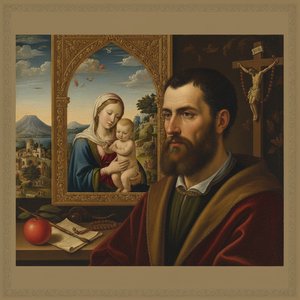
The Shadow of Brescia
In the bustling workshops of Brescia during the late sixteenth century, a painter emerged whose name would often be whispered alongside his contemporaries, yet whose own identity remained somewhat veiled by the passage of time. This man, Giuseppe Amatore, moved through the artistic circles of Northern Italy, leaving behind a legacy that speaks of a quiet but profound mastery of the Lombard Mannerist style. Though the records of his early life are sparse, his presence in the territory of Brescia is felt through the works he left behind, pieces that bridge the transition from the late Renaissance into the early seventeenth century.
He worked in an era of great stylistic shifts, where the rigid structures of the past were giving way to more complex and fluid compositions. Amatore did not merely follow the trends of his day; he absorbed the atmosphere of his surroundings, painting for churches and civic buildings that required a certain grace and theological clarity. His hand was one of skill and composure, capable of handling the intricate demands of religious narratives with a steady, practiced touch.
A Style of Warmth and Architecture
To look upon the works of Amatore is to see a painter deeply influenced by the grand traditions of the Venetian masters, particularly the lessons of Paolo Veronese. He did not adopt a cold or austere approach to his subjects. Instead, he embraced a palette of warm tones that breathed life into his scenes, using color to guide the eye through his compositions. His canvases often featured vast architectural elements that provided a sense of scale and dignity to the sacred events he depicted.
His technique was characterized by a certain fluidity, a way of managing complex arrangements of figures without losing the clarity of the story. This ability to organize many characters within a single space made him a significant figure in the local school of Mannerism. His brushwork was often compared to that of Grazio Cossali, a similarity so striking that scholars have, in years past, struggled to distinguish the hand of one from the other. His artistic identity is found in this intersection of Lombard tradition and Venetian color.
The surviving evidence of his talent includes several notable commissions:
- The Communion of the Apostles, a significant oil on canvas held in the Diocesan Museum of Brescia.
- Santa Monica dispensing alms to the poor, located in the Municipio di Orzinuovi.
- Small decorative paintings intended for the choir of the church of Santa Giulia, which have since been lost to time.
The Legacy of the Mannerist
The historical significance of Giuseppe Amatore lies in his position within the hierarchy of Brescian art. He occupied a space just below the most celebrated masters like Antonio Gandino and Grazio Cossali, acting as a vital link in the regional tradition. His work represents a specific moment in Italian art history when the elegance of Mannerism met a more naturalistic, colorful sensibility. While many of his smaller works have vanished, the pieces that remain, such as his depiction of the Apostles, continue to offer a glimpse into the devotional life of sixteenth-century Brescia.
Vprašanja in odgovori
Od kod prihaja Giuseppe Amatore?
Giuseppe Amatore se je rodil/a v državi Italy.